

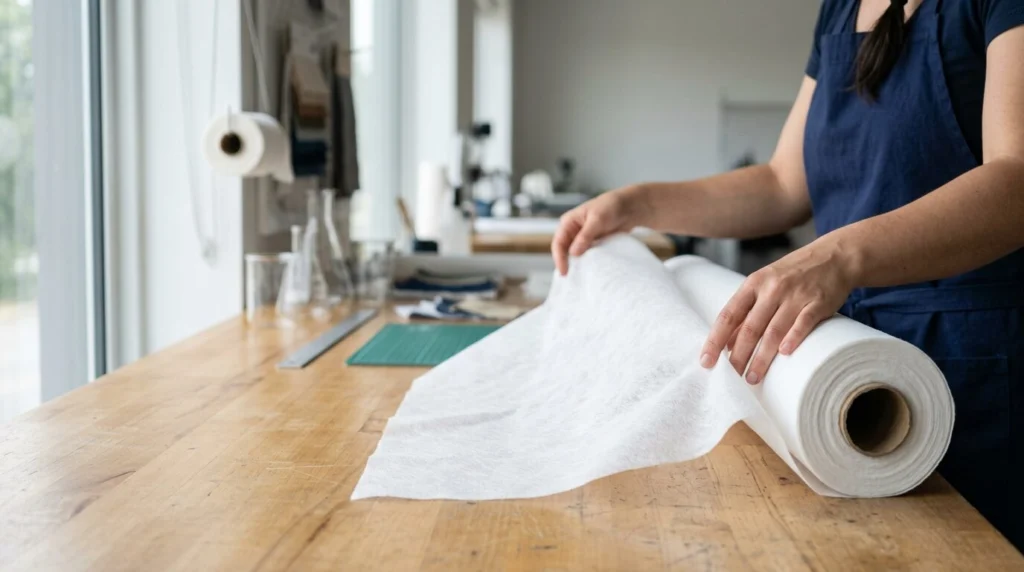
Microfibre Spunlace Nonwoven Fabric — Manufacturer & Supplier India
Favourite Fab supplies microfibre spunlace nonwoven fabric in bulk to premium wet wipe manufacturers, cosmetic sheet producers, optical and electronics cleaning product OEMs, and medical nonwoven converters across India and 50+ export markets. Microfibre spunlace is a distinct substrate category from standard spunlace — produced from fibres finer than 1 denier, it delivers measurably superior cleaning efficiency, particle capture, and skin feel that standard denier fibres cannot replicate regardless of GSM or fibre composition.
What Is Microfibre Spunlace Nonwoven Fabric?
Microfibre spunlace nonwoven fabric is produced by hydroentangling fibres with a linear density below 1.0 denier (approximately 10 micrometres diameter for polyester). Standard spunlace uses fibres in the 1.5–3.0 denier range. The reduction in fibre diameter from 2.0 denier to 0.5 denier increases the number of fibres per gram by a factor of sixteen — producing a fabric with dramatically more fibre-to-surface contact points, a significantly smaller effective pore size, and a qualitatively different surface texture that is perceptibly smoother and softer to touch and skin contact.
The performance difference between microfibre and standard fibre spunlace is not incremental — it is categorical in three areas: cleaning efficiency (microfibre captures and retains particles rather than moving them across the surface), skin feel (the absence of fibre ends coarser than ~10 µm against the skin eliminates the mechanical irritation that causes ‘scratchy’ nonwoven feel), and optical-grade surface performance (microfibre can clean optical coatings without the micro-scratching caused by coarser fibres).
For B2B procurement, microfibre spunlace is specified in applications where standard spunlace has been tried and found insufficient on one of these three performance dimensions — or where the end product is positioned at a premium price point requiring verifiably superior performance. Microfibre spunlace carries a raw material cost premium of 25–60% over standard denier spunlace at equivalent GSM.
STANDARD FIBRE — 2.0 DENIER (~14µm)
~9 fibres visible · large gaps between fibres
Particles pass between fibre gaps
MICROFIBRE — 0.5 DENIER (~7µm) ✓
~60+ fibres visible · minimal gaps between fibres
Particles captured and retained by dense fibre network
Microfibre Spunlace — Full Specification Range
Microfibre spunlace is available in polyester microfibre, polyamide/polyester split-type microfibre, and viscose/microfibre blend. Fibre denier and blend ratios confirmed at enquiry based on application.
| Parameter | Standard Range | Notes for Buyers |
|---|---|---|
| Fibre Denier | 0.2 – 0.9 denier (microfibre range) | 0.5 denier is the most common specification; below 0.3 denier for ultra-premium optical and medical applications at higher cost |
| Fibre Diameter | 5 – 10 µm (typical) | Fibre diameter determines optical scratch threshold and skin feel performance — confirm at enquiry |
| GSM (Weight) | 20 – 80 gsm | 30–40 gsm for cosmetic sheets and facial wipes; 40–60 gsm for cleaning cloths and premium wet wipes; 50–80 gsm for industrial microfibre wipes |
| Fibre Composition | 100% Polyester Microfibre; PA/PET Split Microfibre; Viscose/PET Microfibre Blend | PA/PET split microfibre has the highest cleaning efficiency; 100% PET microfibre for cost-sensitive applications |
| Web Structure | Parallel laid (20–45 gsm); Cross-lapped (45–80 gsm) | Parallel laid for lightweight cosmetic applications; cross-lapped for heavier cleaning cloths |
| MD Tensile Strength | ≥ 45 N / 5cm at 40 gsm (100% PET microfibre) | Microfibre PET has higher MD tensile than viscose at equivalent GSM |
| Surface Texture | Plain (smooth face); Embossed; Apertured | Plain smooth face is standard for optical and cosmetic applications; embossed for premium aesthetic |
| Cleaning Efficiency | ≥ 99% particle capture (0.5 µm particles) for PA/PET split microfibre | Particle capture efficiency provided on request for optical and clean-room applications |
| Roll Width | 10 cm – 260 cm | Standard converting widths: 30, 50, 100, 160 cm for wipes; custom optical cleaning cloth widths available |
| Colour | White; Optical White; Dyed (various); Sublimation printable | Dyed microfibre for branded cleaning cloths; sublimation printable for full-colour custom optical cloths |
| Certifications | ISO certified; OEKO-TEX Standard 100; skin compatibility tested on request | COA with fibre denier verification, tensile, and particle capture efficiency per batch |
Microfibre Spunlace — B2B Applications
Microfibre spunlace is specified where standard denier spunlace produces an identifiable performance shortfall in cleaning efficiency, optical surface safety, or consumer skin feel that justifies the 25–60% raw material cost premium.
25–40 gsm PA/PET or PET
Sheet mask substrates for premium K-beauty, J-beauty, and luxury cosmetic brands where the silk-like skin feel is a core product differentiator. Microfibre at 25–35 gsm delivers the second skin sensation that premium mask brands command a price premium for.
30–60 gsm PA/PET Split
Lens cleaning cloths for spectacle, camera, binocular, and precision instrument optics. PA/PET split microfibre at 0.2–0.4 denier is the industry-standard substrate for optical cleaning cloth products sold by lens manufacturers and optical retailers globally.
35–50 gsm PET Microfibre
Screen cleaning cloths for smartphones, tablets, laptops, and display screens. 100% PET microfibre at 0.5 denier is standard for screen cleaning — fine enough to avoid scratching anti-reflective coatings, dense enough to capture fingerprint oils and dust without smearing.
30–50 gsm PET or Blend
Facial cleansing wipes, micellar wipes, and makeup removal wipes for sensitive and reactive skin types. Microfibre removes makeup with less mechanical pressure and fewer passes than standard spunlace — reducing friction-induced skin irritation.
40–70 gsm PET Microfibre
Medical swabs, wound contact layers, and surgical preparation wipes where the high fibre density of microfibre improves exudate absorption and particle capture without leaving large fibre residues. Sterile-grade microfibre for wound care applications.
40–60 gsm PA/PET Split
Clean-room wipers, precision component cleaning cloths, and semiconductor manufacturing wipes. Microfibre’s high particle capture efficiency and low particle shedding make it the preferred substrate for ISO Class 5–8 clean-room wiping applications.
Why Manufacturers Source Microfibre Spunlace From Favourite Fab
Microfibre spunlace quality is determined by fibre denier consistency across the roll. Favourite Fab verifies fibre denier per batch and reports it on the COA.
Frequently Asked Questions — Microfibre Spunlace
Source Microfibre Spunlace Nonwoven Fabric in Bulk
State your fibre type, target denier, GSM, and application — receive a quote and denier-verified sample within 48 hours.
More Spunlace Nonwoven Fabric — Full Range
Favourite Fab supplies the complete spunlace nonwoven catalogue across all fibre types, denier ranges, GSM, and web structures.
Full spunlace range — all fibre types, GSM, web structures, and denier specificationsView Range →
Low particle shedding grades for clean-room, pharmaceutical, and precision manufacturingView Product →
Premium lyocell — biodegradable microfibre alternative with exceptional softnessView Product →
100% bamboo — natural, biodegradable, and among the softest cellulosic alternativesView Product →


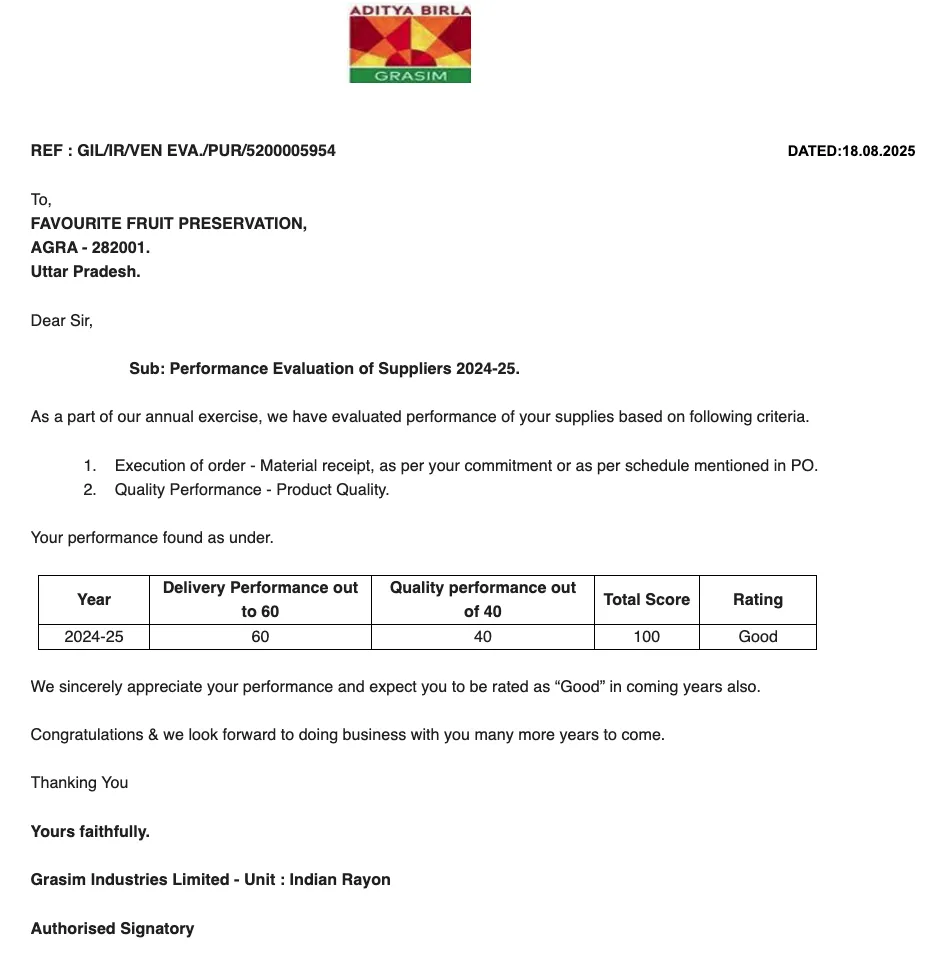


























We Do Business On Trust.Our Nonwoven fabric Business is Built on trust. Trust starts with Transparency.
Mr.Ramniwas Garg Founder Of Favourite Group