

Absorbency Testing for Nonwoven Fabric: Sink Time Method EDANA 10.0 — India Supplier Guide
Absorbency testing using the sink time method (EDANA ERT 10.1 / WSP 10.1) is the primary quality test for hydrophilic nonwoven fabrics used in hygiene products, wet wipes, and wound care. Favourite Fab, a B2B nonwoven fabric raw material supplier based in Agra, India, tests sink time on every batch of hydrophilic nonwoven — PP spunbond topsheet, acquisition distribution layers, and spunlace grades. This guide explains the sink time test procedure, what the result means, and typical values for hygiene nonwoven applications.
What Is the Sink Time Test for Nonwoven Fabric Absorbency
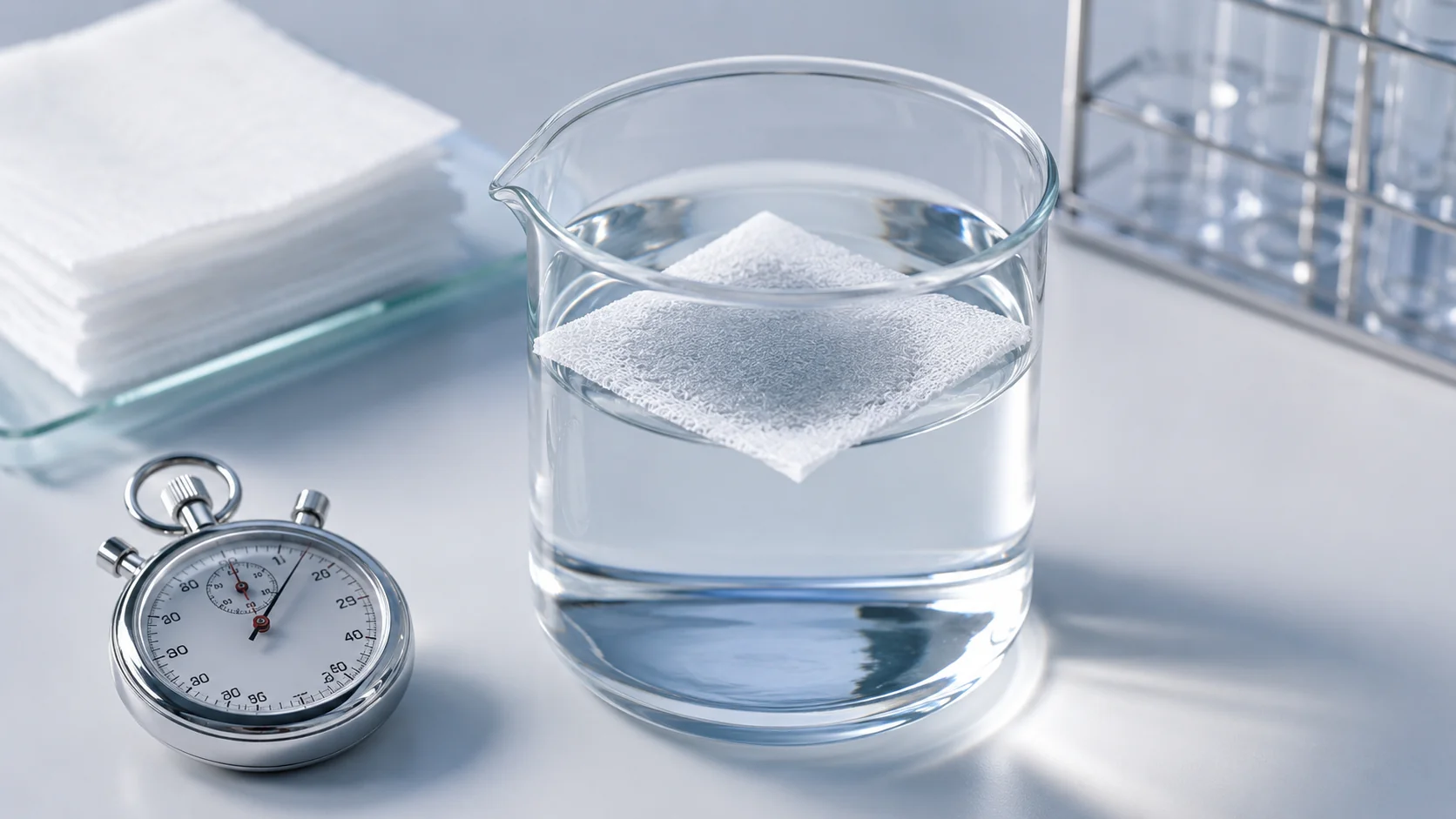
The sink time test measures how quickly a nonwoven fabric sample — placed flat on the surface of distilled water — absorbs enough water to sink below the surface. It is a simple, reproducible test that characterises the hydrophilicity of a fabric’s surface finish. A short sink time indicates high surface wettability, meaning the hydrophilic finish is effective and the fabric will rapidly transfer liquid in the end product. A long sink time — or failure to sink — indicates a hydrophobic or insufficiently treated surface.
Key Parameters: EDANA ERT 10.1 Sink Time Test
| Parameter | Specification | Detail |
|---|---|---|
| Test method | EDANA ERT 10.1 / WSP 10.1 | Harmonised EDANA/INDA standard for absorbency (sink time) |
| Sample size | 100 mm × 100 mm | Cut carefully to avoid edge fibre disturbance |
| Water temperature | 23°C ± 2°C | Distilled or deionised water; vessel depth ≥ 100 mm |
| Placement method | Flat drop from 10–25 mm above surface | No pushing or pressing; sample placed by releasing from fingers |
| Timing | Start: sample touches water surface; Stop: last point submerges | Stopwatch or automatic timer; repeat 10 samples per lot |
| Result reporting | Mean sink time (seconds) ± standard deviation | Outliers (>3σ) investigated for surface contamination |
| Acceptance criteria — hygiene topsheet | < 10 seconds (typical) | High-speed converting lines may specify < 5 s |
| Acceptance criteria — ADL | < 5 seconds | Acquisition distribution layer requires fast rewet performance |
Typical Sink Time Values by Application
| Fabric Type | Application | Typical Sink Time | Notes |
|---|---|---|---|
| PP Spunbond 15–20 GSM | Sanitary pad topsheet | 3–8 seconds | Hydrophilic surfactant finish; single-use application |
| PP Spunbond 20–25 GSM | Baby diaper topsheet | 2–6 seconds | Stricter specification for sensitive skin contact |
| PP/PE Bicomponent 20–30 GSM | ADL (acquisition layer) | 1–4 seconds | Fastest wetting required for rewet performance |
| Spunlace Viscose/PET 40–60 GSM | Wet wipes substrate | 1–3 seconds | Inherently hydrophilic; natural fibre wetting |
| Spunlace Viscose 40 GSM | Wound care / medical swab | < 2 seconds | Rapid fluid absorption required for medical grade |
| PP Spunbond (hydrophobic) | Backsheet / barrier layer | Does not sink (hydrophobic) | Intentionally hydrophobic — repels water |
Why Absorbency Testing Matters for Hygiene Manufacturers
The sink time of the topsheet nonwoven directly affects the consumer experience of a sanitary pad or diaper — slow absorption causes surface pooling, leakage risk, and skin irritation. For sanitary pad manufacturers, a topsheet with sink time above 12–15 seconds will cause visible rewet on the converting line and fail end-product absorption performance tests. Incoming inspection using the EDANA 10.1 sink time test is a rapid, low-cost gate that prevents production line failures and field complaints.
Sink time is also affected by storage conditions — nonwoven rolls stored in high humidity or exposed to certain chemicals can undergo finish degradation that increases sink time. Favourite Fab tests sink time at dispatch; buyers should re-test on receipt if rolls have been stored for more than 6 months.
Sink Time vs Absorption Capacity: Key Distinction
Sink time measures how quickly a fabric starts absorbing water — it is a surface wettability measure, not a measure of total absorption capacity. Total absorption capacity (measured by EDANA ERT 10.4 / gravimetric method) measures how much liquid a fabric can hold per gram of fabric weight. Both tests are needed for a complete absorbency characterisation. For most hygiene topsheet applications, sink time is the primary specification; for absorbent core materials, total absorption capacity is the primary measure.
Why Source From Favourite Fab
- MOQ-friendly — sink time test results provided at sampling stage for all hydrophilic grades
- Export-ready — EDANA 10.1 test certificates with every shipment
- ISO certified — calibrated testing; traceable batch records
- 10+ years hygiene and medical nonwoven supply
- Custom specs on request — sink time targets matched to converting line requirements
- Hydrophilic finish durability tested — performance maintained across roll storage life
Pricing and MOQ
Sink time test certificates are provided at no charge for all hydrophilic grades. Custom sink time specifications — specific target values, dual-pass testing, accelerated ageing — are available for volume buyers. Contact sale@favouritehub.com with your absorbency requirements and application for a targeted grade recommendation and quotation.
See also: tensile strength MD/CD testing, EDANA INDA testing standards guide, and our spunlace nonwoven for wet wipes product page. Full pillar: nonwoven fabric.
How to Order
- Send requirements to sale@favouritehub.com — specify target sink time and application
- Receive TDS with sink time data + quotation within 48 hours
- Confirm sample or bulk order — sink time certificate issued with every batch
Frequently Asked Questions
Q: What is a good sink time for nonwoven topsheet in sanitary pads?
A: A sink time of 3–8 seconds per EDANA ERT 10.1 is typical for standard sanitary pad topsheet (PP spunbond, 15–20 GSM). High-speed converting lines and premium product specifications may require sink times below 5 seconds. Baby diaper topsheet is typically specified at 2–6 seconds due to more stringent performance requirements.
Q: What does EDANA ERT 10.1 (WSP 10.1) measure?
A: EDANA ERT 10.1 measures sink time — the time in seconds from when a 100mm × 100mm fabric sample is placed flat on distilled water (23°C) until the entire sample is submerged. It characterises surface hydrophilicity / wettability, not total absorption capacity.
Q: Can sink time change during storage of nonwoven rolls?
A: Yes. Hydrophilic finish can degrade over time, especially in high humidity, elevated temperature, or if rolls are stored near chemical agents. Sink time typically increases (slower wetting) with prolonged or adverse storage. Favourite Fab tests sink time at dispatch and recommends storage in dry conditions below 30°C with original packaging intact.
Q: What is the difference between sink time and total absorbency for nonwoven fabric?
A: Sink time (EDANA ERT 10.1) measures wetting speed — how quickly water starts to penetrate the fabric surface. Total absorbency (EDANA ERT 10.4 gravimetric method) measures how much water the fabric holds per gram of fabric weight. For topsheet qualification, sink time is primary; for absorbent core materials, total absorption capacity is primary.
Q: Does Favourite Fab test absorbency on every batch of hydrophilic nonwoven?
A: Yes. Sink time per EDANA ERT 10.1 is tested on every production batch of hydrophilic nonwoven grades — PP spunbond topsheet, bicomponent ADL, and spunlace. Results are recorded in the batch quality record and provided to buyers as a test certificate with shipment documentation.
Contact Favourite Fab
Email: sale@favouritehub.com | WhatsApp: +91-8800775462
Send your absorbency requirements today for a same-day sink time data sheet and quotation.

Gaurav Garg
I'm Gaurav Garg, CEO of Favourite Fab, a company on a mission to revolutionize the nonwoven industry with sustainable practices. We work hand-in-hand with manufacturers and suppliers who share our commitment to eco-friendly production. With a deep interest in textile innovation, I'm passionate about educating consumers about sustainable material options and their potential to transform the nonwoven landscape.


