

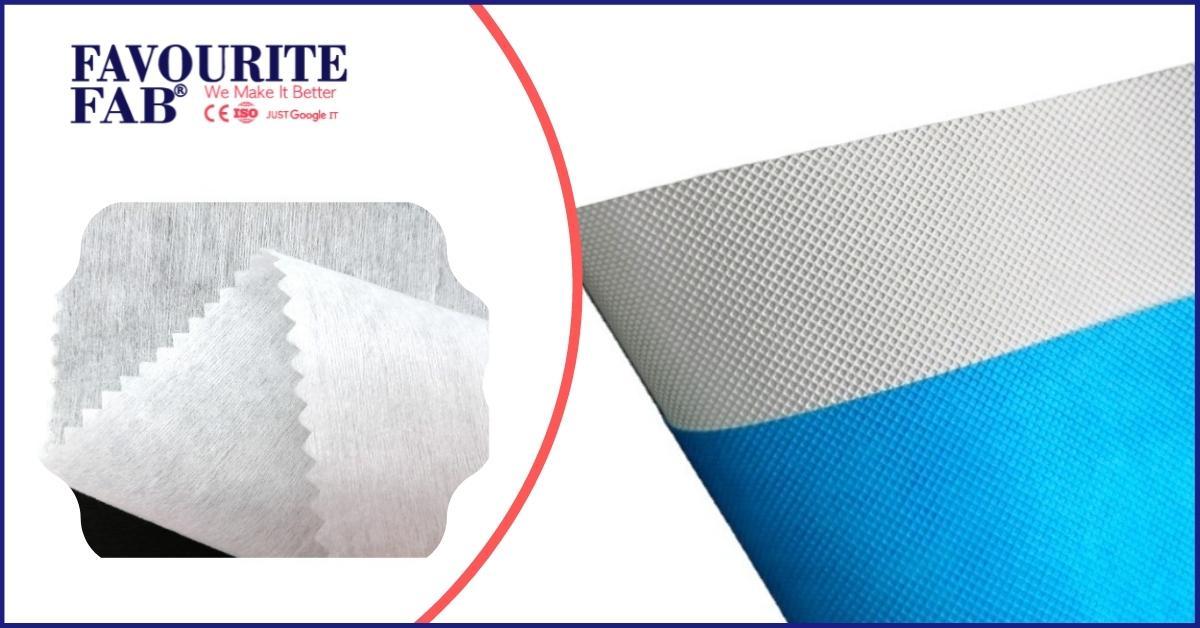
Looking to choose between spunlace and spunbond non woven fabric? This guide compares both fabrics across every key factor — manufacturing process, tensile strength, softness, absorbency, cost per kg and best applications — so you can make the right decision for wipes, medical, hygiene or industrial use.
Spunlace vs Spunbond: Quick Comparison Table
| Factor | Spunlace | Spunbond | Winner |
|---|---|---|---|
| Manufacturing Process | Hydroentanglement (high-pressure water jets) | Thermal bonding (heated rollers + continuous filaments) | — |
| Raw Material | Viscose, polyester, PET-viscose blend | Polypropylene (PP), polyester | — |
| Softness | ⭐⭐⭐⭐⭐ Very soft, skin-safe | ⭐⭐ Stiffer feel | ✅ Spunlace |
| Tensile Strength | ⭐⭐⭐ Isotropic (equal in all directions) | ⭐⭐⭐⭐⭐ Very high tensile strength | ✅ Spunbond |
| Absorbency | ⭐⭐⭐⭐⭐ Excellent (up to 6× its weight) | ⭐⭐ Low absorbency | ✅ Spunlace |
| Breathability | ⭐⭐⭐⭐⭐ Excellent | ⭐⭐⭐⭐ Good with barrier properties | ✅ Spunlace |
| Cost per kg | Higher (₹180–₹320/kg depending on GSM) | Lower (₹80–₹160/kg) | ✅ Spunbond |
| GSM Range | 20–120 GSM | 10–200 GSM | — |
| Biodegradable Option | Yes (viscose, lyocell fibers) | Limited (PP is not biodegradable) | ✅ Spunlace |
| Best For | Wipes, medical, hygiene, cosmetics | Bags, geotextiles, agriculture, packaging | Depends on use |
What is Spunlace Fabric?
Spunlace fabric — also called hydroentangled nonwoven — is made by entangling fibers using high-pressure water jets. No chemical binders or heat are used. The result is a soft, flexible, and highly absorbent fabric that feels close to woven textile. It is the material of choice for wet wipes, baby wipes, medical gauze, cosmetic pads and hygiene products.
Spunlace Manufacturing Process
- Fiber Preparation: Viscose, polyester or blended fibers are opened and formed into a web.
- Hydroentanglement: High-pressure water jets (up to 200 bar) entangle the fibers mechanically — no adhesives or chemicals.
- Drying and Finishing: The fabric is dried on a through-air drum and may be embossed, apertured or laminated for specific end uses.
Key Properties of Spunlace Fabric
- Softness: No binders means a genuinely soft, skin-friendly hand feel
- High Absorbency: Viscose spunlace absorbs up to 6× its own weight in liquid
- Isotropic Strength: Equal tensile strength in machine direction and cross direction
- Breathability: Open fiber structure allows excellent air and moisture passage
- Biodegradable Options: 100% viscose and lyocell spunlace are fully biodegradable
Best Applications for Spunlace
- Wet Wipes & Baby Wipes: 40–60 GSM viscose spunlace is the industry standard
- Medical Supplies: Wound dressings, surgical swabs, sterile gauze
- Feminine Hygiene: Top sheet for pads and panty liners
- Cosmetic Pads: Cotton-feel viscose spunlace for facial wipes
- Industrial Wipes: 60–80 GSM polyester spunlace for heavy-duty cleaning
What is Spunbond Fabric?
Spunbond fabric is a nonwoven made by extruding continuous thermoplastic filaments (usually polypropylene) and thermally bonding them with heated rollers. The result is a strong, lightweight and cost-effective fabric with excellent dimensional stability. Spunbond is the dominant material for non-woven bags, crop covers, geotextiles and disposable protective wear.
Spunbond Manufacturing Process
- Polymer Extrusion: Polypropylene pellets are melted and extruded through spinnerets to form continuous filaments.
- Web Formation: Filaments are laid randomly onto a moving belt to form a uniform web.
- Thermal Bonding: The web passes through heated calender rollers that fuse the filament crossover points.
- Cooling and Winding: The bonded fabric is cooled, slit to width and wound into rolls.
Key Properties of Spunbond Fabric
- High Tensile Strength: Continuous filaments + thermal bonding gives excellent tear resistance
- Dimensional Stability: Holds shape under mechanical stress and outdoor conditions
- Lightweight: Available from 10 GSM — very low weight for its strength
- Barrier Properties: Blocks liquids and fine particulates effectively
- Cost-Effective: PP spunbond is one of the cheapest nonwovens to produce
Best Applications for Spunbond
- Non-Woven Bags: 60–80 GSM PP spunbond is the standard for reusable bags
- Agriculture: Crop covers, mulch mats, root protection
- Geotextiles: Soil stabilization, road construction, drainage layers
- Medical PPE: Disposable gowns, shoe covers, caps
- Packaging: Furniture wrap, mattress covers, gift wrap fabric
Spunlace vs Spunbond: Which Should You Choose?
The right fabric depends entirely on your end application. Here is a simple decision guide:
| If you need… | Choose | Reason |
|---|---|---|
| Fabric for wet wipes or baby wipes | ✅ Spunlace | High absorbency + skin-safe softness |
| Fabric for non-woven bags | ✅ Spunbond | High strength + low cost per kg |
| Medical wound dressings or gauze | ✅ Spunlace | Soft on wounds + absorbent + sterile options |
| Disposable protective gowns | ✅ Spunbond | Barrier properties + lightweight + low cost |
| Cosmetic pads or facial wipes | ✅ Spunlace | Cotton-like feel + gentle on skin |
| Agriculture crop covers | ✅ Spunbond | UV resistance + durability outdoors |
| Industrial cleaning wipes | ✅ Spunlace | Absorbency + strength + lint-free |
| Geotextiles or construction | ✅ Spunbond | Maximum tensile strength + dimensional stability |
Advantages and Disadvantages
Spunlace Fabric — Pros and Cons
Pros:
- Softness and Comfort: Ideal for products in contact with skin
- High Absorbency: Up to 6× its weight — excellent for wipes and hygiene
- No Chemical Binders: Safer for sensitive skin and medical use
- Biodegradable Options: 100% viscose spunlace is fully biodegradable
- Customizable: Available in plain, embossed, apertured, and crosslap variants
Cons:
- Higher Cost: Hydroentanglement is more expensive than thermal bonding
- Water-Intensive: Production uses significant water volumes
- Lower Tensile Strength: Not suitable for load-bearing or structural applications
Spunbond Fabric — Pros and Cons
Pros:
- High Strength and Durability: Suitable for demanding industrial applications
- Cost-Effective: Lower production cost — good for high-volume applications
- Lightweight: High strength-to-weight ratio
- Barrier Properties: Blocks liquids and particulates effectively
Cons:
- Low Absorbency: Not suitable for wipes or medical absorbent products
- Less Soft: Stiffer feel — not ideal for skin-contact applications
- Not Biodegradable: Standard PP spunbond does not break down naturally
Conclusion
Spunlace and spunbond are both excellent nonwoven fabrics — but for very different applications. Choose spunlace when your product needs softness, absorbency and skin safety — wipes, medical, hygiene and cosmetics. Choose spunbond when you need strength, barrier properties and low cost — bags, agriculture, construction and PPE.
At Favourite Fab, we manufacture premium spunlace nonwoven fabric in viscose, polyester and PET-viscose blends from 20–120 GSM. We supply to wipes manufacturers, medical companies and hygiene brands across India and globally. Learn more about spunlace fabric or check the HS code and pricing for spunlace.
Frequently Asked Questions
What is the main difference between spunlace and spunbond nonwoven fabric?
Spunlace is made using high-pressure water jets (hydroentanglement) which gives it softness and high absorbency — ideal for wipes and medical products. Spunbond is made by thermally bonding continuous polypropylene filaments, giving it high tensile strength and low cost — ideal for bags, agriculture and construction. The key difference is softness and absorbency (spunlace) vs strength and cost (spunbond).
Which is better for wet wipes — spunlace or spunbond?
Spunlace is far better for wet wipes. It absorbs up to 6× its weight in liquid, feels soft on skin and holds together when wet. The industry standard for baby wipes, cosmetic wipes and medical wipes is 40–60 GSM viscose spunlace. Spunbond does not have enough absorbency for wet wipe applications.
Is spunlace more expensive than spunbond?
Yes. Spunlace costs approximately ₹180–₹320 per kg depending on GSM and fiber type. Spunbond polypropylene costs approximately ₹80–₹160 per kg. The higher cost of spunlace is due to the water-intensive hydroentanglement process and the use of premium fibers like viscose.
Can spunlace fabric be used instead of spunbond for non-woven bags?
Technically yes, but it is not practical. Spunbond PP at 60–80 GSM provides all the strength, stiffness and printability needed for non-woven bags at a much lower price. Spunlace is better reserved for wipes, medical and hygiene applications.
Which nonwoven fabric is more eco-friendly — spunlace or spunbond?
Spunlace has a stronger eco-friendly profile. 100% viscose spunlace is biodegradable and compostable. Lyocell-based spunlace is made from sustainably sourced wood pulp. Standard spunbond uses polypropylene which is not biodegradable, though it can be recycled.
Contact Us
Need help choosing between spunlace and spunbond for your specific application? Our team at Favourite Fab can recommend the right fabric type, GSM and fiber blend for your product.
Email: sale@favouritehub.com | WhatsApp: 8800775462
Related Articles
- What is Spunlace Fabric? A Comprehensive Guide to Its Properties & Uses
- Spunlace Nonwoven Fabrics: Types, GSM & Applications
- Top 10 Spunlace Uses in Various Industries
- Spunlace Non Woven Fabric HS Code: Import Guide & GST Rate
- Spunlace Fabric Manufacturers in India: Leading Suppliers
I'm Gaurav Garg, CEO of Favourite Fab, a
company on a mission to revolutionize the nonwoven industry with sustainable practices. We work
hand-in-hand with manufacturers and suppliers who share our commitment to eco-friendly production.
With a deep interest in textile innovation, I'm passionate about educating consumers about
sustainable material options and their potential to transform the nonwoven landscape.
Gaurav Garg


