

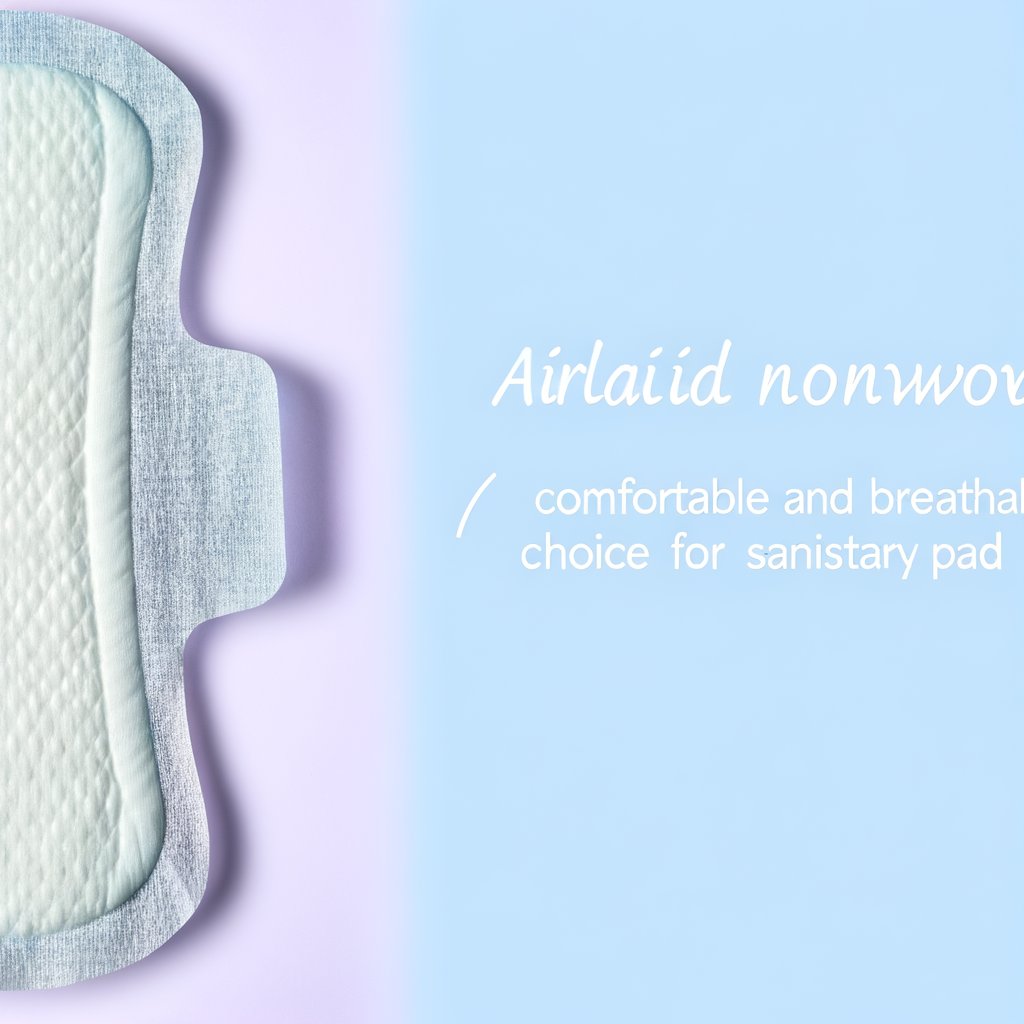
Airlaid Nonwoven for Sanitary Pads — Absorbent Core Supplier India | Favourite Fab
Airlaid nonwoven for sanitary pads is the absorbent core material that replaces bulky fluff pulp in modern ultra-thin pads. Air-laid from wood pulp and superabsorbent polymer (SAP), it delivers 8–15 g/g fluid retention, rapid wicking, and a dry-feel surface in a compact 0.8–3.5 mm profile — enabling pad manufacturers to produce slimmer, lighter SKUs without sacrificing protection. Favourite Fab supplies custom-GSM airlaid core rolls direct from Agra, India, with competitive wholesale pricing and low MOQs. Request a sample today.
What Is Airlaid Nonwoven for Sanitary Pads?
Airlaid nonwoven is a textile structure formed by dispersing natural or synthetic fibers — most commonly bleached wood pulp — through high-velocity air currents onto a moving conveyor. Unlike woven or spunbond fabrics, the airlaid process does not extrude continuous filaments; instead, individual fibers are randomized into a three-dimensional web, then bonded through thermal, latex, or hydrogen-bonding mechanisms. The result is a uniquely bulky, high-loft material with a paper-like hand but textile-like flexibility.
In a sanitary pad, this material functions as the absorbent core — the layer positioned between the topsheet and backsheet that captures, distributes, and locks away menstrual fluid. Understanding airlaid nonwoven technology in depth is essential for any pad manufacturer evaluating a core material switch or new product development.
The manufacturing sequence involves five stages:
- Fiber selection: Wood pulp (fluff or dissolving grade), cotton, viscose, or bicomponent synthetic fibers are chosen based on target absorbency and softness.
- Fiber preparation: Pulp bales are fiberized and the fibers are defibrated to individual filament level.
- Web formation: Air streams deposit fibers uniformly onto a forming drum or belt, building a lofty, isotropic web.
- Bonding: Thermal calendering (bicomponent fibers), latex spray, or hydrogen bonding locks the web into a coherent sheet.
- Finishing: Calendering, embossing, or SAP incorporation is applied to reach final specification.
Why Airlaid in the Pad Core — Absorbency, SAP Integration, Thinness, and Dry-Feel
Pad manufacturers select airlaid over traditional fluff pulp cores for four compounding technical advantages:
Absorbency and fluid management. The open, randomized fiber network creates a high surface-area matrix that acquires fluid rapidly — typical acquisition rates of 5–15 mm/sec in the machine direction. Fluid distributes laterally before pooling, which reduces point-saturation and leakage risk.
SAP integration. Superabsorbent polymer granules can be metered directly into the airlaid web during formation, achieving SAP loadings of 10–60% by weight. The fiber matrix immobilizes SAP particles, preventing gel-blocking even at high saturation levels — a problem more common in loose-fill fluff-SAP cores.
Thinness without performance compromise. Airlaid’s high fiber density per unit thickness means a 120 GSM airlaid-SAP composite can outperform a 180 GSM fluff pulp pad in absorbency while reducing finished pad caliper by 30–40%. This directly enables ultra-thin and body-fit SKU development.
Dry-feel surface. The breathable pore structure of airlaid allows vapor transmission while retaining liquid, keeping the topsheet-facing surface drier under load. Combined with a soft, cloth-like texture, this reduces skin irritation — a critical QC parameter for premium feminine hygiene lines.
Technical Specifications of Airlaid Core Material
The table below reflects typical customizable ranges available from Favourite Fab. Exact values depend on fiber blend, SAP loading, and bonding method. All parameters are confirmed per sample order before bulk supply.
| Parameter | Typical Range | Unit |
|---|---|---|
| Basis weight (GSM) | 40 – 300 | g/m² |
| SAP content | 0 – 60 | % by weight |
| Absorption capacity | 8 – 15 | g/g |
| Wet tensile strength (MD) | 2 – 10 | N/25 mm |
| Caliper (thickness) | 0.8 – 3.5 | mm |
| Wicking rate (MD) | 5 – 15 | mm/sec |
| Roll width | 100 – 3,200 | mm (slit to order) |
| Fiber composition | Wood pulp, viscose, bicomponent PE/PP, or blends | — |
Airlaid Grades for Hygiene — SAP-Airlaid, Multi-Bonded, and Thermobonded
Not all airlaid is equivalent. Three primary grades serve the sanitary pad market, each targeting a different product tier:
SAP-airlaid composite (SAP-AL). Wood pulp airlaid web with SAP granules metered at 20–60% loading during web formation. Used in overnight pads, heavy-flow ultra-thins, and incontinence liners where maximum fluid lock-in is required. GSM typically 80–200.
Multi-bonded airlaid (MBA). Combines latex spray bonding with thermal calendering, producing a sheet with higher wet strength and dimensional stability. Suitable for pad cores running through high-speed converting lines (400–800 pads/min) where web tear-resistance is critical. GSM range 60–160.
Thermobonded airlaid (TBAL). Uses bicomponent PE/PP or PET/PE fibers that fuse under heat rather than latex chemicals. Produces the softest, most textile-like hand with no residual binder chemistry — preferred for organic and chemical-free pad lines. GSM range 40–120; thinnest profiles for daily liners and panty liner SKUs.
Within each grade, ultra-thin targets (40–80 GSM) suit daytime and panty liner products, while maxi targets (100–300 GSM) suit overnight pads and adult incontinence cores.
Airlaid vs Fluff Pulp Core — Why Airlaid Enables Ultra-Thin Pads
Fluff pulp has been the default absorbent core since the 1970s, but modern pad designs increasingly migrate to airlaid for these reasons:
| Attribute | Airlaid Nonwoven Core | Fluff Pulp Core |
|---|---|---|
| Minimum achievable caliper | 0.8 – 1.5 mm | 3 – 5 mm |
| SAP lock-in | Fiber matrix holds SAP, low gel-block risk | Loose SAP prone to migration and gel-block |
| Wet integrity | Maintains shape after saturation | Clumps and collapses when wet |
| Wicking speed | High (structured fiber network) | Moderate (loose fiber mass) |
| Converting line speed | Runs as bonded roll — high-speed compatible | Requires on-line defibration — slower, dusty |
| Dust generation | Minimal (bonded web) | Significant (loose fiber) |
| Biodegradability | Natural fiber grades fully biodegradable | Biodegradable (wood pulp only) |
The converting-line advantage is commercially significant: airlaid rolls drop into existing SAP-core lines without a defibration unit, reducing equipment capex for manufacturers transitioning from fluff-SAP cores.
Applications Beyond Sanitary Pads
The same airlaid nonwoven for sanitary pads also serves adjacent hygiene and industrial categories, giving buyers multi-SKU sourcing efficiency from a single roll specification:
- Panty liners: Ultra-thin thermobonded grades (40–60 GSM, no SAP) provide minimal absorbency with maximum softness and discretion for light daily use.
- Acquisition-Distribution Layer (ADL) in diapers: Low-GSM airlaid used as the sub-topsheet layer to accelerate fluid transport to the SAP core — reducing rewet and improving dry feel in baby diapers and adult incontinence products.
- Adult incontinence pads and briefs: High-SAP airlaid composites (150–300 GSM) for moderate-to-heavy urinary incontinence, where core integrity under pressure and odour control are priorities.
- Wet wipes and dry wipes: Airlaid’s softness and lint-free surface make it a premium substrate for personal care and surface-cleaning wipes.
- Wound care and surgical dressings: Medical-grade airlaid (sterilizable via ethylene oxide or gamma irradiation) is used in wound contact layers, surgical drapes, and absorbent dressing pads.
- Industrial absorbent pads: High-GSM grades serve oil-water separation pads and chemical spill-control products in manufacturing environments.
- Filtration media: Airlaid’s controlled porosity makes it suitable as a filtration layer in air filters, HVAC units, and liquid filtration assemblies where efficient particle capture and low pressure drop are both required.
- Food service and packaging: Food-grade airlaid is used in absorbent table covers, meat and produce tray pads, and fresh-food packaging where moisture absorption extends shelf life and presentation quality.
Why Source Airlaid From Favourite Fab
Favourite Fab is a B2B nonwoven raw material supplier based in Agra, India, serving sanitary pad manufacturers, diaper OEMs, and hygiene brand owners across South Asia, Southeast Asia, Africa, and the Middle East. Key reasons procurement teams work with us:
- Custom GSM and SAP content: We formulate airlaid rolls to your pad-design spec — GSM, SAP %, fiber blend, width, and core density — not to a catalogue. Samples are dispatched before bulk commitment.
- Slit-to-order rolls: Roll widths from 100 mm to 3,200 mm, slit precisely for your converting line to eliminate waste and changeover downtime.
- Competitive wholesale pricing: Factory-direct supply from India removes trader margins. Volume-based pricing is available for repeat purchase contracts.
- Quality assurance: Each production batch is tested for GSM, caliper, absorption capacity, and wet tensile strength before dispatch. TDS and COA are provided with every shipment.
- Biodegradable options: Natural wood-pulp airlaid grades with no synthetic binder chemistry are available for manufacturers targeting eco-certified or organic pad lines.
- Supplier evaluation support: Procurement teams receive full documentation packages — TDS, COA, MSDS, and MOQ confirmation — to meet internal qualification requirements.
Explore our full capabilities as an airlaid nonwoven manufacturer and as a dedicated airlaid nonwoven fabric manufacturer India for the hygiene and medical sectors.
How to Order Airlaid Nonwoven for Sanitary Pad Manufacturing
Ordering is straightforward. Share your pad design brief — target GSM, SAP loading (if any), roll width, estimated monthly volume, and end product type — and our technical team returns a specification sheet and sample dispatch timeline within one business day.
- Email: sale@favouritehub.com
- WhatsApp: +91 88007 75462
Sample rolls (typically 5–10 m) are available for running line trials before any bulk purchase order is placed. MOQ for bulk supply is confirmed during sample stage based on grade and configuration.
Frequently Asked Questions
What GSM of airlaid nonwoven is typically used in sanitary pad cores?
Sanitary pad cores commonly use airlaid in the 60–200 GSM range. Ultra-thin daytime pads typically use 60–100 GSM airlaid (with or without SAP), while overnight and heavy-flow pads use 120–200 GSM SAP-airlaid composites. Panty liners use the thinnest grades at 40–60 GSM. Favourite Fab supplies across this full range with custom specifications to your converting-line requirements.
What is the difference between airlaid nonwoven and a fluff pulp core?
A fluff pulp core is a loose, unconsolidated mass of defibrated wood pulp mixed with SAP granules, formed on the converting line itself. An airlaid nonwoven core is a pre-bonded roll material where fibers are already locked into a coherent web, optionally with SAP incorporated at the mill. Airlaid runs cleaner (no pulp dust), maintains its shape when wet (no clumping), and enables markedly thinner pad profiles compared to equivalent fluff-SAP cores — a key reason modern ultra-thin pads migrate away from fluff.
Can airlaid nonwoven be customized with SAP content for different absorbency levels?
Yes. SAP loading in airlaid can be specified from 0% (absorbency from fiber alone) up to approximately 60% by weight, depending on the bonding method and required wet integrity. Higher SAP content delivers greater fluid retention per gram but requires a stronger bonding system (multi-bonded or bicomponent thermal) to prevent gel-blocking. Favourite Fab works with buyers to match SAP loading to their target absorption spec and converting-line capability.
Is airlaid nonwoven biodegradable?
Biodegradability depends on fiber composition and bonding chemistry. Airlaid made entirely from wood pulp fibers with hydrogen bonding or latex (water-dispersible grade) is biodegradable and compostable. Grades containing synthetic bicomponent fibers (PE, PET, PP) or conventional latex binders are not fully biodegradable. For manufacturers targeting eco-certified or organic pad lines, Favourite Fab offers natural-fiber airlaid grades free of synthetic binder — confirm fiber spec during the sample stage.
What is the difference between airlaid and spunbond or spunlace nonwoven?
Spunbond nonwoven is produced by extruding molten polymer through spinnerets into continuous filaments, then bonding — resulting in a strong, low-loft sheet used primarily for topsheets and backsheets, not absorbent cores. Spunlace (hydroentangled) nonwoven uses high-pressure water jets to entangle short fibers, producing a thin, smooth fabric suited to topsheets and wipes. Carded nonwoven aligns fibers using a carding machine, producing a thinner, less bulky web than airlaid. Airlaid, by contrast, is purpose-built for absorbency: its three-dimensional fiber web and high void volume give it substantially higher fluid-holding capacity than spunbond, spunlace, or carded fabrics at equivalent GSM, making it the correct choice for pad and diaper cores.
Can airlaid nonwoven be sterilized for medical or premium hygiene applications?
Yes. Airlaid nonwoven can be sterilized by ethylene oxide (EtO), gamma irradiation, or E-beam methods, depending on fiber and binder chemistry. Thermobonded bicomponent grades are generally compatible with gamma and E-beam. EtO is compatible with most grades but requires adequate post-sterilization aeration time. Latex-bonded grades should be validated for sterilization compatibility with the relevant standard (ISO 11135 / ISO 11137) before specification into a regulated medical device or sterile hygiene product line.

Gaurav Garg
I'm Gaurav Garg, CEO of Favourite Fab, a company on a mission to revolutionize the nonwoven industry with sustainable practices. We work hand-in-hand with manufacturers and suppliers who share our commitment to eco-friendly production. With a deep interest in textile innovation, I'm passionate about educating consumers about sustainable material options and their potential to transform the nonwoven landscape.


