

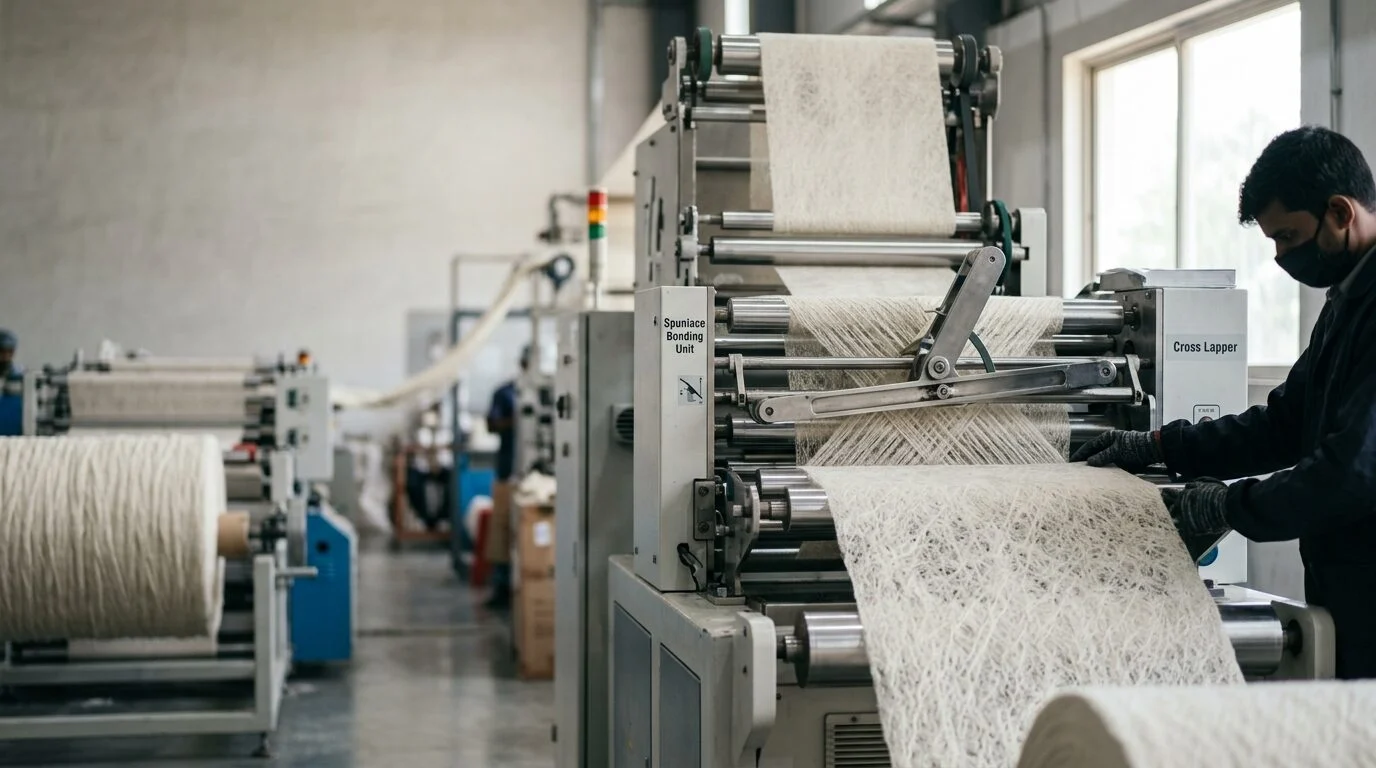
Cross Lapped Spunlace Nonwoven Fabric — Manufacturer & Supplier India
Favourite Fab supplies cross lapped spunlace nonwoven fabric in bulk to hygiene product manufacturers, medical nonwoven converters, industrial wipe producers, and wet wipe makers across India and 50+ export markets. Cross lapped structure delivers significantly higher cross-direction tensile strength than parallel-laid grades — critical for converting lines with high lateral pull forces.
What Is Cross Lapped Spunlace Nonwoven Fabric?
Cross lapped spunlace nonwoven fabric is produced by feeding a carded fibre web through a cross-lapper — a machine that folds successive web layers diagonally across the conveyor belt before hydroentanglement. Each fold alternates direction, stacking fibres at opposing angles (typically ±45° to 60° from the machine direction). The result is a multi-layer fibre assembly with a substantially more isotropic structure than a single-pass parallel-laid web.
After cross-lapping, the layered web passes through high-pressure water jet manifolds — the hydroentanglement step — which mechanically interlock fibres across all planes without adhesives or heat. Because cross-lapped webs have significantly more fibre oriented in the cross-direction (CD), the finished fabric achieves a CD tensile strength that can approach or match the machine-direction (MD) tensile. This makes cross lapped spunlace the preferred substrate wherever balanced tensile, resistance to lateral tearing, or consistent behaviour in both directions is required.
For B2B procurement, understanding the web-formation method is essential to selecting the correct spunlace grade. Cross lapped fabric commands a modest price premium over parallel-laid — but eliminates costly production stoppages caused by CD tearing during high-speed wipe folding, diaper top-sheet application, or medical wipe dispensing.
Cross Lapped vs Parallel Laid Spunlace — When to Specify Which
This is the single most important decision in spunlace procurement. Specifying the wrong web-formation method causes converting line failures that cannot be resolved by changing the hydroentanglement parameters.
Cross Lapped Spunlace — Full Specification Range
Cross lapped spunlace is available in a wider GSM range than parallel-laid grades. All specifications below are for standard wholesale orders. Custom parameters are confirmed at the time of enquiry.
| Parameter | Standard Range | Notes for Buyers |
|---|---|---|
| GSM (Weight) | 25 – 120 gsm | Cross lapping is the standard method for 60 gsm and above; below 40 gsm, parallel laid is more cost-efficient |
| Roll Width | 20 cm – 320 cm | Standard slit widths: 50, 100, 160, 220, 280, 320 cm available from stock |
| Fibre Composition | Viscose, Polyester, Bamboo, Cotton, Lyocell, Blends | Web-formation method (cross lapped) is independent of fibre type — specify both independently |
| MD Tensile Strength | ≥ 50 N / 5cm at 50 gsm | Slightly lower MD tensile than parallel laid at equivalent GSM due to fibre angle distribution |
| CD Tensile Strength | ≥ 35 N / 5cm at 50 gsm | CD tensile 3–5× higher than equivalent parallel-laid grade — the primary reason to specify cross lapped |
| MD:CD Tensile Ratio | 1.2:1 – 1.8:1 | Parallel laid grades typically 3:1 – 6:1; cross lapped target is 1.5:1 ± 0.3 for most industrial applications |
| Surface Pattern | Plain, Apertured, Embossed, Spunlace Dot | Apertured cross lapped is used for industrial wipes; embossed for premium hygiene products |
| Water Absorption | ≥ 7× fabric weight (viscose blend) | Fibre type determines absorption; cross-lapped structure increases liquid retention by increasing tortuosity of flow paths |
| Colour | White (bleached or optical), Natural (unbleached) | Coloured grades available on request with minimum order quantity |
| Roll Length | 500 – 2,500 m per roll | Heavy GSM rolls (80–120 gsm) have shorter roll lengths due to weight constraints in shipping |
| Packaging | PE-wrapped rolls on cardboard core, palletised | Export packaging — FCL and LCL shipments with full documentation |
| Certifications | ISO certified; OEKO-TEX compatible grades available | COA, MSDS issued per batch; third-party test reports arranged on request |
Selecting the Right GSM for Cross Lapped Spunlace
Cross lapped spunlace spans a wider GSM range than other spunlace grades. The correct GSM is determined by required tensile strength, liquid absorption capacity, and end-product thickness requirement.
Facial wipes and lightweight hygiene substrates where cross-lapped structure is specified for converting line stability rather than heavy tensile requirement. At this GSM, the cross-lapped structure prevents misregistration on high-speed cutting lines.
Premium wet wipes requiring resistance to tearing when pulled from the pack. Feminine hygiene top sheets where the converting line applies cross-direction tension during pad assembly. The most commonly ordered cross-lapped GSM range from Favourite Fab.
Industrial cleaning wipes, workshop wipers, and clean-room cloths where aggressive scrubbing forces are applied in unpredictable directions. Medical wound dressing contact layers requiring assured tear resistance when peeled from packaging. Cross-lapping is mandatory at this GSM range for industrial applications.
Hygiene underpads, bed protection sheets, and heavy industrial filtration nonwovens. Cross-lapping is the only viable web-formation method at this GSM range — parallel laid webs at 80+ gsm lack the structural coherence to survive converting without tearing.
Cross Lapped Spunlace — B2B Applications by Segment
The following segments purchase cross lapped grades specifically because their converting or end-use conditions require balanced tensile performance.
Workshop, automotive, and heavy industry cleaning wipes — cross-lapped viscose/polyester blend at 60–80 gsm is the industry standard for resistance to tearing under multidirectional scrubbing force.
Wound dressing contact layers, surgical prep wipes, and sterile drape components — medical grade specifies cross-lapped to prevent tearing during clinical application and removal.
Disposable underpads for incontinence care and hospital bed protection — heavy cross-lapped spunlace must withstand patient repositioning forces in both directions.
Premium and thick wet wipes for household, personal care, and antibacterial applications — cross-lapped substrate prevents lid-pop tearing when the consumer removes wipes from the pack.
Some sanitary pad and liner converting lines apply lateral tension during pad assembly — cross-lapped top-sheet specification eliminates web drift and tear on these lines.
Air and liquid filtration media, geotextiles, and industrial barrier nonwovens where isotropic tensile is required for installation under multidirectional stress.
Why Manufacturers Source Cross Lapped Spunlace From Favourite Fab
Cross lapped spunlace requires higher process control than parallel-laid grades. Favourite Fab supplies cross-lapped nonwoven with batch-to-batch tensile consistency verified by COA including both MD and CD tensile values.
Wholesale Pricing & How to Order Cross Lapped Spunlace
Cross lapped spunlace pricing is determined by GSM, fibre composition, roll width, and order volume. Cross-lapped grades carry a modest 10–20% premium over parallel-laid at equivalent GSM. Send your specification for an accurate volume quote.
Frequently Asked Questions — Cross Lapped Spunlace
Source Cross Lapped Spunlace Nonwoven Fabric in Bulk
Send your material specification including GSM, fibre type, and target MD:CD ratio — receive a quote within 24 hours.
Related B2B Resources

Gaurav Garg
I'm Gaurav Garg, CEO of Favourite Fab, a company on a mission to revolutionize the nonwoven industry with sustainable practices. We work hand-in-hand with manufacturers and suppliers who share our commitment to eco-friendly production. With a deep interest in textile innovation, I'm passionate about educating consumers about sustainable material options and their potential to transform the nonwoven landscape.


