

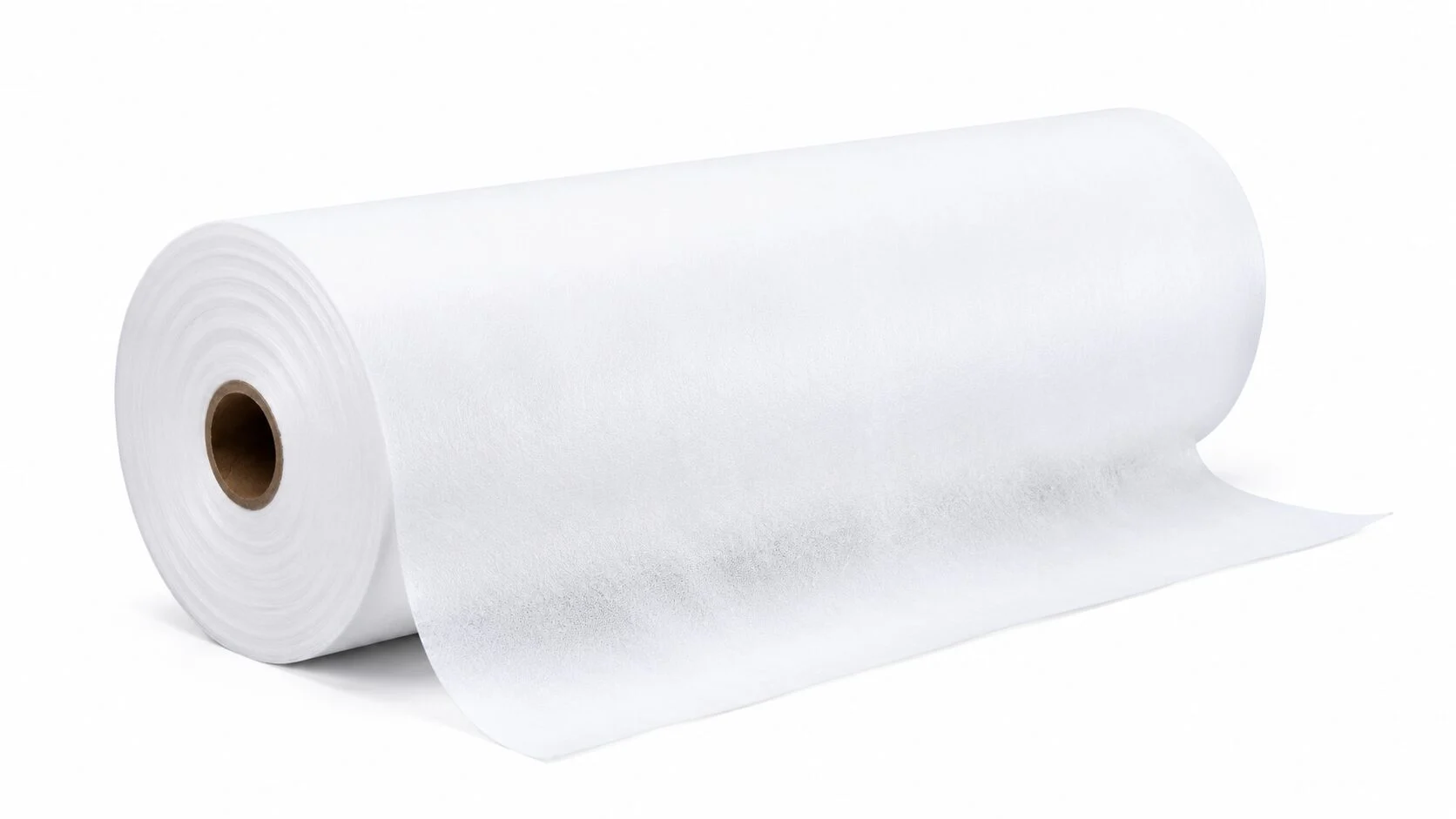
Non Woven Fabric for Oxygen Absorber Pouches — B2B Wholesale India
Non woven fabric for oxygen absorber pouches must be breathable, food-contact safe, and chemically inert to iron powder — a fundamentally different specification from silica gel desiccant pouches. Favourite Fab supplies the correct non woven outer wrap for oxygen absorbers: PP spunbond and PE/PP bicomponent rolls, 30–50 GSM, FDA 21 CFR & EU 10/2011 certified, O2 permeability ≥500 cc/m²/24h (ASTM D3985). Rolls ship from Agra to 30+ countries.
What Are Oxygen Absorber Pouches?
Oxygen absorber pouches are small sealed sachets containing iron powder, salt, and a moisture activator. Placed inside food packaging, they deplete headspace O2 to below 0.01%, extending shelf life without chemical preservatives. The outer fabric wrap must pass oxygen molecules freely into the sachet while physically containing all iron fines — making it a precision-engineered material with specific gas-permeability and food-contact requirements that differ from standard desiccant pouch fabrics.
Why Non Woven Fabric for Oxygen Absorbers?
Thermally bonded non woven structures deliver uniform inter-fibre channels that pass gas while blocking particles above 10–20 microns — unlike woven fabrics, which risk iron-fines migration. Key advantages of the correct non woven outer wrap for oxygen absorbers:
- Controlled O2 permeability: Open pore structure allows rapid oxygen uptake, reducing time-to-depletion inside food packs.
- Iron-particle containment: Thermally bonded matrix retains fines down to 15–20 microns — critical for food-contact safety.
- Inert polymer base: Virgin PP and PE carry no additives that migrate into food at typical storage temperatures.
- Machine-compatible seal: Consistent caliper seals cleanly on bar-seal and rotary lines without pinholes.
Full Specification Sheet
All parameters tested in-house; third-party verification available on request. Custom tolerances available at contract volumes.
| Parameter | Value / Range | Test Standard |
|---|---|---|
| GSM range | 30–50 GSM | ISO 9073-1 |
| Roll width | 100–260 cm (slit to order) | — |
| O2 permeability | ≥500 cc/m²/24h | ASTM D3985 |
| MVTR | 600–1,500 g/m²/24h | ASTM E96 |
| Food contact compliance | FDA 21 CFR 177.1520; EU Regulation 10/2011 | Migration testing |
| Heat seal temperature | 130–155°C (bar seal) | In-house seal test |
| Burst strength | ≥80 kPa | ISO 2758 |
PP Spunbond vs Bico for O2 Absorber Machines
Two fabric constructions dominate oxygen absorber pouch manufacturing. Choosing incorrectly increases seal rejects or compromises containment.
| Property | PP Spunbond | PE/PP Bicomponent (Bico) |
|---|---|---|
| Heat seal mechanism | PP fibre fusion; 145–155°C | Low-melt PE sheath at 130–140°C; PP core preserves structure |
| O2 permeability | Higher — more open pore at equivalent GSM | Slightly lower — PE sheath partially closes inter-fibre gaps |
| Machine compatibility | Bar-seal and ultrasonic | Preferred for high-speed rotary and bar-seal hybrid lines |
| Cost position | Lower; standard availability | 10–15% premium; justified for high-speed, low-reject lines |
Above 150 pouches/minute, Bico’s lower seal temperature increases throughput. For slower or retrofit lines, PP spunbond delivers equivalent containment at lower cost.
Food-Grade & Safety Compliance
Oxygen absorbers sit in direct food proximity — requirements are stricter than industrial desiccant pouch grades:
- FDA 21 CFR 177.1520 — olefin polymers (PP and PE) for food contact. Virgin resin only; no recycled content.
- EU Regulation 10/2011 — overall migration limit 10 mg/dm². Compliance certificates supplied on request.
- No optical brighteners or fluorescent whitening agents — prohibited in food-contact grades; standard nonwovens often contain them.
- Iron-inert chemistry — PP and PE do not catalyse or interfere with the iron oxidation reaction.
Who Buys This Fabric?
- Oxygen absorber manufacturers: Sachet producers filling iron-based compounds who need roll stock compatible with their converting machines.
- Contract food packagers: Companies providing modified-atmosphere or oxygen-free packaging to bakeries, snack brands, and meat processors.
- Pharmaceutical converters: Tablet and capsule manufacturers where O2 control extends drug shelf life.
- Trading companies and distributors: Import-export houses stocking food-grade sachet materials; also suitable as moisture absorber sachet fabric when specified with silica gel or clay fill.
Why Source From Favourite Fab
- Segregated food-grade production line — no co-mingling with industrial grades.
- Slit-to-order width — 100–260 cm master rolls, ±1 mm tolerance.
- Batch-consistent GSM — ±2 GSM tolerance across rolls in an order; critical for automated seal consistency.
- Full documentation package — CoA, TDS, food-contact compliance declaration, and packing list with every shipment.
- Export-ready dispatch from Agra — sea and air freight to 30+ countries, GST invoicing included.
How to Order
Contact our B2B sales desk with your machine type (bar seal / rotary / ultrasonic), target GSM, required width, and monthly volume. We confirm availability, send a TDS, and arrange a sample roll for machine trials before commercial order placement.
Request a Sample Roll or Bulk Quote
Share machine spec and required width — response within one business day.
Competitive wholesale pricing on inquiry. MOQ details in FAQ below. Custom GSM and width available at contract volumes.
Frequently Asked Questions
What is the difference between desiccant pouch fabric and oxygen absorber pouch fabric?
Desiccant pouch fabric (silica gel or clay) is engineered for high MVTR but has no O2 permeability requirement. Oxygen absorber pouch fabric must meet ≥500 cc/m²/24h O2 permeability (ASTM D3985) and stricter food-contact compliance (FDA 21 CFR, EU 10/2011) because iron powder in proximity to food carries additional migration-risk scrutiny.
Does the fabric react with iron powder in oxygen absorbers?
No. Virgin PP and PE are chemically inert to iron powder and its oxidation products (iron oxide, ferrous chloride). They do not catalyse the iron reaction or leach any compound that alters the absorption chemistry.
Which GSM is recommended for food packaging oxygen absorber pouches?
35–40 GSM covers most food packaging applications (500–2,000 cc O2 capacity). 30 GSM suits small-capacity absorbers on high-speed lines. 45–50 GSM is used for large-format absorbers in bulk grain or coffee packaging.
Can the same roll be used on both bar seal and heat seal machines?
PP spunbond (145–155°C) works on bar-seal and ultrasonic machines. Rotary heat-seal lines operating below 140°C require PE/PP Bico — its low-melt PE sheath seals cleanly at 130–140°C. For facilities running both, Bico at 140–145°C can bridge both processes after qualification trials.
What is the minimum order quantity for oxygen absorber pouch rolls?
Standard MOQ is 500 kg per width per GSM. Pre-commercial sample rolls (50–100 m) are available at nominal charge, credited against the first production order. Contact sale@favouritehub.com with your target width and monthly volume for a confirmed MOQ and lead time.
Related Resources
Full range: desiccant nonwoven fabric manufacturer India. Related: food grade desiccant nonwoven fabric.

Gaurav Garg
I'm Gaurav Garg, CEO of Favourite Fab, a company on a mission to revolutionize the nonwoven industry with sustainable practices. We work hand-in-hand with manufacturers and suppliers who share our commitment to eco-friendly production. With a deep interest in textile innovation, I'm passionate about educating consumers about sustainable material options and their potential to transform the nonwoven landscape.


