

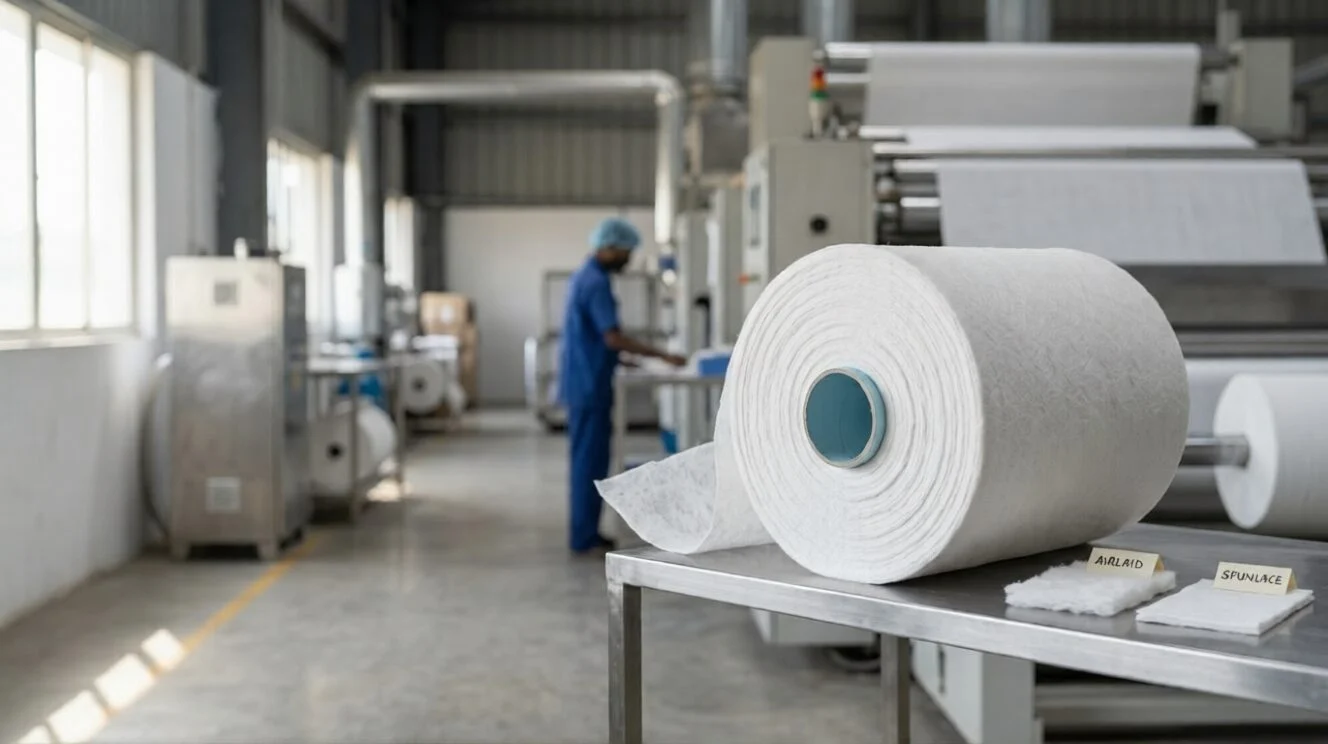
Airlace Nonwoven Fabric — Airlaid Spunlace Composite Manufacturer India
Airlace nonwoven fabric combines airlaid web formation with hydroentanglement (spunlace) bonding — creating a composite with ultra-high absorbency from the airlaid fluff pulp component and mechanical strength from hydroentanglement bonding. Unlike standard spunlace (which uses staple fibres), airlace uses short wood pulp fibres air-laid into a random web before water-jet bonding. The result is a bulky, high-absorbency fabric used in premium hygiene, medical, and wipe applications requiring maximum liquid uptake.
Technical Specifications
| Parameter | Specification |
|---|---|
| GSM | 50–200 GSM |
| Composition | Wood pulp (airlaid) + polyester or viscose reinforcement |
| Absorbency | 1,500–3,000% of fabric weight |
| Bulk | 3–10 mm thickness |
| Bonding | Hydroentanglement |
| MOQ | 1,000 kg |
Applications
Premium hygiene cores, high-absorbency medical pads, premium wipes, surgical drape absorbent layers, underpad cores.
Source from Favourite Fab
Direct manufacturer Agra, India. Custom GSM/width. COA per batch. Sample 3–5 days. See: spunlace nonwoven fabric. Related: spunbond nonwoven fabric manufacturer India.
Frequently Asked Questions
What is airlace nonwoven?
Airlace combines airlaid (air-formed wood pulp web) with spunlace (hydroentanglement) bonding. The airlaid process creates a loose, 3D fluff pulp web; hydroentanglement binds it without compression, preserving bulk and absorbency. Result: softer, bulkier, and more absorbent than standard spunlace.
How does airlace compare to standard spunlace?
Airlace: 2–5× higher absorbency, more bulk/loft, more expensive. Standard spunlace: better tensile strength, lower cost, more consistent for wipe applications. Airlace used when maximum absorbency is the priority — premium hygiene cores, surgical drapes.
What is airlace used for?
Premium hygiene underpad cores, surgical drape absorbent panels, high-end kitchen wipes with super-high absorption, and premium baby wipe grades requiring cloth-like bulk and high liquid retention.
B2B Applications & End-Uses
Airlace nonwoven fabric — the composite structure produced by bonding an airlaid pulp core with a spunlace nonwoven facing — addresses a specific set of converting requirements that neither airlaid nor spunlace alone can meet. The airlaid core provides volumetric absorbency derived from wood pulp or specialty pulp fibres, while the spunlace facing delivers surface strength, controlled linting, and the tactile properties that differentiate the composite from standard fluff-pulp substrates. OEM manufacturers specifying airlace are typically seeking to combine wet strength and durability with the high fluid absorption capacity that drives performance in their end product.
Medical drape and surgical cover OEMs are primary specifiers of airlace composites in the 40–120 GSM range. Surgical drape applications require a substrate that absorbs surgical field fluid rapidly while maintaining barrier integrity under the mechanical stress of a surgical procedure. The spunlace facing on an airlace composite prevents the surface fibre release and dust generation that occurs when bare airlaid is used as a drape surface — a clinically important attribute in sterile field management. OEM drape manufacturers supplying hospital procurement programmes in the EU, Middle East, and India increasingly specify airlace composites for single-use drape products as a differentiated alternative to SMS laminates in absorbency-critical surgical positions.
Industrial cleaning and maintenance wipe converters use airlace composites as a premium substrate for heavy-duty floor cleaning pads, mop head substrates, and industrial surface cleaning wipes where the combination of high absorbent capacity and mechanical durability under scrubbing load is the primary value driver. At 80–120 GSM, airlace composites absorb substantially more liquid per unit area than conventional 70–80 GSM spunlace alone — an attribute quantifiable in litres-per-square-metre terms that OEM buyers can translate directly into a performance claim for their finished product. Converters producing private-label floor cleaning pads for retail supply chains use this absorbency advantage as a product differentiation argument in category buyer presentations.
Absorbent hygiene product (AHP) OEMs producing adult incontinence pads, maternity care products, and post-surgical absorbent pads specify airlace composites as the acquisition-distribution layer (ADL) or secondary topsheet where rapid fluid distribution combined with rewet resistance is required. The airlaid pulp core in the composite distributes fluid laterally more efficiently than a pure spunlace ADL, reducing pooling at the point of insult and improving overall pad performance. At 40–60 GSM, airlace composites fit within the basis weight envelope of standard AHP production lines without requiring significant tooling modification, making them accessible to OEM manufacturers upgrading from single-layer ADL substrates.
Certifications & Quality Assurance
Airlace composite production at Favourite Fab involves a multi-step manufacturing process — airlaid web formation, spunlace facing bonding, and composite lamination or co-entanglement — each governed by documented process control parameters under the ISO 9001:2015 quality management system. The composite structure introduces additional quality control variables relative to single-layer spunlace, specifically inter-layer bond strength and pulp distribution uniformity. Bond strength between the airlaid core and spunlace facing is tested per an internal protocol derived from peel force methods, and minimum bond strength values are specified for each grade to prevent delamination during converting and end use.
For medical drape applications requiring compliance with EU MDR or equivalent national regulatory frameworks, Favourite Fab provides biocompatibility documentation per ISO 10993 for the composite material, confirming that both the pulp core and spunlace facing components are assessed for cytotoxicity and sensitisation. Sterilisation compatibility data for EO and gamma sterilisation is available for airlace composites intended for sterile medical device integration. OEKO-TEX Standard 100 certification is available for airlace grades used in personal care and adult hygiene applications where a chemical safety audit trail is required for retail or regulatory compliance.
Absorbency performance of airlace composites is characterised beyond standard spunlace testing methods. In addition to EDANA ERT 10.1 (absorbent capacity) and ERT 150.5 (liquid absorption time), Favourite Fab tests airlace grades for rewet performance per ERT 151.3 and fluid distribution area per an internal modified EDANA method. These extended absorbency data are reported on the airlace-specific COA and are directly relevant to AHP OEMs who need to model the composite’s contribution to overall product absorption performance before committing to a qualifying production trial.
More Questions Answered
What pulp types are used in airlace composites, and can buyers specify recycled or sustainably sourced pulp?
Favourite Fab’s airlace composites are produced using fluff pulp sourced from suppliers holding FSC (Forest Stewardship Council) certification, providing a chain of custody for sustainably managed wood fibre that OEM buyers can reference in their own environmental and supplier sustainability disclosures. Specialty pulp options — including high-absorbency SAP-blended airlaid or specialty cellulosic fibres for enhanced softness — are available for buyers requiring performance characteristics beyond standard fluff pulp. Recycled pulp content in airlace composites is a technically constrained option due to fibre length consistency requirements in airlaid web formation; buyers with sustainability targets specifying recycled content should discuss feasibility with Favourite Fab’s technical team, who can assess which airlace grades are compatible with a recycled pulp fraction without compromising web uniformity or composite bond strength.
How does airlace absorbency compare to equivalent-weight pure spunlace for industrial cleaning applications?
At equivalent basis weight, airlace composites substantially outperform pure spunlace in gravimetric absorbent capacity. A 80 GSM airlace composite with a 60 GSM airlaid core and 20 GSM spunlace facing typically achieves 8–10 times its own weight in absorbed water, compared to 3–5 times for a pure 80 GSM viscose/PET spunlace at equivalent basis weight. This difference is driven by the open-cell, high-void-volume structure of the airlaid pulp core, which stores significantly more liquid per unit mass than the entangled fibre matrix of spunlace. For industrial cleaning applications where the wipe must absorb large fluid volumes in a single wiping action — spill response, large surface cleaning, equipment cleaning — airlace composites offer a measurable performance advantage that can be quantified in your product specification and translated into a use-case argument for converting customers.
📋 Related: Spunlace Nonwoven Fabric — Full Range & Specs | All Nonwoven Products from Favourite Fab

Gaurav Garg
I'm Gaurav Garg, CEO of Favourite Fab, a company on a mission to revolutionize the nonwoven industry with sustainable practices. We work hand-in-hand with manufacturers and suppliers who share our commitment to eco-friendly production. With a deep interest in textile innovation, I'm passionate about educating consumers about sustainable material options and their potential to transform the nonwoven landscape.


