

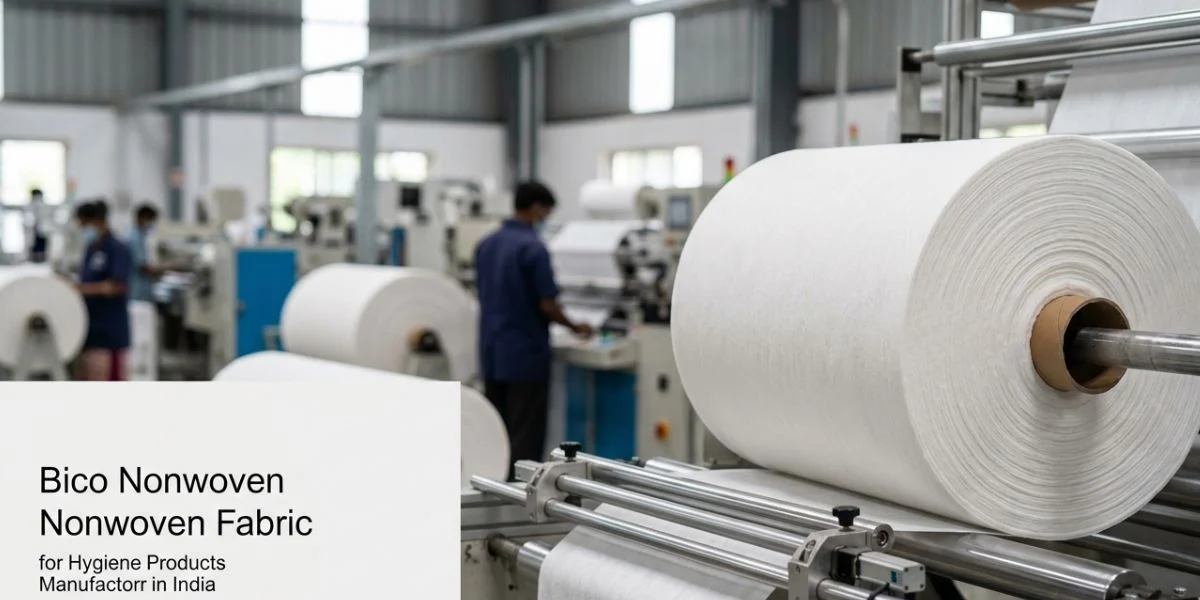
Bico Nonwoven Fabric for Hygiene Products — Soft Coverstock Raw Material India
Bico nonwoven fabric is the premium raw material for hygiene product coverstock — the skin-contact layer in baby diapers, sanitary napkins, adult incontinence pads, and panty liners. The PE/PP core-sheath structure produces the softest commercially available spunbond fabric, with a PE surface that minimises friction against sensitive skin. Hydrophilic-treated PE/PP bico achieves liquid strike-through time under 2 seconds — faster than standard spunbond — while maintaining exceptional dry rewet performance.
Browse our full range: View all nonwoven fabric products — spunlace, spunbond, SMS, bico — with GSM, width and certification options. B2B MOQ from 500 kg.
Technical Specifications
| Parameter | Specification |
|---|---|
| GSM | 12–25 GSM |
| Fibre | PE/PP core-sheath bicomponent |
| Strike-through | <2 sec (EDANA 150.3) |
| Rewet | <0.15g (EDANA 151.1) |
| Softness | Highest available spunbond grade |
| Width | 160–260 cm |
| MOQ | 500 kg |
Applications
Baby diaper coverstock (inner facing), sanitary pad topsheet, adult incontinence coverstock, panty liner topsheet, maternity pad facing.
Source from Favourite Fab
Direct manufacturer Agra, India. Custom GSM and width. COA per batch. Sample 3–5 days. See: nonwoven fabric for hygiene products. Related: bicomponent nonwoven fabric manufacturer India.
Frequently Asked Questions
Why is bico PE/PP the softest hygiene coverstock?
PE (polyethylene) sheath has lower surface hardness and lower friction coefficient than PP. Thermal bonding at lower temperature reduces fibre-to-fibre fusion rigidity vs standard PP spunbond. The result is a fabric with noticeably softer hand feel — measurable by INDA softness testing and perceived by consumers.
What GSM bico coverstock is used in baby diapers?
12–15 GSM for ultra-thin premium diapers. 17–20 GSM for standard premium diapers. 20–25 GSM for extra-soft ‘cotton soft’ positioned diapers. All grades treated with hydrophilic finish to achieve <2 sec strike-through.
Can Favourite Fab supply bico coverstock in embossed patterns?
Yes. Diamond, oval, and custom emboss patterns available on PE/PP bico in 15–22 GSM. Embossing adds surface texture that consumers associate with premium softness. Minimum order for custom emboss: 2,000 kg.
B2B Applications & End-Uses
Bicomponent nonwoven fabric in the PE/PP sheath-core configuration is a foundational raw material across three major hygiene product categories manufactured by OEMs in India and export markets: infant diapers, feminine hygiene pads, and adult incontinence products. In diaper construction, bico spunbond serves as the topsheet \u2014 the layer in direct contact with infant skin \u2014 where the PE sheath component, melting and re-bonding at approximately 130\u00b0C during thermal calendering, creates a smooth, low-prickle surface that passes INDA or EDANA softness perception benchmarks. The PP core retains dimensional stability and tensile integrity across the full converting line speed range. In sanitary pad manufacturing, bico coverstock provides the acquisition and distribution layer interface, channelling fluid away from the skin surface into the absorbent core while maintaining dry-back performance verified by rewet testing per EDANA ERT 151.5 \u2014 the standard referenced in all major hygiene OEM supplier qualification audits.
Adult incontinence product manufacturers specify bico nonwoven for the outer shell of pull-up and tab-style pants, where the fabric’s cloth-like hand feel and low noise-on-movement characteristics are critical for the dignity-sensitive end-user experience. Crimped bico fibres \u2014 produced through the eccentric core-sheath configuration \u2014 deliver a lower prickle index than standard single-component PP spunbond of equivalent GSM, a performance difference quantifiable by automated surface texture analysis and consistently referenced in topsheet upgrade projects by hygiene OEM R&D teams. GSM range for hygiene applications spans 10\u201325 GSM for topsheet and coverstock grades.
Certifications & Quality Assurance
Bicomponent nonwoven for hygiene raw material supply is produced under OEKO-TEX Standard 100 Class I certification \u2014 the highest class, covering products intended for use by infants and in direct skin contact \u2014 confirming that all fibre components, processing aids, and finishes meet stringent limits for harmful substances. Each production lot undergoes rewet performance testing (EDANA ERT 151.5), GSM verification, tensile and elongation testing in MD and CD, and surface softness assessment. Lot traceability is maintained from resin intake through to finished roll dispatch, enabling full chain-of-custody documentation for OEM customer audits. For export customers in the EU and North America, REACH compliance confirmation and California Proposition 65 substance review are available. Internal crimping uniformity is monitored to ensure consistent bico crimp ratio across production runs, directly affecting the tactile softness consistency that hygiene converting lines depend upon.
More Questions Answered
What is the difference between bico spunbond and standard PP spunbond for diaper topsheet applications?
Standard PP spunbond is a single-component filament fabric with a relatively high surface stiffness and prickle index at equivalent GSM. Bico PE/PP spunbond, by contrast, has a PE sheath that after thermal bonding produces a softer, smoother surface with measurably lower friction coefficients against skin \u2014 a key parameter in infant diaper topsheet qualification. Additionally, the crimped bico filament structure creates a loftier, more three-dimensional web that improves fluid strike-through rate and reduces surface rewet compared to flat PP spunbond webs. Most global diaper OEM specifications now mandate bico topsheet for premium and ultra-premium SKUs.
Can Favourite Fab supply bico nonwoven in hydrophilic finish for hygiene converting lines?
Yes. Bico spunbond is available with a durable hydrophilic finish applied inline during production, ensuring consistent strike-through time and fluid distribution performance required for topsheet and acquisition layer applications. The hydrophilic treatment is validated for durability across a minimum of three fluid strike-through cycles per EDANA ERT 150.3. Hydrophobic finish variants are also available for outer shell and backsheet-adjacent applications where liquid barrier performance is required. Finish type is specified at the order stage and confirmed in the product technical data sheet provided with each lot.

Gaurav Garg
I'm Gaurav Garg, CEO of Favourite Fab, a company on a mission to revolutionize the nonwoven industry with sustainable practices. We work hand-in-hand with manufacturers and suppliers who share our commitment to eco-friendly production. With a deep interest in textile innovation, I'm passionate about educating consumers about sustainable material options and their potential to transform the nonwoven landscape.


