

Calendar Bonding Nonwoven Fabric — Point Bond and Flat Bond Process India
Calendar bonding nonwoven fabric with point bond and flat bond options — Favourite Fab supplies calendar bonded nonwoven raw material to hygiene product manufacturers, medical disposable producers, and industrial fabric converters across India and 50+ export markets. Our calendar bonded nonwoven fabrics are produced on precision calender rolls with controlled temperature, pressure, and line speed — delivering consistent GSM, tensile strength, and surface finish batch after batch. Manufacturers sourcing upstream nonwoven raw material rely on our expertise as a dedicated B2B supplier. For the broader bonding process context, see our spunbond non woven fabric range.
What Is Calendar Bonding Nonwoven Fabric
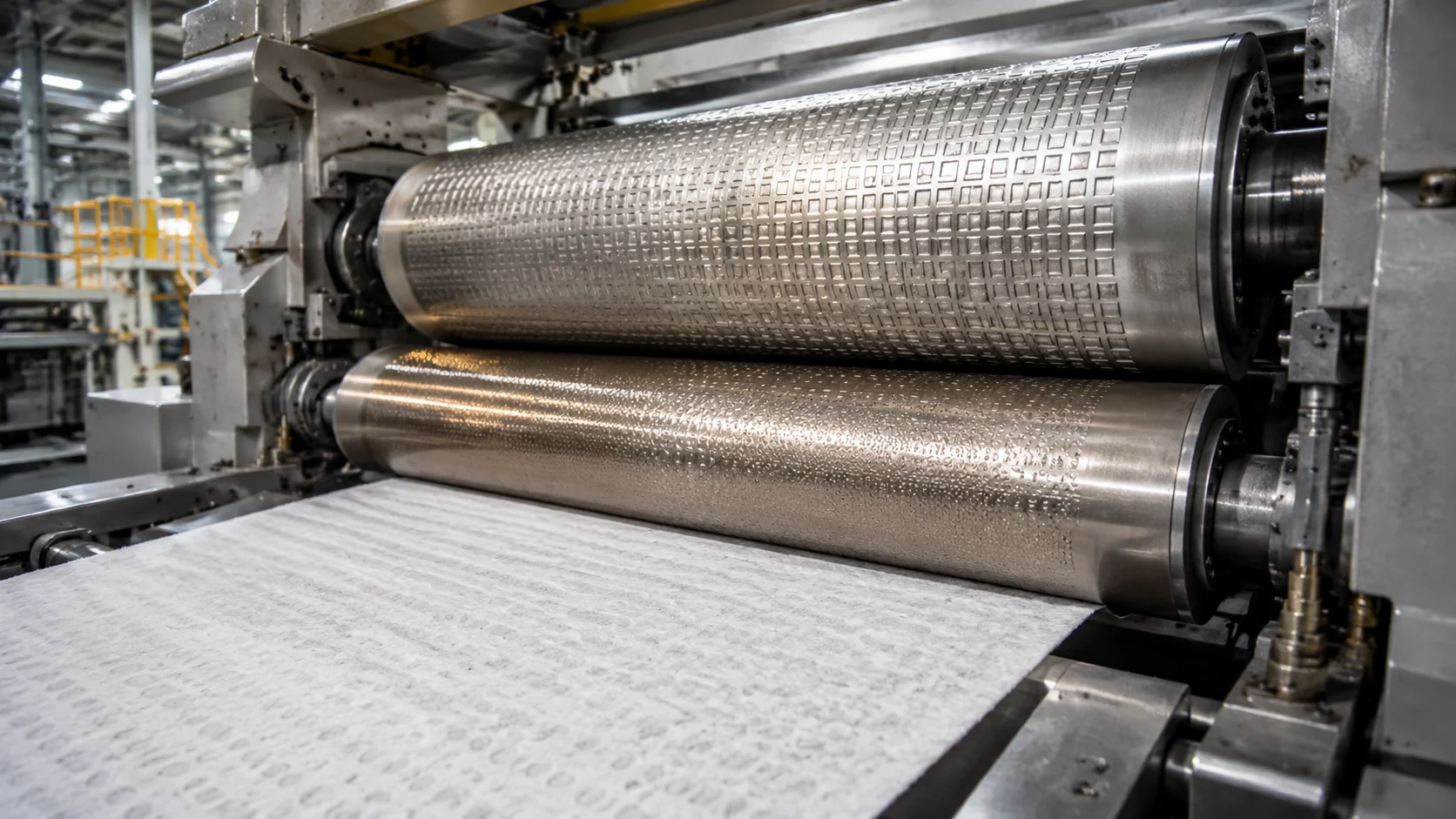
Calendar bonding is a thermal bonding method where a loose fiber web passes through one or more pairs of heated calender rolls. The rolls apply simultaneous heat and pressure across the full width of the web, fusing thermoplastic fibers at contact points. The process is continuous, high-speed, and produces fabric with highly uniform properties across the roll width and length.
Two primary bonding modes exist. Point bond calendering uses an engraved roll with a raised pattern — diamond, oval, or hexagon — that contacts the web only at discrete points. Bond area typically ranges from 10% to 25% of fabric surface. The unbonded regions between bond points remain soft and drapeable. Flat bond calendering uses smooth rolls, bonding the entire fabric surface. Flat bond fabric is stiffer and more film-like, with higher barrier properties and lower air permeability.
Calendar bonding parameters — temperature, pressure, and line speed — interact to determine bond strength and fabric hand. Higher temperature increases bond strength but risks fiber damage and fabric stiffening. Higher pressure increases bond area at a given temperature. Faster line speed reduces dwell time in the nip, requiring higher temperature to achieve equivalent bonding. Favourite Fab optimises these parameters per specification. For process comparison, see our thermal bonded nonwoven and ultrasonic bonded nonwoven pages.
Calendar Bonding Nonwoven — Specifications and Options
Favourite Fab supplies calendar bonded nonwoven fabric in point bond and flat bond configurations across a wide range of GSM, bonding patterns, and fiber types. We manufacture to buyer specifications with documented process parameters for repeat-order consistency.
| Parameter | Specification | Detail |
|---|---|---|
| GSM Range | 10 – 150 gsm | Standard and custom GSM, ±3% tolerance |
| Width | Up to 3200 mm | Slit to buyer requirement |
| Bonding Mode | Point bond / Flat bond | Engraved or smooth calender rolls |
| Bond Pattern | Diamond, Oval, Hexagon, Custom | Engraved roll pattern per order spec |
| Bond Area | 10% – 30% (point bond) | Controls softness-to-strength ratio |
| Calender Temperature | 120 – 180°C | Adjusted per fiber type and GSM |
| Tensile Strength MD | 15 – 130 N/5cm | ISO 9073-3 tested per production lot |
| Fiber Type | PP, PE, PET, Bicomponent | Fiber selection per application and bonding mode |
Calendar Bonding Nonwoven — Applications in Hygiene and Medical Manufacturing
Calendar bonded nonwoven fabric is the most widely used raw material in hygiene product manufacturing. Point bond PP nonwoven is the standard material for sanitary pad topsheets, diaper coverstock, and adult incontinence facings. The discrete bond points create a soft, breathable surface that transfers fluid quickly to the absorbent core. Low bond area (12–18%) maximises softness while maintaining adequate tensile strength for high-speed converting lines.
In medical disposables, flat bond calendar nonwoven provides the barrier properties needed for surgical drape facings, sterilisation pouch substrates, and procedure pack liners. Flat bond fabric has lower air permeability and higher surface smoothness than point bond, making it suitable for applications where particle barrier and clean appearance are priorities.
Industrial applications include agricultural crop cover, packaging liner, and automotive interior components. Heavier GSM calendar bonded nonwovens (80–150 gsm) are used as geomembrane carriers and roofing underlays. Buyers needing softer, higher-loft alternatives for hygiene topsheet should also evaluate our PE PP bico spunbond nonwoven fabric for premium softness applications.
Why Source Calendar Bonding Nonwoven From Favourite Fab
- MOQ-friendly — serves small pad manufacturers and large hygiene OEMs with flexible volumes
- Export-ready — ships to 50+ countries with full documentation including CoA and MSDS
- ISO certified manufacturing with documented calender process parameters per order
- 10+ years supplying calendar bonded nonwoven to India’s hygiene and medical sector
- Custom bond pattern, GSM, and width available — engraved rolls for buyer-specific patterns
- Consistent batch-to-batch quality — critical for high-speed automated converting lines
Calendar Bonding Nonwoven — Pricing and MOQ
Favourite Fab offers competitive wholesale pricing on calendar bonded nonwoven fabric for hygiene, medical, and industrial manufacturers. Pricing varies by bonding mode (point vs flat), GSM, fiber type, bond pattern, and order volume. Standard PP point bond grades in high-volume specifications are available at the most competitive pricing.
To receive a quotation, send your specification — GSM, bonding mode, bond pattern, width, fiber type, and target quantity — to sale@favouritehub.com. We respond within 48 hours. Samples are available for converting line trials and product qualification testing.
How to Order Calendar Bonding Nonwoven Fabric
- Send your material requirements to sale@favouritehub.com including GSM, bonding mode, width, and application
- Receive a quote and sample within 48 hours for converting line trials and quality approval
- Confirm order and production begins with documented process parameters for repeat consistency
Frequently Asked Questions — Calendar Bonding Nonwoven Fabric Point Bond Flat Bond
Q: What is the difference between point bond and flat bond calendar nonwoven fabric?
A: Point bond uses an engraved calender roll to fuse fibers only at discrete raised points — typically 10–25% of the fabric area. The remaining unbonded area stays soft and drapeable. Flat bond uses smooth rolls to fuse the entire fabric surface, creating a stiffer, more film-like material with higher barrier properties and lower air permeability. Point bond is preferred for hygiene topsheets; flat bond for barrier applications.
Q: What GSM of calendar bonded nonwoven is standard for sanitary pad topsheets?
A: Standard GSM for sanitary pad topsheet is 15–22 gsm in PP point bond configuration with 14–18% bond area. Lower bond area gives higher softness scores in consumer testing. Favourite Fab supplies topsheet-grade calendar bonded nonwoven to these specifications with tight GSM tolerance.
Q: How does calender temperature affect the properties of the bonded fabric?
A: Higher calender temperature increases bond strength by melting more fiber at contact points. However, excessive temperature causes fiber degradation, fabric stiffening, and potential roll contamination. The optimal temperature window for PP point bond is 140–165°C depending on fiber linear density and line speed. Favourite Fab sets and documents process parameters for each production run.
Q: What bond patterns are available from Favourite Fab for point bond calendar nonwoven?
A: We offer diamond, oval, hexagon, and dot bond patterns as standard. Custom engraved roll patterns are available for high-volume buyers with specific bond area or aesthetic requirements. Bond area percentage is adjustable from 10% to 30% by changing roll pattern geometry.
Q: Can Favourite Fab supply calendar bonded nonwoven for medical device sterilisation pouch applications?
A: Yes. We supply flat bond calendar nonwoven grades suitable for sterilisation pouch substrate applications. These grades have controlled air permeability for EtO sterilisation gas penetration and seal-compatible surface properties. Test reports for air permeability, tensile strength, and GSM uniformity are available on request.
Q: What is the minimum order quantity for calendar bonded nonwoven from Favourite Fab?
A: MOQ for standard PP point bond grades is 500 kg. Custom bond pattern or fiber specification orders typically require 1000 kg minimum. Sample quantities for line trials are available separately. Contact sale@favouritehub.com or WhatsApp +91-8800775462 to discuss your requirement.
Contact Favourite Fab — Calendar Bonding Nonwoven Fabric Supplier
Email: sale@favouritehub.com
WhatsApp: +91-8800775462
Send your material specifications today for a same-day quote on calendar bonding nonwoven fabric — point bond and flat bond grades available.

Gaurav Garg
I'm Gaurav Garg, CEO of Favourite Fab, a company on a mission to revolutionize the nonwoven industry with sustainable practices. We work hand-in-hand with manufacturers and suppliers who share our commitment to eco-friendly production. With a deep interest in textile innovation, I'm passionate about educating consumers about sustainable material options and their potential to transform the nonwoven landscape.


