

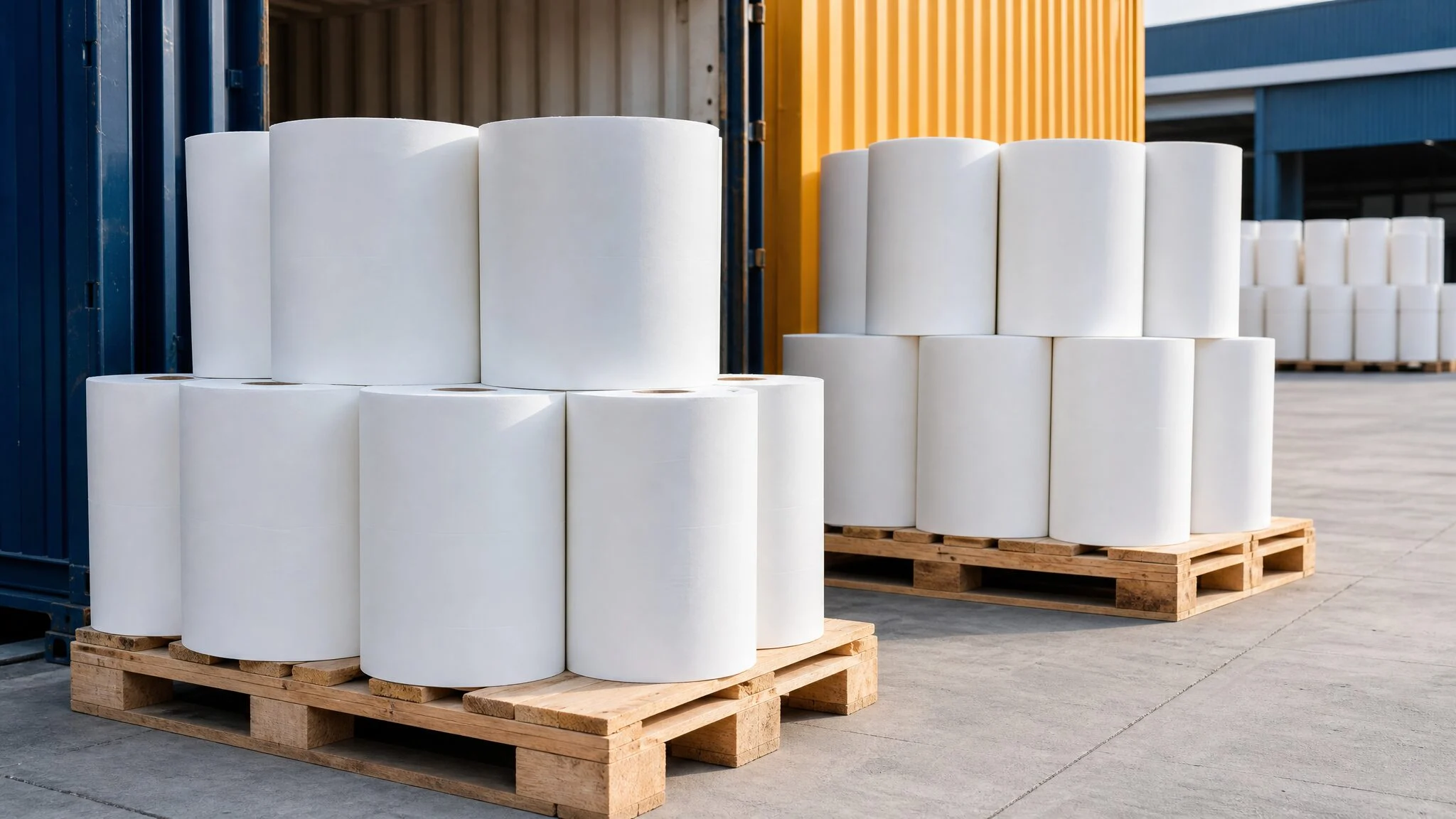
Carrier Tissue Paper HSN Code & Import Guide for India
Carrier tissue paper used to wrap the SAP core in sanitary napkins and diapers falls under HS Chapter 48 (paper and paperboard), within the tissue-stock headings for toilet, facial, towel and napkin stock. The exact 8-digit HSN code and GST rate vary by declaration — confirm with your customs broker or the current CBIC tariff schedule before filing. Need a compliance-ready quote? Request a sample and quotation.
perforated nonwoven — skin contact
acquisition & distribution layer
13–15 GSM
SAP + fluff pulp
13–15 GSM
PE film — leak barrier
Carrier tissue wraps the SAP core on both faces — it holds the core together during high-speed converting and blocks SAP granules from pinholing through to the topsheet or backsheet.
Which HSN chapter covers carrier tissue paper?
Carrier tissue is a lightweight, 100% virgin wood pulp tissue engineered for wet and dry strength, used as a wrap layer around the SAP core in sanitary napkins and diapers. Because it is paper-based, not a nonwoven or textile, Indian customs classifies it under HS Chapter 48 — Paper and paperboard, not Chapter 56, where spunbond or SMS nonwoven fabrics fall. Within Chapter 48, tissue-grade base papers for hygiene manufacturing are generally grouped with toilet or facial tissue stock and similar sanitary papers.
The precise 8-digit code depends on how a shipment is declared — jumbo reel stock versus converted tissue — and on the pulp composition and GSM range on the invoice. Favourite Fab does not publish one fixed HSN code, since classification is a legal determination made at filing, not a universal number for every variant. Verify the exact code and current GST rate with a licensed customs house agent (CHA) or the CBIC tariff notification before placing a purchase order, as rates on paper products have been revised in past Council meetings.
Why the HSN code matters for GST input credit and customs clearance
The HSN code on a carrier tissue invoice affects three things for manufacturers. GST input tax credit: a mismatched code between the supplier’s invoice and your GSTR-2B can flag the credit during reconciliation. Clearance speed: misclassification at the port can trigger re-assessment and shipment holds — costly for lines running just-in-time raw material delivery. Audit trail: manufacturers supplying institutional or export buyers are often asked to produce HSN-consistent purchase records. Insist on a supplier invoice that states the HSN code explicitly and matches the GST rate charged, not a generic “tissue paper” line with no code.
Import and customs considerations for bulk buyers
Carrier tissue for Indian sanitary napkin manufacturing is largely imported, since domestic tissue-grade base paper at 13–15 GSM wet-strength specification is a specialised, low-volume category. Practical points for bulk carrier tissue import into India:
- Bill of entry should list HSN code, GSM, pulp composition, and declared end-use to support correct classification.
- IGST on import is charged at clearance alongside basic customs duty — confirm the applicable rate for the tariff line used.
- Country of origin / FTA status can affect basic customs duty separately from domestic GST.
- Quality documentation — GSM certificate, wet/dry tensile strength report, pulp composition — should travel with the shipment.
Manufacturers new to importing carrier tissue paper raw material often find it faster to buy from an established supplier with existing import documentation, rather than filing a first-time import themselves.
How Favourite Fab’s import and supply process works
Favourite Fab supplies carrier tissue paper as an imported raw material for sanitary napkin and diaper manufacturers — a supplier and importer of this product, not the mill producing the base tissue. The current imported specification is 13–15 GSM, at a minimum order quantity of 1,000 kg per order. Every consignment is quality-checked on arrival — GSM, wet strength, roll consistency verified — before repacking and dispatch. Buyers get import-cleared, HSN-documented, quality-verified carrier tissue without managing their own import filing, broker relationship, or container-load minimums.
For more on the raw material itself, or comparing it against Favourite Fab’s own SMS nonwoven core-wrap alternative, see the complete carrier tissue paper buying guide, what carrier tissue is and how GSM affects performance, and carrier tissue vs SMS nonwoven for core wrap.
Carrier tissue technical data — sanitary pad grade
| Property | Sanitary pad grade | Test method |
|---|---|---|
| Basis weight (GSM) | 13–15 g/m² | EDANA WSP 130.1 / ISO 9073-1 |
| Composition | 100% virgin wood pulp | Furnish declaration |
| Wet-strength treatment | Yes — wet-strength resin for hygiene-core duty | Wet tensile (MD), ISO 12625-5 |
| Tensile strength | MD/CD rated for high-speed unwind | EDANA WSP 110.4 / ISO 9073-3 |
| Function in pad | Core wrap — top & bottom face of SAP/fluff core | — |
| Primary job | Pinhole / strike-through resistance under SAP swell | — |
| Minimum order (MOQ) | 1000 kg | — |
| Sourcing | Imported & quality-verified by Favourite Fab | — |
Test-method references are the recognised EDANA/ISO standards for nonwoven and tissue basis weight, tensile, and wet tensile. Confirm exact per-lot values against your incoming-QC spec sheet — see the full quality checklist.
Matching the material spec to your customs declaration and import paperwork
The 13–15 GSM virgin wood pulp, wet-strength-treated specification is not just a performance detail — it is what drives correct customs classification. Basis weight, pulp furnish, and whether the tissue is wet-strength treated are exactly the attributes that separate one tissue-stock tariff line from another within HS Chapter 48, so the figures on your incoming-QC sheet should also appear on the bill of entry and product declaration. Bulk buyers should document the GSM range, 100% virgin wood pulp composition, wet-strength treatment, and declared end-use (hygiene core wrap) on the commercial invoice and packing list, keeping the mill’s test report as evidence for the classification claimed. For consignment sizing, the 1,000 kg MOQ is the practical planning unit — build order quantities as multiples of it against your line’s run rate and lead time so a consignment clears in economic lot sizes. Confirm the final tariff line and rate with your customs broker or the CBIC schedule before filing.
Pricing & MOQ
Carrier tissue paper is supplied at a minimum order quantity of 1,000 kg per order, priced on a wholesale, competitive basis depending on GSM, volume, and delivery terms. Per-kg quotes, including GST breakdown, are issued by the sales team once specification and quantity are confirmed. Request a sample and quotation.
FAQs
- What is the HSN code for carrier tissue paper?
- Carrier tissue paper falls under HS Chapter 48, within tissue-stock headings for toilet, facial, towel, and napkin base papers. The exact 8-digit code depends on the product declaration — confirm with a customs broker or the current CBIC tariff schedule before import filing.
- Is carrier tissue paper classified as a nonwoven fabric for customs purposes?
- No. Carrier tissue is a pulp-based paper product, classified under Chapter 48 (paper), not Chapter 56, which covers nonwoven fabrics such as spunbond or SMS nonwoven.
- What GST rate applies to carrier tissue paper in India?
- GST rates on paper-based tissue products have been revised in past GST Council notifications, so verify the current rate against the live CBIC/GST portal schedule for the specific HSN code on your invoice.
- Why does the HSN code matter if I buy in bulk rather than import myself?
- The HSN code on your purchase invoice affects your GST input tax credit claim even when buying domestically. A mismatched or missing code can delay ITC reconciliation during a GST audit.
- What is the minimum order quantity for carrier tissue paper from Favourite Fab?
- The minimum order quantity is 1,000 kg per order, for imported carrier tissue paper in the 13–15 GSM specification.
- Does Favourite Fab manufacture carrier tissue paper in India?
- No. Favourite Fab sources carrier tissue paper as an imported raw material and supplies it quality-checked to Indian manufacturers. Favourite Fab does manufacture other core-wrap alternatives, such as SMS nonwoven fabric, in-house.
- What documentation should I request when buying bulk carrier tissue paper?
- Ask your supplier for the HSN code stated on the invoice, GSM certificate, wet/dry tensile strength test report, and pulp composition declaration — this supports both GST input credit and incoming quality checks.
For supplier vetting criteria beyond import compliance, see Top Carrier Tissue Paper Manufacturers & Suppliers in India.

Gaurav Garg
I'm Gaurav Garg, CEO of Favourite Fab, a company on a mission to revolutionize the nonwoven industry with sustainable practices. We work hand-in-hand with manufacturers and suppliers who share our commitment to eco-friendly production. With a deep interest in textile innovation, I'm passionate about educating consumers about sustainable material options and their potential to transform the nonwoven landscape.


