

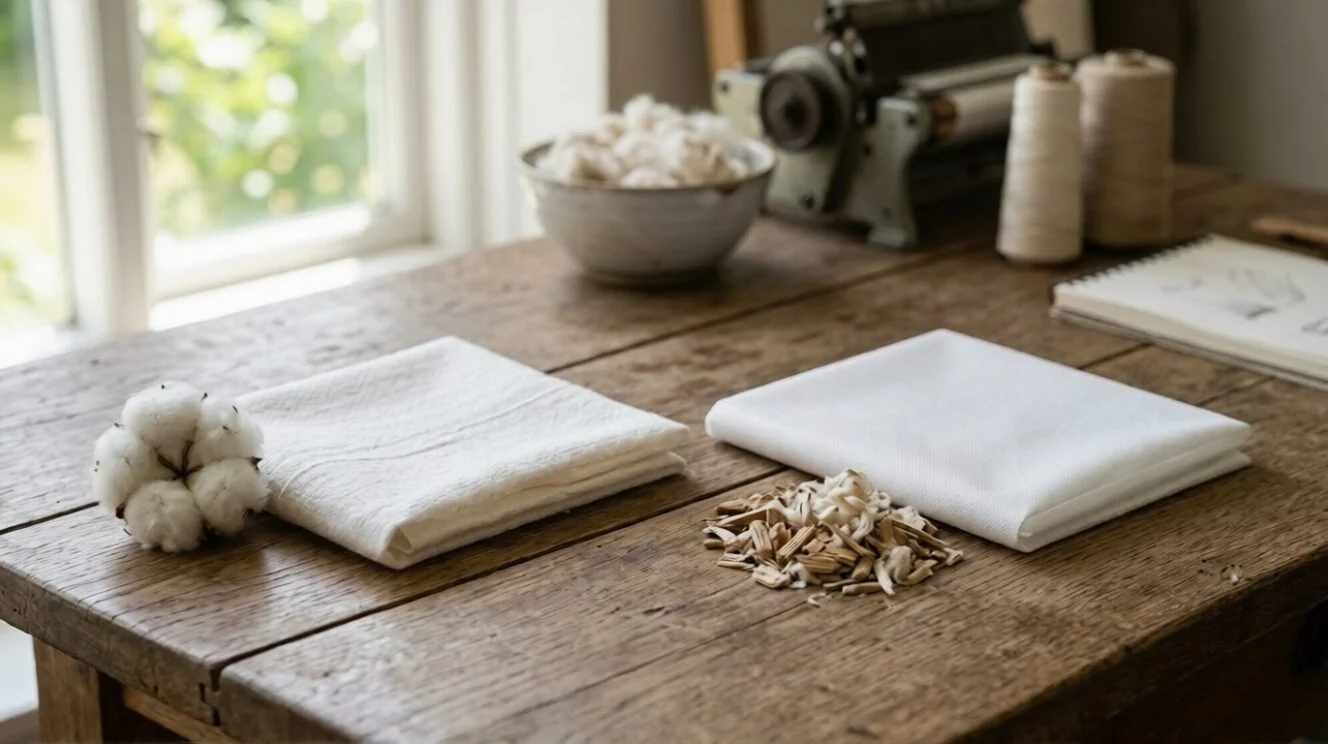
Cotton vs Viscose Spunlace Nonwoven — Natural Fibres Compared
Both cotton and viscose spunlace are natural-origin fibres offering biodegradability and softness — but they differ significantly in fibre origin, consumer perception, certification path, and cost. This comparison helps hygiene and cosmetic OEMs choose the right natural fibre for their product positioning.
Browse our full range: View all nonwoven fabric products — spunlace, spunbond, SMS, bico — with GSM, width and certification options. B2B MOQ from 500 kg.
Comparison Table
| Property | Cotton Spunlace | Viscose Spunlace |
|---|---|---|
| Fibre origin | Natural cotton plant | Wood pulp (regenerated cellulose) |
| Consumer perception | “Natural cotton” — strong brand appeal | “Soft/gentle” — less explicit natural claim |
| Certification | GOTS (organic cotton) | OEKO-TEX Standard 100 |
| Softness | Cotton-feel (distinct texture) | Silky smooth |
| Absorbency | 600–900% | 1,000–1,400% |
| Biodegradability | Yes | Yes |
| Cost | 30–50% premium over viscose | Benchmark |
| Best for | Premium/organic cosmetic pads, natural wipes | General hygiene, medical, premium wipes |
FAQ
Which is softer — cotton or viscose spunlace?
Both are soft, but differently. Viscose is silkier and smoother. Cotton has a distinct natural-cotton texture — more like cotton wool. Consumer preference varies by category: cosmetic pads often prefer cotton texture; wipes prefer viscose smoothness.
Which certification do cotton and viscose spunlace carry?
Cotton: GOTS (Global Organic Textile Standard) for organic cotton grades. Viscose: OEKO-TEX Standard 100 for skin-safe certification. Both certifications respected by EU/US premium brands. GOTS commands higher market premium.
When does the cotton price premium justify the choice?
When the product makes a “cotton” or “organic cotton” front-of-pack claim — justifying retail price premium of 20–40% over viscose-topsheet alternatives. For backend/non-visible layers, viscose delivers equivalent performance at lower cost.
Full range: spunlace nonwoven fabric. Related: cotton spunlace nonwoven fabric.
B2B Applications & End-Uses
The selection between cotton and viscose as the primary cellulosic fibre in a spunlace nonwoven substrate is a specification decision that affects product cost, certification eligibility, end-use performance, and supply chain positioning simultaneously. For B2B procurement engineers and product development teams, understanding the practical trade-offs between cotton spunlace and viscose spunlace — beyond the simplistic “cotton is natural, viscose is synthetic” framing — is essential for writing specifications that align substrate performance with finished product requirements and market positioning strategy.
Cotton spunlace nonwoven is the substrate of choice for premium personal care, dermatological, and organic hygiene product OEMs. The natural cellulosic origin of cotton fibre enables GOTS (Global Organic Textile Standard) certification for products using certified organic cotton, providing a recognised third-party certification that brand owners can use to support “organic” and “natural” product claims in regulated markets. Cosmetic OEMs, pharmaceutical-grade wipe producers, and feminine hygiene brand owners targeting health-conscious consumer segments in the EU, US, and Japan markets specify cotton spunlace specifically to access GOTS certification and the retail positioning premium it supports. The softness of cotton fibre — measured as lower surface friction values versus viscose of equivalent denier — is a secondary but commercially relevant attribute for facial care and intimate hygiene applications where dermatologist-tested softness claims are part of the product’s market positioning.
Viscose spunlace is the dominant substrate for high-volume, cost-sensitive wipe and hygiene applications — household wipes, standard wet wipes, feminine hygiene wipe bases, and AHP topsheets — where the cost efficiency of the fibre relative to cotton determines product economics at commercial converting volumes. Viscose is produced from wood pulp cellulose and is fully biodegradable, but it is not a natural fibre in the GOTS sense — it is a manufactured cellulosic. This distinction matters for buyers marketing biodegradability: viscose-based spunlace can claim biodegradability but cannot claim “natural” or “organic” origin without misleading consumers under EU and UK environmental claims regulations. OEM buyers whose marketing strategy relies on natural origin claims should specify cotton rather than viscose and confirm GOTS certification status with their fibre and fabric supplier.
Industrial cleaning, medical, and technical textile OEMs for whom neither GOTS certification nor soft-touch consumer perception is a purchase criterion typically default to viscose over cotton for economic and supply chain reasons. Viscose is manufactured at scale in India and China with high fibre consistency, defined staple length, and predictable denier — characteristics that make it a stable input for high-speed spunlace production. Cotton fibre quality varies with crop year, origin, and ginning process, introducing supply chain variables that can affect the consistency of the spunlace production process and, consequently, of the finished nonwoven substrate. For industrial applications where performance consistency batch-to-batch is more critical than fibre origin, viscose’s manufactured consistency is an advantage over crop-dependent cotton.
Certifications & Quality Assurance
Favourite Fab’s quality assurance framework for cotton versus viscose spunlace reflects the different certification pathways and performance validation requirements of each fibre type. For cotton spunlace grades qualifying for GOTS certification, the certification chain requires that the cotton fibre input carries organic certification from an accredited certification body, and that the manufacturing process at Favourite Fab’s facility is audited and certified under GOTS scope 2 (manufacturing). Buyers requiring GOTS-certified cotton spunlace should engage Favourite Fab’s quality team early in the qualification process to confirm current GOTS scope and available certified grades.
OEKO-TEX Standard 100 certification is available for both cotton and viscose spunlace grades. However, the testing requirements differ between cotton and viscose in the context of pesticide residue assessment: cotton is an agricultural crop subject to pesticide application, so OEKO-TEX testing for cotton grades includes a broader range of pesticide analytes than viscose grades, where pesticide residue is not a primary concern. OEM buyers supplying wipe products into EU markets where the EU Toy Directive or Cosmetics Regulation requires substantiated absence of prohibited substances should ensure they understand which OEKO-TEX product class applies to their application and that the certification covers the relevant analyte list.
Mechanical performance testing for cotton versus viscose grades follows identical EDANA ERT methods, but the target specification values differ between the two fibre types at equivalent basis weight and blend ratio. Cotton spunlace at 80/20 cotton/PET typically exhibits higher elongation at break compared to equivalent viscose/PET blends, while tensile strength values may be marginally lower due to the shorter staple length distribution in cotton versus standard textile-grade viscose. Favourite Fab provides full tensile, elongation, and absorbency data for both fibre types at the grades offered, and buyers substituting between cotton and viscose at the same basis weight and blend ratio should validate the mechanical and absorbency performance of the alternate fibre type in their converting process before making a commercial transition.
More Questions Answered
Is viscose spunlace genuinely biodegradable, and can it be marketed as a plastic-free substrate?
Yes. Viscose spunlace without synthetic PET content — produced as 100% viscose or as a viscose/cotton blend — meets the criteria for biodegradability under standard test methods including ISO 14851/14852 (aerobic aquatic) and EN 13432 (industrial composting). Viscose, as a regenerated cellulosic fibre, breaks down via the same biological pathways as natural cellulose fibres — it does not persist in the environment as synthetic polymers do. For OEM buyers making “plastic-free” or “no synthetic fibres” claims, 100% viscose or viscose/cotton spunlace qualifies, subject to confirming that no synthetic binder, coating, or finishing agent containing plastic-derived polymers is applied during manufacturing. Blended viscose/PET grades contain synthetic PET polymer and cannot be claimed as plastic-free. Favourite Fab’s technical team can provide fibre composition confirmation and finishing chemistry data to support buyers’ environmental claims compliance review under the EU Green Claims Directive and UK Green Claims Code, both of which require substantiated evidence for environmental marketing claims.
What is the price differential between cotton and viscose spunlace at equivalent specifications, and how does it affect OEM product economics?
Cotton spunlace commands a meaningful premium over viscose spunlace at equivalent basis weight and blend ratio, driven by the higher raw material cost of cotton fibre relative to viscose staple in the Indian nonwoven market. The premium varies with cotton market prices, which are subject to global commodity cycles, and with GOTS certification status — GOTS-certified organic cotton fibre carries an additional premium over conventional cotton. For OEM buyers calculating product cost structures, the cotton premium needs to be evaluated against the retail price premium achievable from GOTS certification and natural-origin positioning, the softness improvement that supports higher consumer satisfaction scores in sensory testing, and the differentiation value in product ranges where cotton spunlace is marketed alongside a standard viscose SKU. For high-volume industrial or commodity wipe applications where no premium positioning is involved, viscose at competitive wholesale pricing consistently delivers better product economics. Favourite Fab’s commercial team provides indicative pricing for both fibre types in the context of the buyer’s target specification and volume to support the specification decision with actual cost data.
📋 Related: Spunlace Nonwoven Fabric — Full Range & Specs | All Nonwoven Products from Favourite Fab

Gaurav Garg
I'm Gaurav Garg, CEO of Favourite Fab, a company on a mission to revolutionize the nonwoven industry with sustainable practices. We work hand-in-hand with manufacturers and suppliers who share our commitment to eco-friendly production. With a deep interest in textile innovation, I'm passionate about educating consumers about sustainable material options and their potential to transform the nonwoven landscape.


