

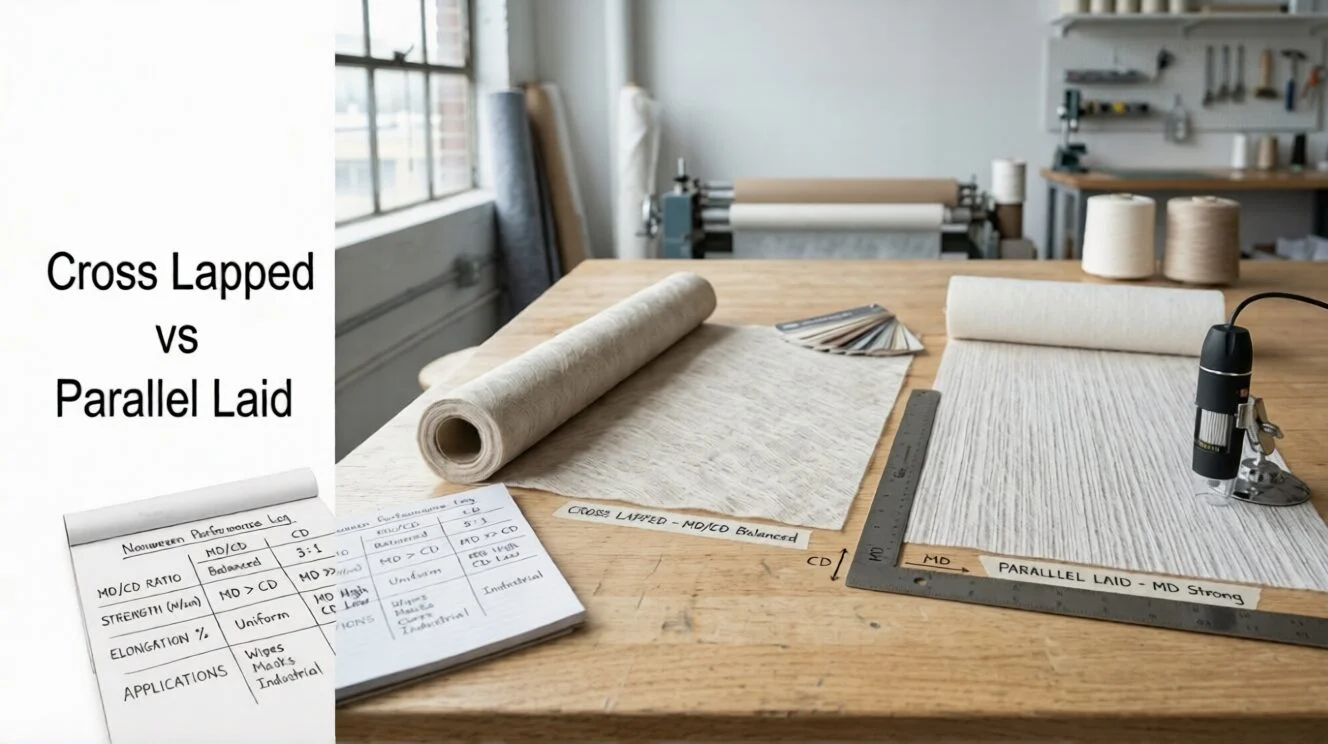
Cross Lapped vs Parallel Laid Spunlace — MD/CD Ratio & Performance Guide
The web formation method determines the tensile strength balance of spunlace nonwoven. Parallel-laid (carded) spunlace has most fibres oriented in the machine direction — stronger MD than CD. Cross-lapped spunlace uses alternating web layers at opposing angles — balancing MD and CD strength. Understanding this difference helps buyers specify the right fabric for their converting process and end application.
Browse our full range: View all nonwoven fabric products — spunlace, spunbond, SMS, bico — with GSM, width and certification options. B2B MOQ from 500 kg.
Comparison Table
| Property | Parallel Laid | Cross Lapped |
|---|---|---|
| MD/CD ratio | 2:1 to 4:1 | 1.0:1 to 1.5:1 |
| Isotropy | Anisotropic (directional) | Near-isotropic |
| Machine speed | Higher output | Lower output (more complex) |
| Cost | Lower | 10–20% higher |
| Die-cut stability | Directional tear risk | Uniform in all directions |
| Best use | Roll-to-roll wipes | Die-cut pads, shaped products |
When to Use Parallel Laid
Wet wipes, hygiene topsheets, and any product that runs roll-to-roll through converting equipment. The higher MD strength handles machine-direction tension during wetting, folding, and dispensing. CD strength still sufficient for wiping action. Most cost-effective.
When to Use Cross Lapped
Die-cut round cosmetic pads, medical drapes stressed in multiple directions, shaped wipes, and products where tearing in the CD is a failure mode. Cross-lapped provides consistent performance regardless of orientation.
FAQ
Does cross-lapped spunlace cost more?
Yes — 10–20% premium over parallel-laid at equivalent GSM/fibre blend. Cross-lapping adds web formation complexity and reduces line speed. For applications requiring near-isotropic strength, the performance benefit justifies the premium.
Can I specify MD/CD ratio when ordering from Favourite Fab?
Yes. Standard stock is parallel-laid. Cross-lapped available with 1,000 kg minimum order. Specify required MD/CD ratio (e.g., ≤1.5:1) and we confirm achievable specification for your GSM/blend combination.
Full range: spunlace nonwoven fabric. Related: MD CD ratio spunlace nonwoven fabric.
B2B Applications & End-Uses
The choice between cross-lapped and parallel-laid spunlace nonwoven construction is a specification decision with direct, measurable consequences for converting performance, finished product mechanical properties, and end-use suitability. Understanding this distinction allows procurement engineers, converting managers, and product development teams to write precise substrate specifications rather than leaving the construction type undefined — an omission that can result in receiving a substrate that underperforms in a specific converting or end-use context even if it meets the stated basis weight and blend requirements.
Cross-lapped spunlace construction is the preferred choice for wipe OEMs and converting operations where isotropic tensile performance is a functional requirement. In cross-lapping, the carded web is laid at alternating angles across the conveyor before hydroentanglement, resulting in fibre orientation distributed more evenly across the machine direction (MD) and cross direction (CD). This produces an MD/CD tensile ratio typically in the 1.5:1 range, versus 3:1 or higher in parallel-laid constructions. For baby wipe, facial wipe, and personal care wipe applications where the wipe is pulled, stretched, and manipulated in unpredictable directions during use, the more isotropic tensile distribution of cross-lapped construction ensures the wipe performs consistently regardless of the direction of mechanical stress applied during use.
Parallel-laid spunlace is the preferred choice for high-speed converting operations where machine-direction web runnability is prioritised and the end-use application does not require isotropic tensile behaviour. Parallel-laid construction aligns the majority of fibres in the machine direction, producing high MD tensile values at lower basis weights and enabling higher converting line speeds with fewer web breaks. Industrial wipe converters running pre-saturated formats on continuous saturator-folder-pack lines often specify parallel-laid grades specifically because the MD-dominant fibre orientation provides the web stiffness and tensile reserve needed to survive the tension transitions in their converting process. The higher MD/CD ratio — potentially 4:1 or greater — is acceptable in a wiping application where the wipe is primarily used with linear strokes in a single direction.
Technical textile OEMs, filtration media manufacturers, and nonwoven laminate producers use the MD/CD ratio as an input to their product design calculations. A parallel-laid substrate used as a reinforcement layer in a laminate structure can be oriented to place maximum tensile strength in the direction of the primary load path — a design option that cross-lapped isotropic construction does not offer with the same degree of directionality. Buyers integrating spunlace into multi-layer composite structures should specify the construction type as part of the substrate specification rather than accepting whichever construction type the supplier runs at standard, as substituting one construction for another mid-supply-relationship can materially alter the composite’s mechanical properties.
Certifications & Quality Assurance
Favourite Fab characterises both cross-lapped and parallel-laid grades with full directional tensile data, reporting MD and CD values separately on every batch COA. This is not standard practice across all nonwoven suppliers, who may report only MD tensile as the headline specification — but for buyers making a specification decision based on MD/CD ratio, having both values as batch-level data is essential. Tensile testing is conducted per EDANA ERT 20.2 with a 5 cm gauge width and 20 cm/min crosshead speed, with both dry and wet condition values reported for grades intended for wet wipe saturation.
The ISO 9001:2015 quality management system at Favourite Fab covers both production processes, with separate manufacturing instructions for cross-lapped and parallel-laid grades that specify the lapper settings, web overlap angle, and hydroentanglement configuration for each construction type. Cross-lapped production requires additional process monitoring at the lapper to maintain consistent web angle across the roll width — variation in lap angle produces localised variation in MD/CD ratio that can cause converting problems for buyers with tight directional tensile specifications. In-process tensile sampling at multiple across-width positions is conducted for cross-lapped grades to verify uniformity before the roll is released to winding.
For buyers conducting their own converting qualification on cross-lapped versus parallel-laid grades, Favourite Fab recommends requesting matched samples at the same basis weight and blend ratio — one of each construction type — to allow direct comparison in the same converting trial. This eliminates the confounding variable of basis weight or blend differences and isolates the construction type effect on converting performance and finished product properties. Matched sample requests can be fulfilled within the standard sample lead time for most standard grades.
More Questions Answered
Can cross-lapped spunlace be specified with a target MD/CD tensile ratio rather than just a minimum MD value?
Yes, and Favourite Fab’s technical team actively encourages buyers who require controlled anisotropy to specify an MD/CD ratio range rather than a minimum MD value alone. Specifying only MD tensile minimum does not constrain the CD value — a parallel-laid grade could in principle meet an MD minimum while having a CD value far below what the buyer’s converting process or end-use application requires. For cross-lapped grades, Favourite Fab can qualify a production process targeting a specific MD/CD range — for example 1.3:1 to 1.7:1 for near-isotropic applications — and include the MD/CD ratio as a release criterion on the batch COA. This specification approach requires a formal product qualification run to establish process capability at the target ratio, which the technical team can schedule as part of the initial supplier qualification process.
Does the choice of cross-lapped versus parallel-laid construction affect absorbency performance at the same basis weight and blend?
Yes, though the effect is secondary to basis weight and blend ratio in determining absorbent capacity. Cross-lapped construction, with its more random and isotropic fibre orientation, typically produces a slightly more open and lofty fabric structure at the same basis weight compared to parallel-laid, resulting in marginally higher absorbent capacity and slightly faster liquid strike-through due to the more tortuous but better-distributed pore network. Parallel-laid construction tends toward a more planar, denser structure that can slow strike-through rate in some applications. For most wipe applications, the difference in absorbency between cross-lapped and parallel-laid at the same GSM and blend is smaller than the difference produced by changing blend ratio by 10–15% — buyers optimising for absorbency should focus primarily on blend composition before construction type. For applications where absorbency is a critical differentiator, Favourite Fab can provide comparative absorbency data for both construction types at the same specification to support the decision quantitatively.
📋 Related: Spunlace Nonwoven Fabric — Full Range & Specs | All Nonwoven Products from Favourite Fab

Gaurav Garg
I'm Gaurav Garg, CEO of Favourite Fab, a company on a mission to revolutionize the nonwoven industry with sustainable practices. We work hand-in-hand with manufacturers and suppliers who share our commitment to eco-friendly production. With a deep interest in textile innovation, I'm passionate about educating consumers about sustainable material options and their potential to transform the nonwoven landscape.


