

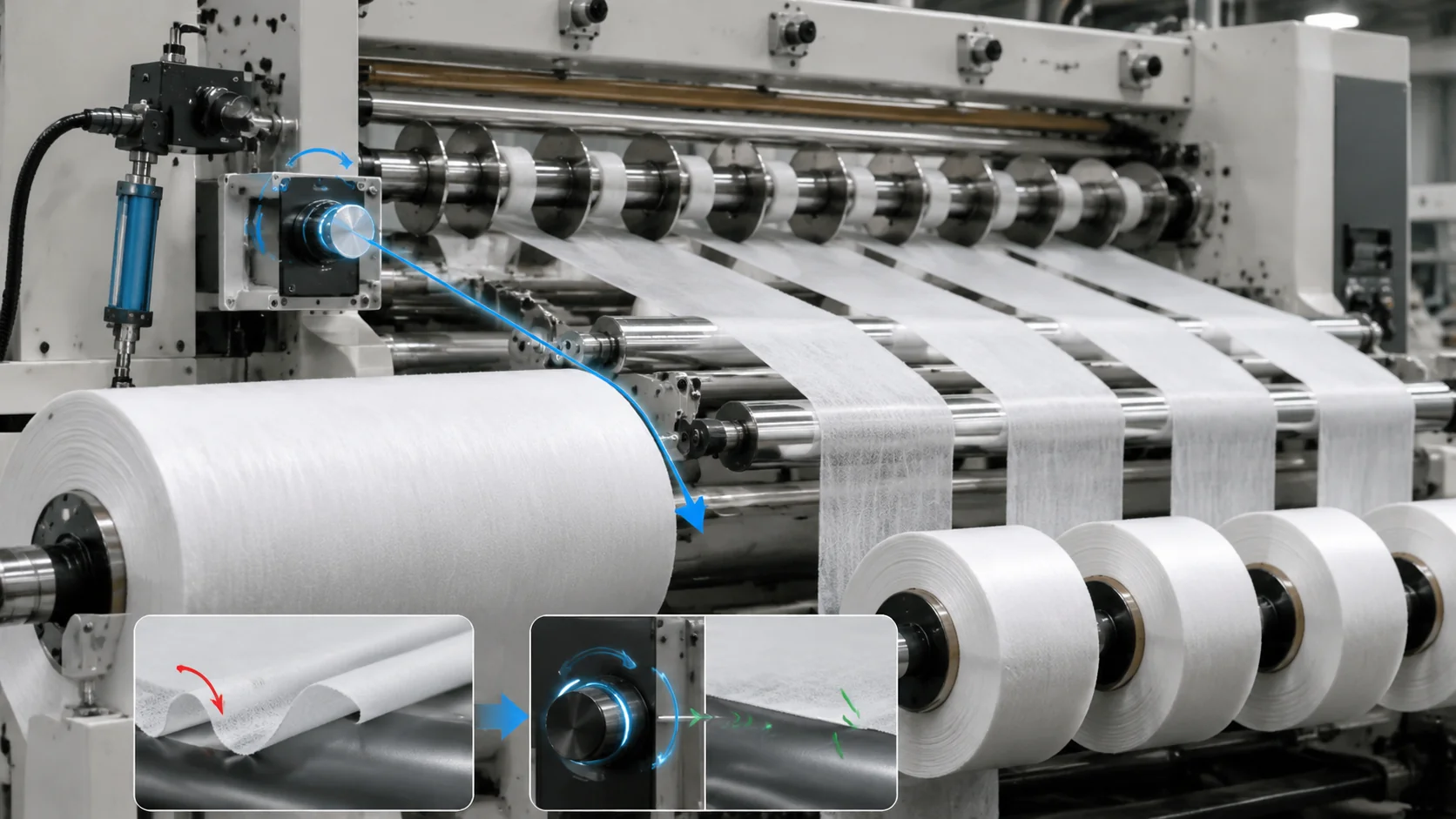
Fix Fabric Curling During Slitting of Nonwoven Roll — Tension and Edge Curl Solutions
Fabric curling during slitting is a production defect that causes roll waste, misaligned converting, and downstream machine stoppages. When nonwoven rolls curl at the edge after the slitter, the root cause is almost always residual stress in the fabric — built in during manufacturing through uneven tension, incorrect winding, or wrong fibre orientation. Favourite Fab supplies spunbond nonwoven fabric with controlled internal stress profiles that eliminate curling at the slitting stage. This guide identifies the tension zones where curl originates and specifies the fabric parameters that resolve each failure mode.
Favourite Fab is a B2B raw material supplier in Agra, India. We supply the spunbond nonwoven rolls that go through your slitter — we do not manufacture the slitting machines. Our spunbond nonwoven fabric range covers medical, hygiene, and industrial applications with controlled MD/CD ratio and winding tension profiles. See our full range at nonwoven fabric supplier India.
Understanding the Problem: Why Nonwoven Fabric Curls During Slitting
Curling in nonwoven rolls originates from imbalanced residual stress between the machine direction (MD) and cross direction (CD) of the fabric. During spunbond manufacturing, fibres are laid down under tension. If the MD tension during production or winding is significantly higher than the CD tension, the fabric has a structural preference to curl in one direction. When the slitter cuts the roll into narrower widths, this stress is released at the cut edge — and the strip curls.
Three tension zones control curl behaviour: the unwind zone, the slitting zone, and the rewind zone. Excess tension at unwind stretches the fabric and locks in additional MD stress. Uneven tension across the web width at the slitter creates differential curl between the left and right edges of each slit strip. Incorrect rewind tension locks curl into the finished slit roll — and the operator sees it immediately when the roll is placed on the downstream converting machine.
Machine settings matter — but if the same machine slit other fabric grades without curling, the problem is in the material specification. Specifically: MD/CD tensile ratio above 2.5:1, uneven basis weight distribution across the roll width, or incorrect winding tension profile are all material-side causes that machine adjustment cannot fully compensate.
Root Causes and Diagnostic Checklist
- High MD/CD tensile ratio: Is your fabric’s MD tensile more than 2.5× the CD tensile? This indicates strong fibre orientation bias — the primary driver of edge curl after slitting.
- Uneven GSM across roll width: Does your fabric have GSM variation above ±5% between the centre and edges of the roll? Heavier edges have different stiffness and curl differently under the same tension.
- Excessive winding tension on the parent roll: Was the original roll wound too tightly? Overly wound rolls release tension when slit — the inner layers spring back and curl the strip edges.
- Incorrect slitter unwind brake tension: Is your brake tension set too high? This stretches the web in MD and increases stress differential at the cut edge.
- Differential rewind tension between left and right lanes: Are all slit lanes winding at the same tension? Uneven rewind locks differential curl into the finished slit rolls.
- High basis weight fabric on a low-tension slitter: Heavier GSM fabrics (50+ GSM) need higher tension than lighter grades. Is your slitter calibrated for the current GSM?
- Fibre type mismatch: Some fibre types (e.g. bicomponent) have higher natural crimp and springback — does your fabric specification include fibre orientation data?
Material-Side Fixes — Specifications That Resolve the Issue
| Root Cause | Correct Specification | Why It Fixes the Problem |
|---|---|---|
| MD/CD tensile ratio too high — strong fibre orientation bias | Specify MD/CD ratio ≤2.0:1 on material test certificate | Balanced fibre orientation means equal stress in both directions — no preferential curl direction after slitting |
| GSM non-uniformity across roll width — edge/centre stiffness differential | Specify GSM CV% ≤3% across full roll width | Uniform basis weight gives uniform stiffness — all slit strips behave identically under the same tension |
| Parent roll over-wound — stored tension released at slit edge | Specify maximum winding tension on purchase order; confirm with roll hardness measurement | Correctly wound rolls have minimal stored elastic energy — no springback at slit edge |
| High residual stress from manufacturing over-draw | Request heat-set or relaxed fabric grade for curl-sensitive applications | Heat-setting relieves residual fibre stress — fabric is dimensionally stable when slit |
| Wrong elongation at break — fabric too elastic for slitting | Specify elongation at break 30–60% MD; avoid high-elongation grades for precision slitting | Lower elongation means less elastic springback when tension is released at the slitter |
| High crimp bicomponent fibre — springback after cutting | Use low-crimp spunbond (not BiCo) for applications requiring tight curl control | Low-crimp straight fibres have less stored elastic energy — slit edge remains flat |
| Surface finish creating differential friction on slitter table | Specify uniform finish application across roll width; avoid heavy-face / light-back finish profiles | Uniform friction coefficient means the web tracks straight through the slitter — no lateral curl bias |
How Favourite Fab Supplies the Right Grade
Favourite Fab manufactures spunbond nonwoven fabric with controlled fibre orientation and winding tension profiles. We test MD/CD tensile ratio, GSM uniformity, and elongation on every production batch. Our application engineers can advise on the optimal specification for your slitter type and slit width. For ultrasonic bonding applications that also suffer from curl, see our guide on fixing ultrasonic sealing issues with BiCo nonwoven.
- Grade-specific MD/CD ratio and GSM uniformity certificates available on request
- Sample dispatch within 48 hours for trial runs on your slitter
- Technical support from application engineers with converting line experience
- Custom GSM / width / winding tension profile to match your slitter specifications
- ISO certified — batch-to-batch consistency guaranteed
Pricing and MOQ
Favourite Fab offers competitive wholesale pricing for spunbond nonwoven fabric in curl-controlled grades. Pricing depends on GSM, fibre type, roll width, and order volume. MOQ is typically 500 kg per grade. Contact our sales team with your slitter specifications, current fabric grade, slit width, and monthly consumption for a tailored quotation. We do not publish fixed price lists — actual quotes are issued by our sales engineers after reviewing your technical requirements.
How to Order
- Send your current fabric spec (GSM, fibre type, MD/CD ratio if known), slitter model, and slit width to sale@favouritehub.com
- Receive recommended spunbond grade + MD/CD ratio data + sample within 48 hours
- Run a slitting trial on your machine — check edge curl at unwind, mid-web, and rewind
- Confirm production order with agreed GSM, MD/CD ratio, and winding tension specification
Frequently Asked Questions
Q: What MD/CD tensile ratio is acceptable for precision slitting of nonwoven rolls?
A: For precision slitting applications, MD/CD tensile ratio of 1.5:1 to 2.0:1 is the recommended range. Ratios above 2.5:1 significantly increase the risk of edge curl after slitting. Favourite Fab tests and certifies MD/CD ratio on every production lot — request this data when ordering for slitting applications.
Q: Can we fix fabric curling by adjusting our slitter tension settings without changing the fabric grade?
A: Partial improvement is possible through slitter tension balancing — specifically reducing unwind brake tension and ensuring uniform rewind tension across all lanes. However, if the root cause is a high MD/CD ratio or over-wound parent roll, machine adjustment cannot fully eliminate curl. Material specification change gives a permanent fix.
Q: Does fabric GSM affect how much curl occurs during slitting?
A: Yes. Higher GSM fabrics are stiffer and have more stored elastic energy per unit area. They produce more pronounced curl when slit with the same residual stress level as a lighter fabric. For heavy GSM applications (50+ GSM), tighter MD/CD ratio control is especially important. Contact Favourite Fab to specify the correct grade for your GSM range.
Q: We are slitting nonwoven for surgical gown manufacturing — what additional specifications apply?
A: For medical-grade spunbond used in surgical gowns, low particle shedding and dimensional stability after sterilisation are additional requirements beyond curl control. Favourite Fab’s spunbond for surgical gowns is certified for medical applications. We can provide both the curl control specification and the medical compliance documentation simultaneously.
Q: Is fabric curling during slitting the same problem as edge curling in a bag or pouch after sealing?
A: No — these are related but distinct issues. Slitting curl comes from residual stress in the fabric roll structure released at the cut edge. Sealing curl comes from thermal shrinkage or stress asymmetry introduced during the sealing process itself. For sealing-related curl, see our guide on fixing ultrasonic sealing issues with BiCo nonwoven.
Q: Can Favourite Fab supply pre-slit rolls to eliminate the slitting step on our line?
A: Yes. Favourite Fab can supply rolls pre-slit to your required width. Pre-slit rolls are wound on individual cores at controlled tension profiles. This eliminates the in-house slitting step and the associated curl risk. Specify your required width, core diameter, and maximum roll OD when requesting a quote.
Contact Favourite Fab
Favourite Fab — B2B spunbond nonwoven fabric supplier with controlled MD/CD ratio and winding tension profiles, Agra, India.
Email: sale@favouritehub.com
WhatsApp: +91-8800775462
Send your slitter specifications and current fabric grade today — our team responds within 4 hours and dispatches a trial sample within 48 hours.
Also see: tensile strength testing for nonwoven fabric and full nonwoven fabric range.

Gaurav Garg
I'm Gaurav Garg, CEO of Favourite Fab, a company on a mission to revolutionize the nonwoven industry with sustainable practices. We work hand-in-hand with manufacturers and suppliers who share our commitment to eco-friendly production. With a deep interest in textile innovation, I'm passionate about educating consumers about sustainable material options and their potential to transform the nonwoven landscape.


