

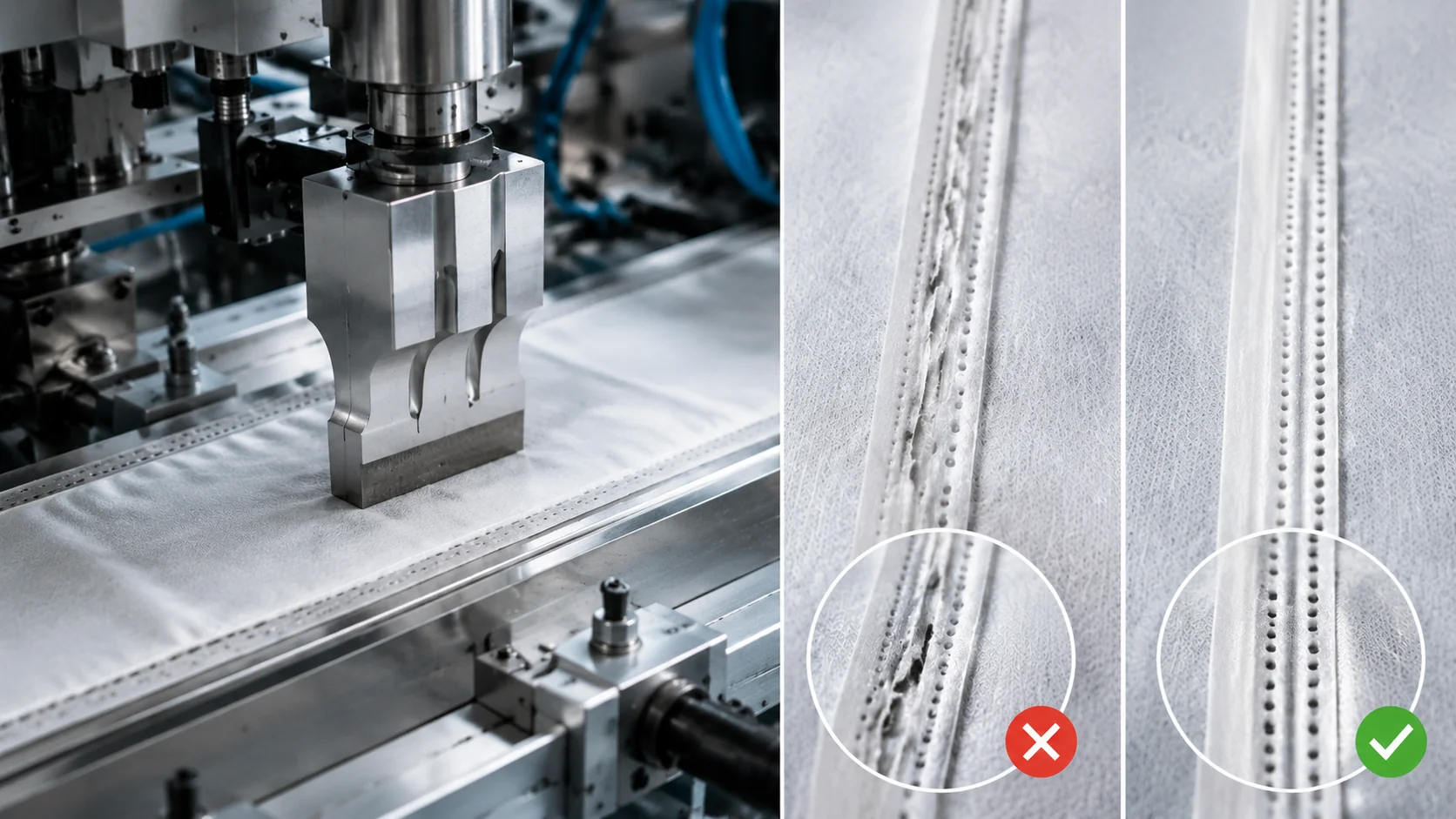
Fix Ultrasonic Sealing Issues with BiCo Nonwoven on Pouch Machines
Ultrasonic sealing failures on pouch machines often trace back to the wrong bicomponent nonwoven fabric grade. When your sheath melt temperature, horn pressure, or fabric GSM do not match, seals split, delaminate, or burn through. Favourite Fab supplies PE/PP BiCo spunbond nonwoven in precise grades that eliminate these sealing failures at the material level. This guide helps you diagnose the root cause and select the correct specification.
Favourite Fab is a B2B raw material supplier based in Agra, India. We do not manufacture pouches — we supply the bicomponent nonwoven fabric that goes into your production line. Our bicomponent nonwoven fabric range is engineered for ultrasonic bonding applications. Each grade ships with test certificates confirming sheath melt point, bond strength, and GSM tolerance.
Understanding the Problem: Why Ultrasonic Sealing Fails on BiCo Nonwoven
Ultrasonic sealing works by converting high-frequency mechanical vibration into localised heat at the fabric interface. The PE sheath in BiCo nonwoven melts and fuses under the horn. The PP core stays solid and provides dimensional stability. When either component deviates from specification, the seal fails.
Three material variables control seal quality: sheath melt temperature, horn pressure response, and fabric GSM. A sheath with too high a melt point needs excessive energy — the core starts to degrade before the sheath flows. A sheath with too low a melt point melts before the horn reaches full amplitude — you get a weak, inconsistent bond. GSM that is too low gives insufficient material at the seal zone. GSM that is too high requires more energy and longer dwell time than most machines allow.
Machine variables matter too — horn frequency, amplitude, and anvil design. But if your machine seals other materials cleanly, the problem is in the fabric specification. Systematic diagnosis saves weeks of machine tuning that cannot compensate for a wrong-grade fabric.
Root Causes and Diagnostic Checklist
- Sheath melt point mismatch: Is your fabric sheath PE grade matched to your machine’s ultrasonic frequency (20 kHz or 35 kHz)?
- Wrong sheath/core ratio: Standard BiCo is 50/50 PE/PP. High-bond applications need 60/40. Is your ratio confirmed on the test certificate?
- GSM out of range: Most ultrasonic pouch machines run optimally on 18–30 GSM BiCo. Are you outside this window?
- GSM non-uniformity: Is your fabric showing ±8% GSM variation? Non-uniform fabric causes alternating over-bond and under-bond.
- Hydrophilic finish interference: Some hydrophilic finishes inhibit ultrasonic fusion. Is the finish compatible with ultrasonic bonding?
- Crimp and loft mismatch: Bicomponent fibres with high crimp require longer dwell times. Is your dwell time calibrated for the specific crimp level?
- Horn pressure calibration: If fabric grade is correct but pressure is inconsistent, check anvil wear — but confirm the fabric grade first.
Material-Side Fixes — Specifications That Resolve the Issue
| Root Cause | Correct Specification | Why It Fixes the Problem |
|---|---|---|
| Sheath melt point too high — seal chars core before sheath flows | PE sheath Tm 128–132°C (low-melt grade) | Sheath fuses at lower energy input; core stays intact; clean seal edge |
| Sheath melt point too low — bond forms before full horn amplitude | PE sheath Tm 134–138°C (standard grade) | Sheath remains solid until full amplitude; bond forms at designed energy |
| Insufficient material at seal zone — seal splits under peel | GSM 22–28 for standard pouches; 28–35 for heavy-duty | More material in seal zone increases bond area and peel resistance |
| GSM non-uniformity causing inconsistent bond width | GSM CV% ≤3% across roll width | Uniform fabric gives consistent energy absorption across the horn |
| Wrong sheath/core ratio for high-peel applications | 60/40 PE/PP instead of standard 50/50 | More PE sheath material available at interface; higher bond strength |
| Hydrophilic finish blocking ultrasonic fusion | Hydrophobic or finish-free BiCo for seal layers | No surfactant film at interface; sheath-to-sheath contact is direct |
| High crimp fibre requiring long dwell — machine speed limited | Low-crimp BiCo fibre (3.5–4.0 crimps/cm) | Less fibre entanglement; horn energy transmits directly to sheath surface |
How Favourite Fab Supplies the Right Grade
Favourite Fab manufactures PE/PP BiCo spunbond nonwoven fabric specifically for ultrasonic and thermal bonding applications. We supply multiple sheath melt-point grades and sheath/core ratios. Each shipment includes a material test certificate with confirmed GSM, tensile, elongation, and sheath melt point.
- Grade-specific testing certificates available on request
- Sample dispatch within 48 hours for trial runs
- Technical support from application engineers familiar with pouch machine requirements
- Custom GSM / width / finish to match your machine specifications
- ISO certified — batch-to-batch consistency guaranteed
Pricing and MOQ
Favourite Fab offers competitive wholesale pricing for BiCo spunbond nonwoven fabric. Pricing depends on GSM, sheath/core ratio, roll width, and order volume. MOQ is typically 500 kg per grade per order. Contact our sales team for a detailed quotation based on your machine specifications and monthly consumption. We do not publish fixed price lists — actual quotes come from our sales engineers after reviewing your technical requirements.
How to Order
- Send your machine specs (horn frequency, dwell time, current fabric grade in use) and problem description to sale@favouritehub.com
- Receive recommended BiCo grade + sample within 48 hours
- Run a sealed-pouch trial on your line — confirm peel strength and visual inspection
- Place your production order with confirmed GSM and melt-point grade
Frequently Asked Questions
Q: Can the same BiCo nonwoven grade work on both 20 kHz and 35 kHz ultrasonic machines?
A: Not always. Higher-frequency machines (35 kHz) deliver energy faster and need a slightly higher melt-point sheath to avoid over-bonding. We supply separate grades for each frequency range. Share your machine specification and we will recommend the correct grade.
Q: What GSM range works best for sanitary pouch ultrasonic sealing?
A: For standard sanitary pouch applications, 18–25 GSM BiCo spunbond gives reliable seals on most ultrasonic machines. Heavier-duty medical pouches typically use 25–35 GSM. The correct choice depends on your machine’s maximum energy output and target peel strength.
Q: How do I verify sheath melt point in my incoming material?
A: DSC (Differential Scanning Calorimetry) is the standard method. Favourite Fab provides DSC data on every material test certificate. You can also request a sample and have it tested at your own lab before placing a production order.
Q: Does Favourite Fab supply BiCo nonwoven in custom widths?
A: Yes. We supply rolls in standard widths (160 cm, 240 cm, 320 cm) and can slit to your required width. Minimum order applies for custom slitting. Specify your unwind width when requesting a quote.
Q: We are experiencing curling at the seal edge after ultrasonic bonding — is this a fabric issue?
A: Edge curl after sealing can result from imbalanced residual stress in the fabric. This is typically a GSM uniformity or fibre orientation issue. See our guide on fixing fabric curling during slitting for related diagnostics. Contact us with your roll winding direction and we can advise on orientation-specific grades.
Q: What is the lead time for BiCo nonwoven fabric orders from Agra?
A: Standard grades in stock typically ship within 3–5 business days from Agra. Custom GSM or sheath/core ratio grades have a production lead time of 10–15 business days. We confirm lead time at the time of order placement.
Contact Favourite Fab
Favourite Fab — B2B bicomponent nonwoven fabric supplier, Agra, India.
Email: sale@favouritehub.com
WhatsApp: +91-8800775462
Describe your production issue today — our team responds within 4 hours. We will recommend the exact BiCo grade for your machine and dispatch a sample within 48 hours.
Also see: ultrasonic bonded nonwoven fabric and bicomponent nonwoven fabric manufacturer India.

Gaurav Garg
I'm Gaurav Garg, CEO of Favourite Fab, a company on a mission to revolutionize the nonwoven industry with sustainable practices. We work hand-in-hand with manufacturers and suppliers who share our commitment to eco-friendly production. With a deep interest in textile innovation, I'm passionate about educating consumers about sustainable material options and their potential to transform the nonwoven landscape.


