

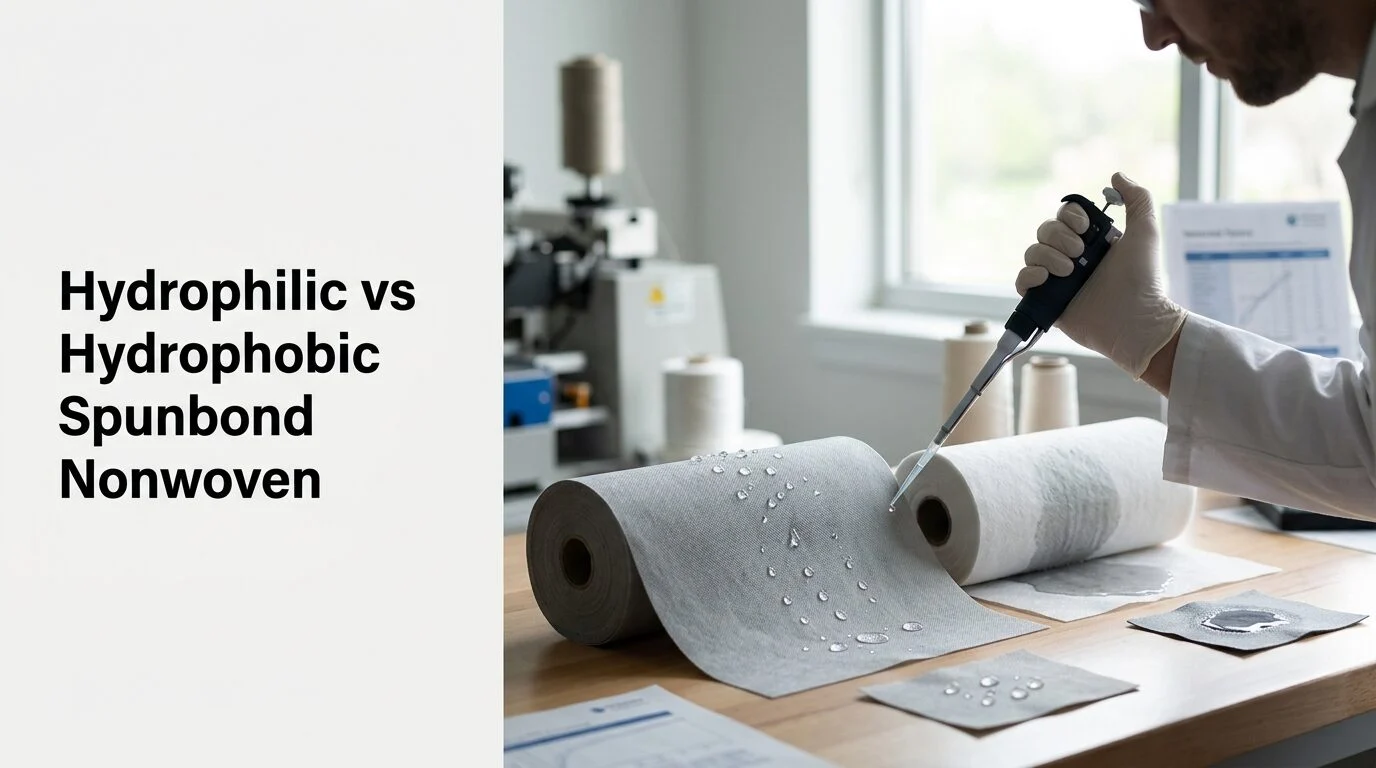
Hydrophilic vs Hydrophobic Spunbond Nonwoven — Manufacturer Selection Guide 2026
PP spunbond nonwoven fabric is naturally hydrophobic — water sits on the surface and runs off. But many hygiene applications require the opposite: water must pass through quickly. To make spunbond hydrophilic, the fabric is treated with surfactants or built-in additives. Choosing the wrong one is one of the most common raw material mistakes in diaper, mask, and pad production.
This guide explains the technical difference, treatment types, durability of treatment, and which application needs which fabric — with specifications and supply from Favourite Fab.
The Core Difference
| Property | Hydrophobic Spunbond | Hydrophilic Spunbond |
|---|---|---|
| Water behaviour | Repels — beads up | Absorbs — passes through |
| Strike-through time | Infinite (water runs off) | <3 seconds |
| Treatment | None — natural PP | Surfactant or additive treatment |
| Cost | Base price | +₹8–15/kg over hydrophobic |
| Use case | Backsheet, outer layer, bag | Topsheet, ADL, wipe substrate |
Why Spunbond Is Naturally Hydrophobic
Polypropylene polymer has no polar groups — the molecule cannot hydrogen-bond with water. Water beads up at a contact angle >90°. This is why untreated PP spunbond is the natural choice for outer mask layer, bag fabric, agricultural cover, and diaper backsheet — anywhere fluid must NOT pass through.
How Hydrophilic Treatment Works
Two methods to make spunbond hydrophilic:
1. Topical surfactant treatment (kiss-roll or spray)
- Surfactant solution applied to the fabric surface during finishing
- Drying fixes the surfactant onto the fibres
- Wash cycles: Survives 1–3 wettings, then surfactant washes off
- Cost: Low — adds ₹6–10/kg
- Used for: Single-use products — wipes, single-insult applications
2. Permanent in-melt additive (master-batch)
- Hydrophilic additive blended into PP resin before extrusion
- Hydrophilicity is built into every fibre — not just surface
- Wash cycles: Survives 5+ insults, retains performance through full diaper use cycle
- Cost: Higher — adds ₹12–18/kg
- Used for: Multi-insult products — diapers, sanitary pads, underpads
For diaper and pad topsheet, always specify permanent hydrophilic — topical-treated topsheet fails after the first wetting and causes severe rewet.
Application Map — Which Type for Which Layer
| Product | Layer | Type Required |
|---|---|---|
| Baby diaper | Topsheet | Permanent hydrophilic |
| Baby diaper | ADL | Permanent hydrophilic |
| Baby diaper | Backsheet outer cover | Hydrophobic |
| Baby diaper | Leg cuff | Hydrophobic |
| Adult diaper | Topsheet | Permanent hydrophilic |
| Sanitary pad | Topsheet | Permanent hydrophilic |
| Sanitary pad | Wing fabric | Hydrophobic |
| Underpad | Topsheet | Hydrophilic (topical OK if low-end) |
| Surgical mask | Outer layer | Hydrophobic (splash repel) |
| Surgical mask | Inner layer | Hydrophilic (skin comfort) |
| Wet wipe | Substrate | Hydrophilic (lotion uptake) |
| Shopping bag | Body | Hydrophobic |
| Agricultural cover | Body | Hydrophobic |
How to Test Hydrophilicity
Two simple tests on incoming spunbond rolls:
Strike-through test (EDANA WSP 70.3)
Place fabric on filter paper. Drop 5 ml saline solution. Time how long until liquid passes through.
- Hydrophilic spec: <3 seconds
- Hydrophobic spec: water sits indefinitely (test fails by design)
Multiple-insult test
Repeat strike-through 3 times in 1-minute intervals.
- Permanent hydrophilic: all 3 inserts <3 sec
- Topical hydrophilic: 1st insult fast, 2nd slower, 3rd fails
Pricing — Both Types from Favourite Fab
| Type | GSM Range | Cost (INR/kg) | MOQ |
|---|---|---|---|
| Hydrophobic PP spunbond | 10–100 GSM | ₹95–135/kg | 500 kg |
| Topical hydrophilic spunbond | 10–25 GSM | ₹105–145/kg | 500 kg |
| Permanent hydrophilic spunbond | 10–25 GSM | ₹115–155/kg | 1,000 kg |
For roll weight calculations: GSM calculator.
Common Sourcing Mistakes
- Using topical hydrophilic for diaper topsheet — fails on 2nd insult, severe rewet, customer complaints
- Using permanent hydrophilic for backsheet — fluid leaks through, defeats backsheet purpose
- Not testing incoming rolls — variation between batches goes unnoticed until production line problems appear
- Buying hydrophilic without spec — supplier may quote topical when permanent is needed
- Mixing hydrophobic and hydrophilic batches — production rolls must be clearly labelled and segregated at warehouse
Frequently Asked Questions
Can hydrophobic spunbond be made hydrophilic later?
Topical surfactant can be applied during converting (spraying or kiss-roll). However, this is unreliable in production — better to source pre-treated spunbond from the supplier with documented surfactant amount and method.
Does hydrophilic spunbond degrade over time?
Topical-treated rolls lose hydrophilicity over 6–12 months in storage as surfactant migrates or evaporates. Permanent hydrophilic spunbond holds performance for 18–24 months. Store rolls sealed and away from direct heat.
What is the contact angle of hydrophilic spunbond?
Untreated PP: ~110° (hydrophobic). Topical hydrophilic: ~30–60° (variable, decreases with each wetting). Permanent hydrophilic: ~30–50° stable across multiple wettings.
Can I use hydrophilic spunbond for face mask outer layer?
No. The outer mask layer must repel splashes and droplets. Hydrophilic outer layer would absorb fluid and contaminate the wearer. Use hydrophobic for outer layer, hydrophilic for inner layer (skin comfort).
Is permanent hydrophilic the same as “super-soft” spunbond?
Different things. Super-soft refers to bonding pattern and fibre softener — affects hand feel but not water behaviour. Hydrophilicity is a separate property. Premium diaper topsheet is both super-soft AND permanent hydrophilic.
What’s the cost difference per diaper?
Permanent hydrophilic adds ~₹0.05 per diaper over topical hydrophilic, and ~₹0.10 per diaper over hydrophobic. The difference is negligible — the rewet performance gain is worth the upgrade for any branded diaper.
Get Both Types — Quote & Sample
Specify your application, GSM, and treatment requirement. Favourite Fab dispatches sample rolls of hydrophobic and permanent-hydrophilic spunbond for side-by-side testing on your line.
- 📞 +91 88007 75462 / +91 88007 75462
- ✉️ sale@favouritehub.com
- 🌐 Request samples
Related Hydrophilic Cluster Resources
- Master Pillar: Hydrophilic Non Woven Fabric Manufacturer India — production, grades (SS / SSS / SMS / HATB / spunlace), GSM matrix, B2B ordering.
- Application Pillar: Hydrophilic Top Sheet for Diapers and Hygiene Products — topsheet selection logic for baby diaper, sanitary napkin, adult incontinence, underpad.
- Process Pillar: Hydrophilic Hot Air Through Nonwoven Fabric — HATB / TAB lofty topsheet + ADL grades, bicomponent fibers, premium hygiene applications.

Gaurav Garg
I'm Gaurav Garg, CEO of Favourite Fab, a company on a mission to revolutionize the nonwoven industry with sustainable practices. We work hand-in-hand with manufacturers and suppliers who share our commitment to eco-friendly production. With a deep interest in textile innovation, I'm passionate about educating consumers about sustainable material options and their potential to transform the nonwoven landscape.


