

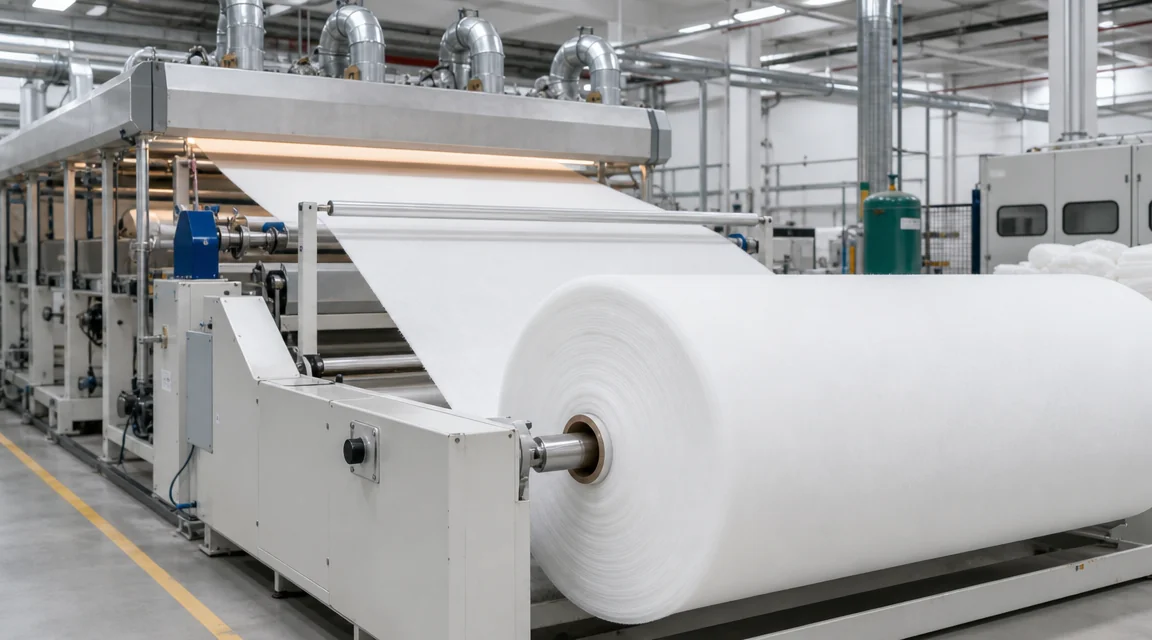
Hydrophilic Hot Air Through Nonwoven Fabric
Hydrophilic hot air through nonwoven fabric — also called HATB (Hot Air Through Bonded) or TAB (Through-Air Bonded) — is the loftiest, softest, bulkiest hydrophilic nonwoven available for premium baby diaper topsheet, adult incontinence top sheet, and acquisition distribution layer (ADL). Favourite Fab manufactures hydrophilic HATB in 18–80 GSM at our Agra, India facility, with strike-through under 2 seconds and rewet under 0.15 g.
This pillar explains the HATB process, when to choose it over calendered spunbond, GSM-vs-application matrix, bicomponent fiber options (PE/PP, PET/PE), and B2B procurement specs. For the master hydrophilic technical pillar, see Hydrophilic Non Woven Fabric Manufacturer India. For application-side topsheet selection, see Hydrophilic Top Sheet for Diapers and Hygiene Products.
What Is Hot Air Through Nonwoven?
Hot air through (HATB or TAB) nonwoven is bonded by drawing heated air through a perforated drum or oven rather than pressing the web between calender rolls. The fibers — usually bicomponent (PE/PP or PET/PE) — partially melt at the lower-melt sheath, fusing fiber crossovers while leaving the inner core fiber structure intact. The result is a fabric that retains bulk and softness because the bonding does not compress the web.
Hydrophilic HATB adds a surfactant — applied online via kiss-roll or built into the chip via master-batch — that makes the fabric wettable. The hydrophilic chemistry plus the lofty open structure gives the dual signature of premium baby diaper topsheet: fast fluid penetration and plush dry hand-feel.
Two routes to hydrophilic HATB at Favourite Fab:
- Online kiss-roll — surfactant applied to the bonded web. Standard route for topsheet (single-strike use).
- Durable master-batch — surfactant compounded into the PP core fiber. Used for ADL (multi-strike fluid management) and wipes substrates.
HATB Production Process — Step by Step
- Bicomponent fiber feed — staple bico fibers (PE/PP or PET/PE) carded into a uniform web; fiber denier 1.5–3.5; web GSM 18–80.
- Optional master-batch additive — durable hydrophilic surfactant compounded at 0.5–2.5% into the core polymer at the fiber-spinning stage.
- Web layering — single or multi-layer card; cross-lapped if anisotropy required.
- Hot-air-through bonding — web passes around perforated rotating drum, heated air (130–150 °C for PE/PP bico) drawn through, sheath polymer melts and bonds at fiber crossings.
- Online surfactant kiss-roll (alternative to master-batch) — aqueous surfactant pickup 0.2–0.6% by weight, dried by residual heat.
- Cooling + winding — cooled to ambient on a chilled drum, wound to parent rolls 5,000–8,000 m.
- Slitting — slit to OEM-spec width (40 mm to 3,200 mm) with ± 1 mm tolerance.
- QC sampling — every 500 m: GSM, strike-through, rewet, tensile, loft, hand-feel grade.
Process deep-dive: Hot Air Through Nonwoven Manufacturer India · Hot Air Through Bonded Manufacturer · HATB Supplier India.
HATB vs Calendered Spunbond — Which Wins When
| Property | Hydrophilic HATB | Hydrophilic Calendered SS |
|---|---|---|
| Loft / thickness at 18 GSM | 0.35–0.45 mm | 0.15–0.20 mm |
| Hand-feel | Plush, cloth-like | Smooth, paper-like |
| Strike-through (1st) | < 1.5 s | 2–3 s |
| Rewet | < 0.15 g | < 0.20 g |
| Tensile MD | Lower at same GSM | Higher |
| Cost per kg | 1.4–1.8× of SS | Baseline |
| Typical end-use | Premium baby diaper topsheet, ADL, adult premium | Mass-market topsheet, backsheet, hygiene wrap |
| Line speed compatibility | High (low fly, stable) | Very high |
Selection logic in one sentence: if the brand is paying for soft hand-feel and dry-feel, spec HATB; if the brand is competing on cost, spec calendered SS.
More: Pricing Insights for HATB · Porosity & Filtration Performance.
Bicomponent Fibers in HATB — PE/PP and PET/PE
The bonding mechanism needs a sheath polymer with lower melt temperature than the core. The two standard configurations:
PE/PP Bicomponent (Sheath/Core)
Polyethylene sheath (m.p. 130 °C) over polypropylene core (m.p. 165 °C). Air at 135–145 °C melts PE, leaves PP intact. Soft, drapable, low cost. Mainstream choice for baby diaper topsheet and ADL.
PET/PE Bicomponent
PE sheath over polyester core. Higher tensile strength than PE/PP. Used where line tension is high and elongation must stay controlled. Adult incontinence premium topsheet, surgical drape interior.
Bico-specific cluster: TAB Bico Nonwoven Fabric.
Applications — Topsheet, ADL, Premium Hygiene
Premium Baby Diaper Topsheet
Brands competing on softness — Huggies Premium, Pampers Premium Care, MamyPoko Extra Dry — typically use HATB topsheet at 18–22 GSM. Strike-through 1.0–1.5 s, rewet under 0.10 g. Visible product positioning: “cloth-like feel,” “plush dry surface.”
Adult Incontinence Premium Topsheet
Long-wear (8–12 hour) adult products require lower rewet to prevent skin maceration. HATB at 20–25 GSM with durable hydrophilic master-batch handles 4–6 wet events without rewet drift. See: Diaper Raw Material PDF.
Acquisition Distribution Layer (ADL)
The ADL sits between the topsheet and the SAP core. It receives the strike from the topsheet and distributes fluid laterally before it enters the core. HATB at 40–80 GSM with very lofty open structure (1.0–1.4 mm thickness) is the standard. See: HATB ADL Supplier India.
Sanitary Napkin Premium Topsheet
Less common than baby diaper because feminine hygiene tends to use apertured SS for the dry-feel. But premium overnight pads sometimes use HATB at 22 GSM with apertures combined. See: HATB for Sanitary Pads · HATB Top Sheet.
High-Filtration Air Filter Media
Lofty HATB is also used in HEPA pre-filter, HVAC primary filter, and respirator outer wraps where loft = dust-loading capacity. Hydrophilic treatment optional for moisture-laden air streams. See: HATB Filtration Performance.
Quality Specs for HATB
| Parameter | Test Method | Topsheet (18 GSM) | ADL (60 GSM) |
|---|---|---|---|
| GSM variance | EDANA WSP 130.1 | ± 5% | ± 5% |
| Thickness | WSP 120.6 | 0.35–0.45 mm | 1.0–1.4 mm |
| Strike-through (1st) | WSP 70.3 | < 1.5 s | < 1.0 s |
| Strike-through (3rd, ADL) | WSP 70.7 | — | < 4 s |
| Rewet | WSP 80.10 | < 0.15 g | < 0.30 g |
| Tensile MD | WSP 110.4 | ≥ 15 N/5cm | ≥ 45 N/5cm |
| Tensile CD | WSP 110.4 | ≥ 8 N/5cm | ≥ 25 N/5cm |
| Hand-feel grade | Internal panel | Plush A | — |
| Hydrophilic decay (90 d, 35°C) | WSP 70.3 post-aging | fresh + < 0.5 s | fresh + < 1 s |
Test method references: Liquid Strike-Through Time Test · QC for Hydrophilic Diaper Topsheet.
Favourite Fab HATB Capability
- Location: Agra, Uttar Pradesh, India.
- Lines: Dedicated HATB lines with PE/PP and PET/PE bico capability.
- GSM range: 18–80 GSM (topsheet to ADL).
- Width range: 40 mm slits to 2,400 mm parent.
- Surfactant route: online kiss-roll standard; durable master-batch for ADL and multi-strike applications.
- Bico fibers: PE/PP standard, PET/PE on contract.
- Roll length: 5,000–8,000 m parent; 2,000–4,000 m slit.
- Colors: white standard; pink, blue, custom Pantone via master-batch.
- Certifications: ISO 9001, OEKO-TEX Standard 100 Class I, REACH, RoHS, MSDS per lot.
- Documentation: COA, MSDS, REACH dossier per shipment.
Why teams choose Favourite Fab: Why Choose Favourite Fab · Global Nonwovens vs Favourite Fab.
B2B Ordering — MOQ, Lead Time, Sampling
Sample policy: 1–2 kg standard-grade HATB samples free for SKU validation. Custom bico or custom-GSM samples carry tooling fee. Sample dispatch 3–5 days domestic, 7–10 days export.
MOQ: 1 MT trial for standard grades; 5 MT regular PO; 3 MT for custom GSM or custom bico configuration. Premium ADL master-batch versions: 5 MT trial.
Lead time: Stocked grades 5–10 days. Custom HATB grades 14–21 days from PO confirmation (longer than spunbond because of bico-fiber sourcing). Containerised export adds 3–4 days documentation.
Packaging: 5,000–8,000 m parent rolls on 3″ or 6″ cores, polywrapped, palletized, stretch-wrapped. ADL rolls packed shorter (2,000–3,000 m) due to bulk.
Container load: ~18 MT per 40 ft HQ for 18 GSM topsheet (volumetric limit at low GSM lofty rolls).
Pricing: Competitive wholesale rates per MT, locked per PO. HATB carries 40–80% price premium over calendered SS. Volume discounts on annual contracts. Pricing varies with PP/PE chip index, bico-fiber type, and FX. HSN + GST applicable.
Sustainable HATB Options
- PLA bico HATB — PLA-based biodegradable bicomponent fiber. Composts in industrial composting. Strike-through retained, hand-feel softer than petro-PE.
- Recycled PET bico HATB (PET/PE) — 30–50% rPET in the core fiber. Traceable supply chain. Supports EPR claims.
- Cellulose-blend HATB — viscose blended at 30–50%. Used in hybrid topsheet for sustainable feminine care brands.
More: Sustainable Hydrophilic Topsheet Options.
Frequently Asked Questions
What is the difference between HATB and TAB?
None functionally. HATB = Hot Air Through Bonded. TAB = Through-Air Bonded. Same process, two names. Some specs use HATB for the wider category and TAB for bicomponent-specific.
What is the typical GSM for a HATB diaper topsheet?
18–22 GSM for baby diaper premium topsheet; 22–25 GSM for adult premium. Lower GSM saves cost; higher GSM gives softer hand and lower rewet.
Why is HATB more expensive than calendered SS?
Three reasons: bicomponent fiber costs more than mono-PP; through-air bonding consumes more energy than calendering; production speed is lower (50–80% of calendered SS line speed at the same GSM).
Can HATB be apertured?
Yes — HATB + aperture combination is used in premium overnight feminine pads. Strike-through drops below 1 s while hand-feel stays plush.
What is the role of HATB in ADL?
ADL (Acquisition Distribution Layer) receives the strike from the topsheet and routes fluid to the SAP core. HATB at 40–80 GSM gives the lofty 1.0–1.4 mm thickness needed for fluid storage and lateral routing. Durable master-batch surfactant is mandatory for multi-strike performance.
Is HATB suitable for surgical drape interior?
Yes, when paired with PET/PE bico. Combines softness for patient comfort with strength for handling. Hydrophilic version preferred for absorbent drape inner layer; hydrophobic for fluid-barrier outer.
What is the MOQ for hydrophilic HATB at Favourite Fab?
1 MT trial PO for standard PE/PP topsheet; 3 MT for custom GSM; 5 MT for premium PET/PE or durable master-batch ADL.
How does HATB hydrophilic decay over storage?
Online surfactant: strike-through drifts by < 0.5 s after 90 days at 35 °C / 65% RH. Master-batch durable: drift < 0.2 s. Both well within converter PO tolerances.
Related Pages — Hydrophilic + HATB Cluster
- Hydrophilic Non Woven Fabric Manufacturer India (Master Pillar)
- Hydrophilic Top Sheet for Diapers and Hygiene Products
- Hot Air Through Nonwoven Manufacturer India
- HATB Manufacturer India
- HATB ADL Supplier India
- TAB Bico Nonwoven Fabric
- Hot-Air-Through Top Sheet
- HATB for Sanitary Pads
- HATB Porosity & Filtration
- HATB Pricing Insights
- Hydrophilic Spunbond Nonwoven Grade
- SSS Hydrophilic Non Woven Fabric
- 13 GSM Hydrophilic SS Diaper Topsheet
- Apertured Topsheet for Hygiene OEM
- Hydrophilic vs Hydrophobic Spunbond
- QC for Hydrophilic Diaper Topsheet
- Liquid Strike-Through Time Test
- Sustainable Hydrophilic Topsheet Options
- Topsheet Nonwoven Manufacturer India
- OEM Contract Manufacturing Hydrophilic Topsheet
- Diaper Raw Material PDF
- Sanitary Pad Raw Material
Talk to the HATB Team
Sourcing hydrophilic hot-air-through nonwoven for premium baby diaper topsheet, ADL, adult incontinence, or filtration? Favourite Fab HATB team handles spec validation, sample dispatch, and quote turnaround within 24 hours on business days.
- Email: sales@favouritehub.com
- WhatsApp / Phone: +91-99970-90856
- Visit: Favourite Fab, Agra, Uttar Pradesh, India
- Get a quote: Send your SKU specs

Gaurav Garg
I'm Gaurav Garg, CEO of Favourite Fab, a company on a mission to revolutionize the nonwoven industry with sustainable practices. We work hand-in-hand with manufacturers and suppliers who share our commitment to eco-friendly production. With a deep interest in textile innovation, I'm passionate about educating consumers about sustainable material options and their potential to transform the nonwoven landscape.


