

Isotropic Spunlace Nonwoven Fabric — Equal MD/CD Strength Manufacturer India
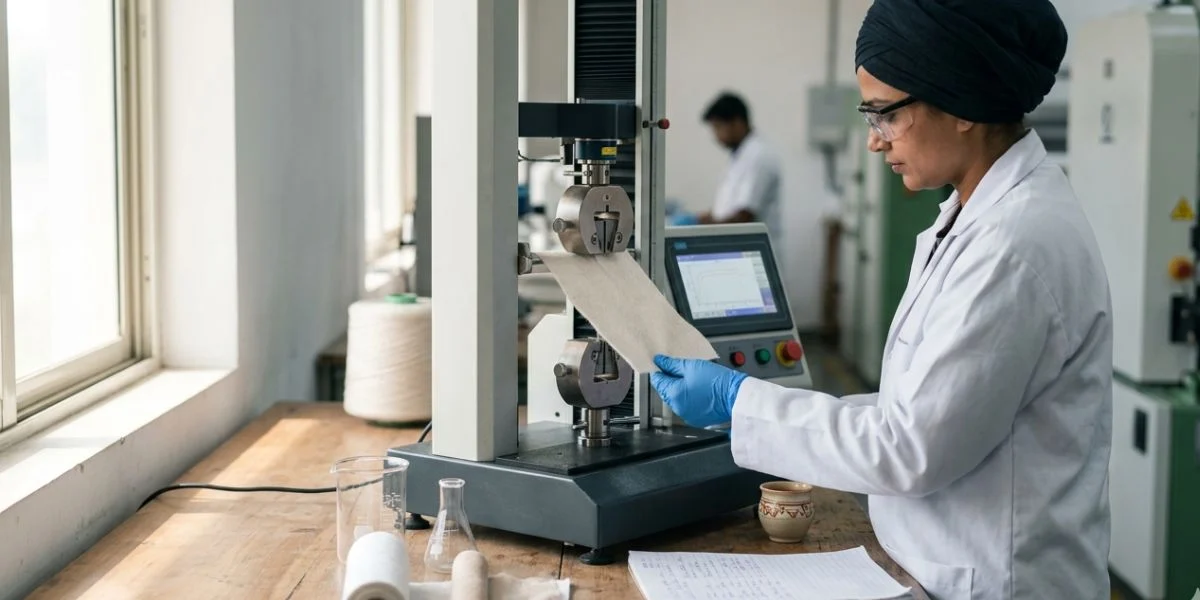
Isotropic spunlace nonwoven fabric has equal or near-equal tensile strength in both the machine direction (MD) and cross direction (CD). Unlike standard parallel-laid spunlace where MD strength significantly exceeds CD, isotropic fabric behaves identically regardless of direction — a critical property for die-cut medical products, shaped wipes, and hygiene applications where the fabric is stressed in multiple directions. Favourite Fab produces isotropic spunlace via cross-lapped web formation or by precisely balancing MD/CD tensile during hydroentanglement.
Technical Specifications
| Parameter | Specification |
|---|---|
| GSM range | 40–120 GSM |
| Fibre blend | Viscose/polyester, 100% viscose |
| Width | 160–320 cm |
| MD/CD ratio | 1.0–1.3:1 (vs 2–4:1 for standard) |
| Tensile MD | 80–400 N/5cm |
| MOQ | 500 kg |
Applications
Medical drapes, wound dressings, shaped die-cut wipes, cosmetic pads, hygiene topsheets.
Why Source from Favourite Fab
Direct manufacturer in Agra, India. No middleman. Custom slit widths 3–320 cm ±1 cm tolerance. COA per batch (GSM, tensile, absorbency). Sample rolls dispatched 3–5 working days. Export to 30+ countries FOB Nhava Sheva.
Full range: spunlace nonwoven fabric. Related: spunlace nonwoven for wet wipes.
Frequently Asked Questions
What does isotropic mean in spunlace fabric?
Isotropic means properties are equal in all directions. For spunlace, it means MD tensile strength ≈ CD tensile strength (ratio 1.0–1.3:1). Standard spunlace has MD/CD ratios of 2–4:1 — much stronger in machine direction.
When do I need isotropic spunlace instead of standard?
When your product is stressed equally in all directions: die-cut round cosmetic pads, medical drapes with multi-directional tension, shaped wipes used in rotational cleaning motions. Standard directional fabric tears along the weaker CD axis in these applications.
How is isotropic spunlace made?
Either cross-lapped web formation (fibres laid at alternating angles) or randomised web deposition. Cross-lapping is most common — it reverses the web orientation during laydown, balancing fibre alignment in MD and CD before hydroentanglement.
B2B Applications & End-Uses
Isotropic spunlace nonwoven fabric is specified in applications where the mechanical performance of the fabric must be independent of the orientation in which it is used, cut, or applied. Cosmetic pad manufacturers producing round, square, and oval cotton pads from spunlace rolls require isotropic tear behaviour because the pad is torn from the pack by the end consumer in a random direction, and a standard spunlace with a 2.5:1 MD/CD ratio produces pads that tear cleanly along the machine direction but resist tearing in the cross direction, creating a non-uniform end-user experience that generates consumer complaints.
Surgical swab and sponge manufacturers require isotropic absorbency distribution — the rate at which the swab absorbs fluid should be equivalent regardless of which edge contacts the wound or surgical field first. A directionally biased fabric absorbs faster along the machine direction, where fibre alignment and pore channel orientation favour capillary flow, producing inconsistent absorption behaviour that is a clinical quality concern in operating room applications where swab performance must be predictable and reproducible.
Industrial wipers used in random-motion cleaning operations — circular buffing machines, robotic wiping heads, and hand wiper applications where the operator changes direction continuously — perform most uniformly when the wiper substrate has equal tensile and tear resistance in all directions. Automotive detailing wipes, optical lens polishing pads, and precision instrument cleaning cloths are end-use markets where isotropic construction is a meaningful specification differentiator that customers can verify through simple tensile testing on received goods.
Certifications & Quality Assurance
Isotropic spunlace nonwoven produced by Favourite Fab is qualified by measuring MD tensile strength and CD tensile strength on every production batch per EDANA ERT 20.2, and computing the MD/CD ratio. The isotropic specification requires this ratio to be 1.5:1 or less — meaning the machine-direction tensile may be no more than 50% higher than the cross-direction tensile. Batch release is conditional on this ratio criterion being met across the full roll width; test samples are taken at the left edge, centre, and right edge to confirm that the cross-lapping process has delivered consistent fibre isotropy across all positions.
Achieving an MD/CD ratio below 1.5:1 requires a cross-lapping web formation stage before hydroentanglement, where the carded fibre web is laid at an angle across the forming belt in alternating directions to distribute fibre orientation uniformly in both MD and CD. Favourite Fab’s cross-lapping equipment is calibrated for each GSM and production speed combination to maintain the target fibre orientation distribution, with lapping angle and overlap ratio documented in the process record for every production run.
Absorption capacity (EDANA ERT 10.4) is tested on samples cut in both MD and CD orientations and reported separately, allowing cosmetic pad and surgical swab buyers to verify that the isotropic construction also delivers equivalent absorption in both directions. Certificate of analysis (COA) data including MD tensile, CD tensile, MD/CD ratio, GSM, thickness, and absorption is supplied with every shipment.
More Questions Answered
How do buyers verify isotropic performance when receiving spunlace nonwoven from a supplier?
Isotropic performance verification on incoming goods requires tensile testing in both machine direction and cross direction per EDANA ERT 20.2. The buyer should cut specimens at 0° (machine direction) and 90° (cross direction) relative to the roll length and test a minimum of five specimens in each direction to obtain statistically reliable mean values. The MD/CD ratio is calculated as the mean MD tensile divided by the mean CD tensile; a specification of ≤1.5:1 is the standard threshold for commercial isotropic grades. Some buyers use a simplified “tear test” using pre-notched specimens — the isotropic roll should propagate the tear at equal force in both directions. For cosmetic pad applications, a practical verification is to perform peel testing on a sample of pads by tearing them in multiple orientations and confirming uniform resistance and clean separation without visible directional bias. Favourite Fab’s COA includes the MD/CD ratio from production testing; incoming goods testing should be conducted within 30 days of receipt and results compared to the COA values. Discrepancies above ±15% relative to the COA should be raised with Favourite Fab’s quality team for investigation.
What GSM range is available for isotropic spunlace nonwoven and what is the minimum order quantity?
Favourite Fab produces isotropic spunlace nonwoven in the 40–120 GSM range. Below 40 GSM, achieving a consistent MD/CD ratio ≤1.5:1 through the cross-lapping process becomes technically difficult because the fibre web is thin enough that small variations in the carding or lapping parameters produce disproportionate effects on fibre orientation uniformity. The most commonly specified isotropic grades are 40 GSM for cosmetic pads, 50–60 GSM for surgical swabs, and 70–90 GSM for industrial wipers requiring high tensile integrity combined with directional neutrality. Standard width options are 160cm and 260cm. Minimum order quantity for isotropic grades is 500 kg per specification due to the additional cross-lapping setup and the tighter batch release testing protocol. Development samples of 30–50 kg can be produced for converting trials at a lead time of 10–15 working days from specification confirmation and advance payment. Contact the technical sales team to discuss your GSM, width, and MD/CD ratio requirements.
📋 Related: Spunlace Nonwoven Fabric — Full Range & Specs | All Nonwoven Products from Favourite Fab

Gaurav Garg
I'm Gaurav Garg, CEO of Favourite Fab, a company on a mission to revolutionize the nonwoven industry with sustainable practices. We work hand-in-hand with manufacturers and suppliers who share our commitment to eco-friendly production. With a deep interest in textile innovation, I'm passionate about educating consumers about sustainable material options and their potential to transform the nonwoven landscape.


