
Life Cycle Assessment Nonwoven Fabric LCA ESG Sustainability India — Favourite Fab
Life cycle assessment nonwoven fabric LCA data from Favourite Fab helps manufacturers quantify the environmental impact of their raw material choices. As a B2B nonwoven supplier based in Agra, India, Favourite Fab provides LCA documentation and comparative CO2 data for PP, PLA, and rPET nonwoven grades to support ESG reporting and procurement decisions.
What Is Life Cycle Assessment for Nonwoven Fabric
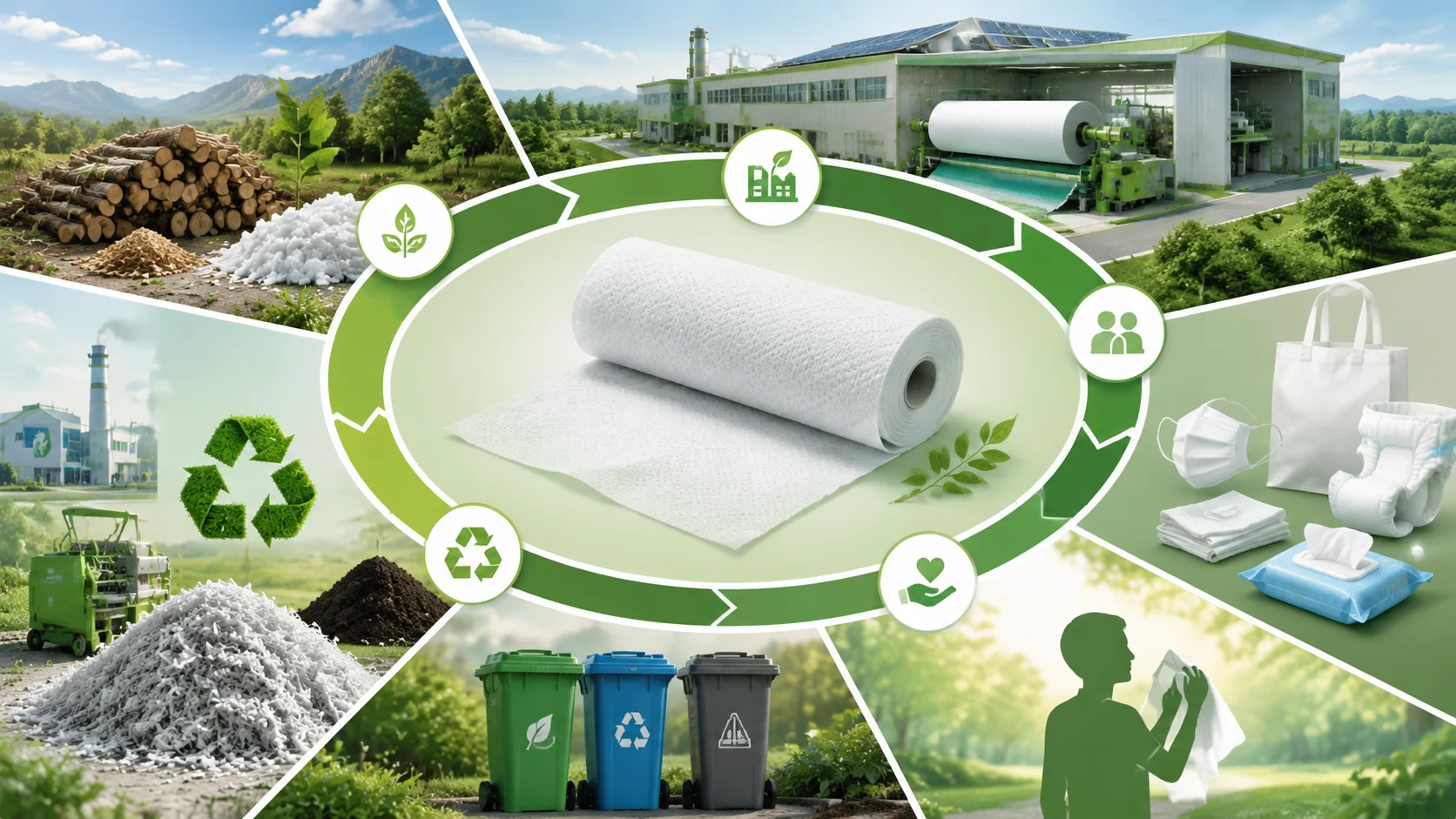
A life cycle assessment (LCA) is a structured methodology for quantifying the environmental impact of a product across its full life cycle — from raw material extraction through manufacturing, transport, use, and end-of-life disposal. For nonwoven fabric, an LCA measures greenhouse gas emissions, energy consumption, water use, and waste generation at each production stage.
The most common LCA boundary used in nonwoven procurement is cradle-to-gate — covering raw material sourcing, fibre production, and fabric manufacturing up to the point of delivery from the mill. This boundary is practical for supplier comparisons because it isolates the manufacturer’s contribution to environmental impact.
ESG-driven procurement teams, sustainability auditors, and brand compliance departments use nonwoven LCA data to compare PP virgin, PLA biobased, and rPET recycled grades on a CO2-equivalent per kilogram basis. Favourite Fab can provide grade-specific LCA summaries and third-party-verified environmental product declarations (EPD) on request.
Specifications and Options
| LCA Parameter | PP Virgin | PLA Biobased | rPET Recycled |
|---|---|---|---|
| CO₂e (cradle-to-gate) | ~3.8 kg/kg | ~2.5 kg/kg | ~1.8 kg/kg |
| Energy (MJ/kg) | ~95 MJ | ~60 MJ | ~45 MJ |
| Water use (L/kg) | Moderate | Higher (crop irrigation) | Low |
| End-of-life | Recyclable | Compostable (EN13432) | Recyclable |
| Certification | ISO 9001, OEKO-TEX | EN13432, GRS optional | GRS, OEKO-TEX |
| EPD available | On request | On request | On request |
Applications in Manufacturing
LCA data for nonwoven fabric is used directly by procurement and sustainability teams to build supplier scorecards, meet Scope 3 emission reduction targets, and satisfy customer questionnaires from global brands running supply chain decarbonisation programmes.
Hygiene product manufacturers use nonwoven LCA comparisons to switch from PP virgin to rPET or PLA grades in topsheet and backsheet layers while maintaining performance specifications. The CO2 saving per kilogram translates directly into Scope 3 reduction disclosures under GHG Protocol standards.
Medical device OEMs conducting environmental product assessments for CE mark or FDA 510(k) submissions use nonwoven LCA data as part of the environmental section of technical files. Industrial manufacturers use LCA data to comply with government green procurement criteria and ISO 14001 environmental management system requirements.
For grade-specific material see GRS certified recycled content nonwoven, post consumer recycled PCR nonwoven, and the parent nonwoven fabric overview.
Why Source From Favourite Fab
- MOQ-friendly — suitable for small and large manufacturers
- Export-ready — ships to 50+ countries
- ISO certified manufacturing facility
- 10+ years supplying hygiene and medical industry
- Custom specifications available on request
- LCA summaries and EPD documentation provided on request
- Multi-grade supply enables direct CO2 comparison from a single supplier
Pricing and MOQ
LCA-documented nonwoven grades — rPET, PLA, and PP virgin — are priced based on GSM, grade, and order volume. Favourite Fab offers competitive wholesale pricing. LCA and EPD documentation is provided at no additional charge for qualifying orders. Contact sale@favouritehub.com with your grade, GSM, width, and volume for a quote within 48 hours.
How to Order
- Send your material requirements to sale@favouritehub.com
- Receive a quote and sample within 48 hours
- Confirm order and production begins
Frequently Asked Questions
Q: What does cradle-to-gate mean in a nonwoven LCA?
A: Cradle-to-gate covers environmental impact from raw material extraction through fibre production and fabric manufacturing up to the mill gate. It excludes transport to customer, product use, and end-of-life. This boundary is standard for supplier-level comparisons.
Q: Can Favourite Fab provide an Environmental Product Declaration (EPD) for nonwoven fabric?
A: Yes. Favourite Fab can provide EPD documentation for PP, PLA, and rPET nonwoven grades on request. EPDs are third-party verified and comply with ISO 14025 for use in sustainability reports and green building certification systems.
Q: How does rPET nonwoven compare to PP in CO2 emissions?
A: rPET nonwoven typically generates approximately 1.8 kg CO2e per kg of fabric compared to approximately 3.8 kg CO2e per kg for virgin PP — a reduction of roughly 50%. The exact saving depends on the recycled content percentage and energy source used in production.
Q: Does switching to PLA nonwoven reduce my Scope 3 emissions?
A: Yes. PLA nonwoven has a lower fossil carbon footprint than PP virgin due to its biobased origin. The CO2e saving is approximately 34% on a cradle-to-gate basis. However, agricultural land use and water consumption are higher for PLA than for rPET grades.
Q: Is LCA data from Favourite Fab suitable for use in GHG Protocol Scope 3 reporting?
A: Yes. Favourite Fab’s LCA summaries and EPDs are based on industry-standard methodology and can be used as supplier-specific emission factors in GHG Protocol Category 1 (purchased goods) Scope 3 calculations.
Contact Favourite Fab
Email: sale@favouritehub.com
WhatsApp: +91-8800775462
Send your material specifications today for a same-day quote.

Gaurav Garg
I'm Gaurav Garg, CEO of Favourite Fab, a company on a mission to revolutionize the nonwoven industry with sustainable practices. We work hand-in-hand with manufacturers and suppliers who share our commitment to eco-friendly production. With a deep interest in textile innovation, I'm passionate about educating consumers about sustainable material options and their potential to transform the nonwoven landscape.


