

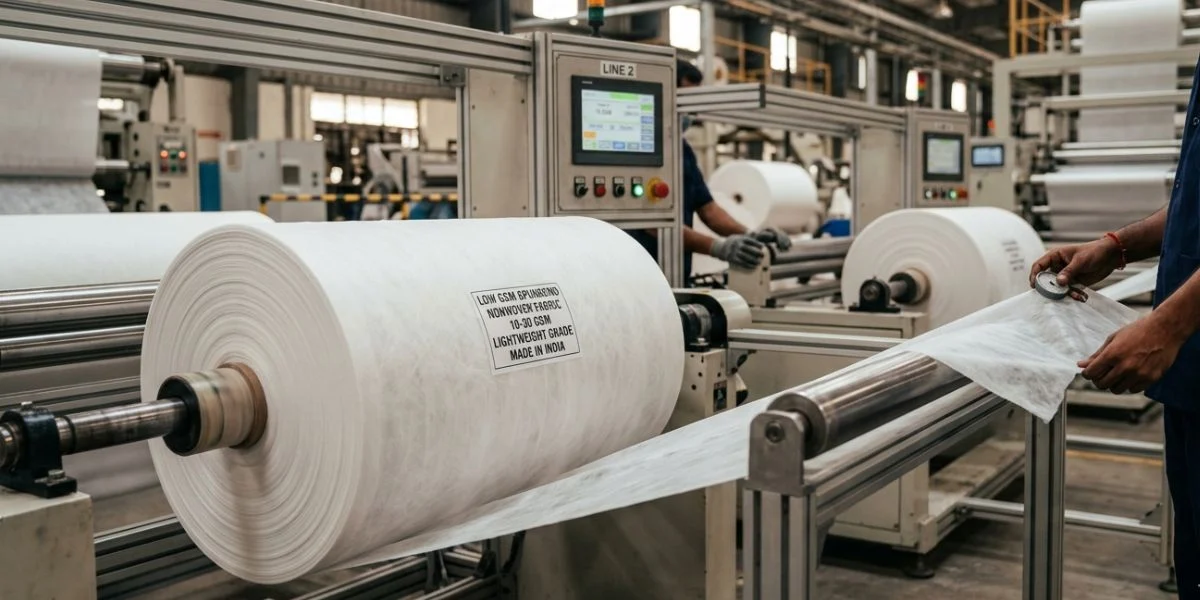
Low GSM Spunbond Nonwoven Fabric — 10–30 GSM Lightweight Grade Manufacturer India
Low GSM spunbond nonwoven fabric (10–30 GSM) represents the lightweight end of the PP spunbond range — ultra-thin, translucent, and feather-light while maintaining the structural integrity of hydroentanglement bonding. Applications include ultra-thin hygiene product layers, lightweight agricultural covers, disposable medical face masks (inner comfort layer), teabag materials, and thin packaging wraps. Favourite Fab produces 10–30 GSM PP spunbond with consistent weight uniformity of ±5% — critical for high-speed hygiene converter compatibility.
Technical Specifications
| Parameter | Specification |
|---|---|
| GSM | 10–30 GSM |
| Fibre | 100% PP |
| Uniformity | ±5% weight variation |
| Tensile MD | 15–120 N/5cm |
| Width | 160–260 cm |
| Available finish | Hydrophilic, hydrophobic, standard |
| MOQ | 500 kg |
Applications
Ultra-thin diaper topsheet/coverstock, light incontinence liner, agricultural row cover, medical mask inner layer, tea/coffee filter bag, thin packaging wrap.
Source from Favourite Fab
Direct manufacturer Agra, India. Custom GSM/width. COA per batch. Sample 3–5 days. See: spunbond nonwoven fabric manufacturer India. Related: hydrophilic spunbond nonwoven fabric India.
Frequently Asked Questions
What is 10 GSM spunbond nonwoven used for?
10 GSM is the lightest commercial PP spunbond grade. Used in teabag/coffee filter applications, ultra-thin packaging wraps, and experimental ultra-light hygiene topsheets. At 10 GSM, the fabric is semi-transparent and has low tensile strength — primarily used in applications where weight minimisation is critical and structural load is minimal.
What is the minimum GSM available in PP spunbond?
Commercial production starts at 10 GSM. Below 10 GSM, consistent web formation becomes difficult and pinholes increase — compromising fabric integrity. 10–15 GSM is standard minimum for B2B supply.
What GSM is used for agricultural row covers?
17–25 GSM UV-stabilised PP spunbond for spring frost protection and insect barrier covers. Light enough for crop stems to push up naturally. Heavier 30–50 GSM for frost protection in colder climates or for direct contact soil mulch.
B2B Applications & End-Uses
Ultra-low GSM spunbond nonwoven fabric in the 10–30 GSM range serves applications where the fabric’s primary function is coverage or barrier separation rather than structural load-bearing, and where minimising material weight per square metre has a direct impact on finished product cost or performance. Hygiene coverstock manufacturers producing topsheets for baby diapers, feminine hygiene pads, and adult incontinence products specify 10–18 GSM spunbond because the topsheet contributes directly to the total absorbent core cost; every gram saved per square metre, multiplied across billions of units per year, represents a significant cost reduction without compromising the fluid-management function of the topsheet layer.
Disposable face mask manufacturers producing three-layer surgical masks and two-layer community masks use 20 GSM spunbond as the outer shell layer on masks where the meltblown filtration layer is the functional barrier and the spunbond layer’s role is mechanical protection, shape retention, and user-facing aesthetics. Agriculture fabric suppliers producing seeding fleece and row-cover material for protected horticulture specify 17–20 GSM UV-stabilised spunbond, where the lower GSM reduces the shadow factor cast on seedlings while the UV stabiliser additive maintains adequate tensile strength through an outdoor growing season of 60–90 days.
Specialty food packaging applications including tea bag wrapper, coffee pod cover, and spice sachet material use heat-sealable 10–15 GSM spunbond that is thin enough to allow rapid infusion through the fabric wall while providing sufficient wet strength to hold the sachet intact during brewing. The critical requirement is uniform porosity at low GSM, which is highly sensitive to production process control.
Certifications & Quality Assurance
Producing sub-20 GSM spunbond nonwoven requires significantly tighter process control than standard industrial grades. Favourite Fab specialises in the 10–30 GSM production window and maintains documented process qualification data for each GSM point in this range. Inline basis weight uniformity monitoring using nuclear or infrared sensors provides real-time feedback to the extrusion and web-forming parameters, with automatic adjustment routines that maintain GSM variation within ±8% at 10 GSM and ±6% at 20 GSM across the full roll width.
Finished roll testing at low GSM grades includes basis weight (EDANA ERT 40.3) sampled at a minimum of 10 positions across the width and at three roll positions (outer, mid, inner) to confirm cross-direction and machine-direction uniformity. Tensile strength in machine direction at 10 GSM is validated to a minimum of 5 N/5cm per EDANA ERT 20.2, confirming the fabric can withstand the tension applied during converting on hygiene manufacturing lines. For food-contact applications, compliance with IS 10146 (polyolefins in contact with food) or EU Regulation 10/2011 (plastics materials in contact with food) is documented through migration testing conducted by accredited laboratories.
UV stability testing per ISO 4892-2 (xenon arc weathering, 500 hours) is available for agricultural nonwoven grades in the 17–25 GSM range, providing retained tensile strength data relevant to buyers assessing the multi-season durability of crop cover material.
More Questions Answered
What are the main quality challenges in producing 10 GSM spunbond nonwoven and how does Favourite Fab address them?
Three principal quality challenges arise in producing 10 GSM spunbond that do not occur at standard 30–40 GSM grades. First, pinhole formation — localised areas of very low fibre density or complete voids — becomes more probable as the fibre web becomes thinner, because statistical variation in the air-lay fibre distribution has a proportionally larger impact on a thin web than on a heavier one. Favourite Fab addresses this through a bicomponent die configuration that distributes fibres at higher linear density across the forming belt. Second, GSM uniformity in the cross direction is harder to maintain at low GSM because the profile adjustment mechanisms on the extrusion die have less tolerance for error; Favourite Fab’s inline monitoring system samples width-direction basis weight every 25mm and feeds back to die-lip adjustment actuators in real time. Third, low GSM rolls are mechanically fragile and prone to telescoping or creasing during winding if core tension control is not precisely managed; Favourite Fab uses centre-winding with taper-tension control to maintain roll geometry integrity from the first metre to the last. Development samples at any GSM between 10 and 30 can be produced with a lead time of 10–15 working days from order confirmation.
What is the minimum tensile strength specification for 20 GSM spunbond nonwoven used as a face mask outer layer?
For disposable three-layer surgical mask applications, the outer spunbond layer at 20 GSM is typically required to meet a minimum machine-direction tensile strength of 12 N/5cm and a cross-direction tensile of 8 N/5cm, per the converting parameters of standard mask-making machines that apply ear loop ultrasonic welding and nose wire insertion under mechanical tension. The elongation at break should be below 80% in the machine direction to prevent web stretching on the mask-forming station. These values are derived from the mechanical loads applied during mask assembly rather than from the finished mask performance standards (such as YY 0469 or EN 14683), which specify the performance of the assembled mask rather than individual layer properties. Favourite Fab can provide tensile data at your specified GSM and width from current production stock and can supply a converting trial sample of 20–50 kg for validation on your mask-making line before committing to a full production order.

Gaurav Garg
I'm Gaurav Garg, CEO of Favourite Fab, a company on a mission to revolutionize the nonwoven industry with sustainable practices. We work hand-in-hand with manufacturers and suppliers who share our commitment to eco-friendly production. With a deep interest in textile innovation, I'm passionate about educating consumers about sustainable material options and their potential to transform the nonwoven landscape.


