

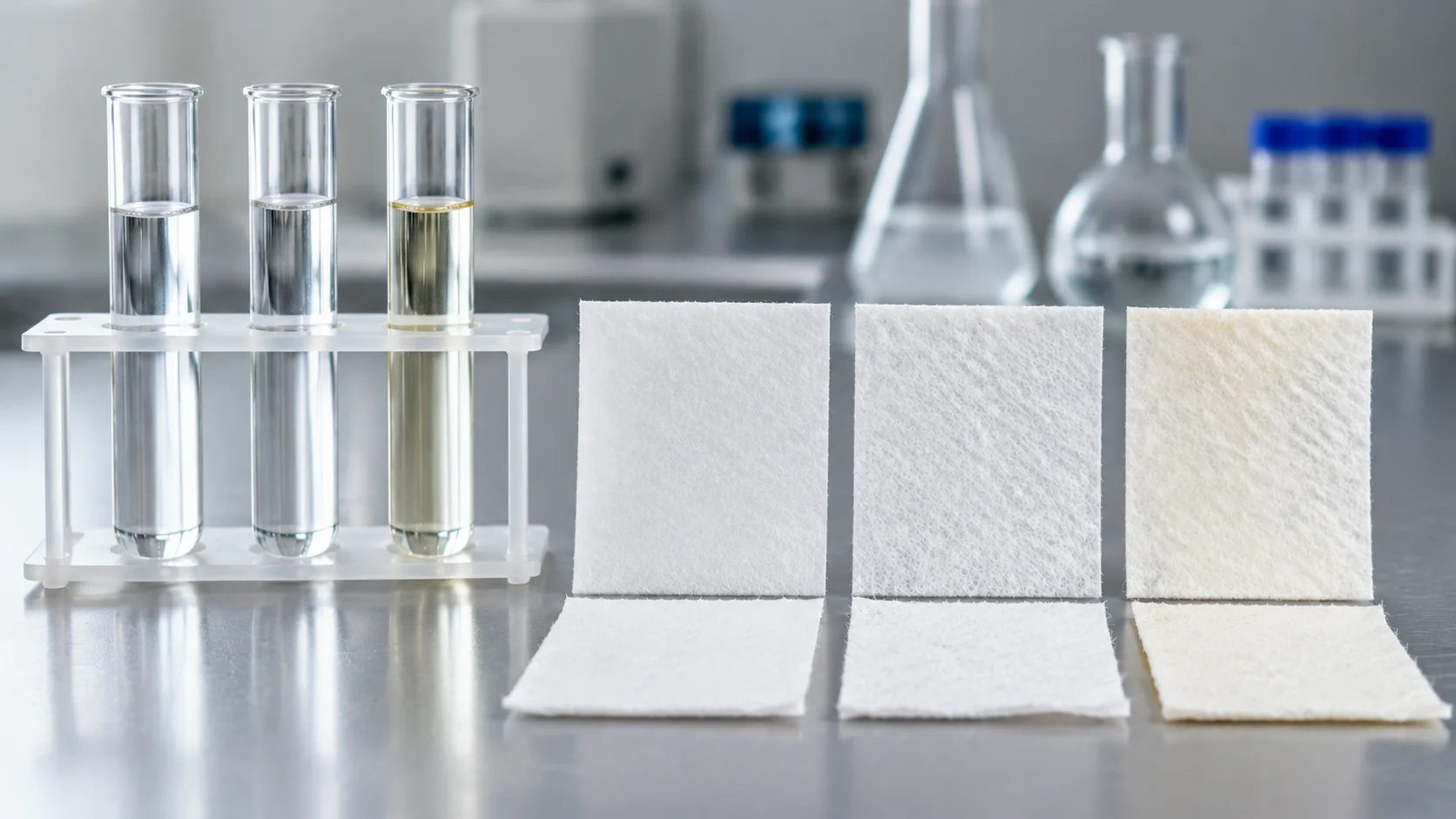
Nonwoven Fabric Chemical Resistance Chart: IPA, Ethanol, Bleach — PP, PET, Viscose Guide
Nonwoven fabric chemical resistance determines whether a fabric substrate can withstand contact with industrial chemicals, cleaning agents, and disinfectants without losing structural integrity or releasing harmful extractables. Favourite Fab, a B2B nonwoven fabric raw material supplier based in Agra, India, provides chemical resistance data for PP spunbond, PET, and viscose nonwoven grades. This guide covers resistance to IPA (isopropyl alcohol), ethanol, bleach, acids, and alkalis — essential data for buyers in wet wipes, medical, industrial cleaning, and alcohol swab applications.
What Is Chemical Resistance for Nonwoven Fabric
Chemical resistance describes how well a nonwoven fabric maintains its physical properties — tensile strength, elongation, barrier performance, and dimensional stability — after exposure to a chemical agent. It is rated by exposure duration, concentration, and temperature. A fabric that is resistant to a chemical shows no significant loss of tensile strength, no delamination, no dissolution, and no visible degradation after specified exposure. Resistance varies significantly by polymer type: PP is broadly chemical-resistant; viscose is susceptible to strong acids and alkalis.
Chemical Resistance Detail by Fabric Type
| Chemical | PP Spunbond | PET Nonwoven | Viscose/Spunlace | Notes |
|---|---|---|---|---|
| IPA 70% (isopropyl alcohol) | Good | Good | Good | Standard alcohol swab substrate; all types suitable |
| Ethanol 70% | Good | Good | Good | Widely used in wet wipes; all types compatible |
| Sodium hypochlorite 5% (bleach) | Good | Moderate | Moderate | PP most bleach-resistant; PET/viscose may yellow at high concentration |
| Dilute acid (pH 2–4) | Good | Moderate | Poor | Viscose dissolves in strong acid; PP resistant to most dilute acids |
| Dilute alkali (pH 10–12) | Good | Good | Poor | Viscose swells and weakens in strong alkali; PP and PET resistant |
| Hydrogen peroxide 3–6% | Good | Good | Moderate | Common wound care agent; PP/PET well-suited |
| Quaternary ammonium (quat) | Good | Good | Good | Used in disinfectant wipes; all substrates compatible |
| Acetone | Moderate | Good | Good | PP may swell with prolonged acetone exposure; PET more resistant |
Why Chemical Resistance Matters for Manufacturers
Wet wipe manufacturers, alcohol swab producers, and industrial cleaning product makers must select nonwoven substrates that are compatible with their active chemistry. A viscose spunlace substrate that weakens in the presence of bleach will cause wipe breakage during dispensing — a costly production and quality problem. An alcohol swab nonwoven that releases extractables into IPA will contaminate the product and risk patient safety.
Selecting the right substrate chemistry before scaling production is far less costly than discovering incompatibility in a field complaint. Favourite Fab’s technical team provides chemical resistance data for all grades and can recommend substrates based on your specific active ingredient and concentration.
Why Source From Favourite Fab
- MOQ-friendly — chemical resistance test data available at sampling stage
- Export-ready — material compatibility data for regulatory submissions
- ISO certified — consistent polymer and finish chemistry across production batches
- 10+ years hygiene and medical nonwoven supply
- Custom specs on request — chemical-resistant finishes and substrate blends available
- Alcohol swab nonwoven grades with IPA/ethanol compatibility data provided as standard
Pricing and MOQ
Chemical resistance data is provided free of charge for all grades. Custom compatibility testing — extended exposure, elevated temperature, specific concentration — is available at cost for buyers developing new wet wipe or disinfectant formulations. Contact sale@favouritehub.com with your chemical agent and substrate requirements for a targeted quotation.
See also: MSDS for nonwoven chemical finishes, EDANA INDA testing standards, and our alcohol swab nonwoven fabric product page. Full pillar: nonwoven fabric.
How to Order
- Send requirements to sale@favouritehub.com — specify chemical agent, concentration, and application
- Receive grade recommendation + chemical resistance data within 48 hours
- Confirm sample or bulk order — compatibility data included with shipment documentation
Frequently Asked Questions
Q: Which nonwoven fabric is best for IPA (isopropyl alcohol) wet wipes?
A: PP spunbond, PET nonwoven, and viscose spunlace are all compatible with IPA at standard wet wipe concentrations (60–70%). Viscose spunlace is most commonly used for alcohol swabs and skin-contact IPA wipes due to its softness and high absorbency. PP spunbond is preferred for industrial IPA wipes requiring higher tensile strength.
Q: Is PP spunbond resistant to sodium hypochlorite (bleach)?
A: Yes. PP spunbond shows good resistance to sodium hypochlorite at concentrations up to 5–10%. This makes it well-suited for bleach-based disinfectant wipes and surface cleaning applications. PET and viscose substrates show moderate resistance — yellowing may occur at high concentrations with prolonged contact.
Q: Why does viscose nonwoven have poor acid and alkali resistance?
A: Viscose (regenerated cellulose) is susceptible to hydrolysis by strong acids and swelling/degradation by strong alkalis. At dilute concentrations (pH 4–9), viscose performs adequately. At pH below 3 or above 11, significant loss of tensile strength and potential dissolution occurs. For aggressive chemistry, PP or PET substrates are recommended.
Q: What nonwoven fabric is recommended for hydrogen peroxide disinfectant wipes?
A: PP spunbond and PET nonwoven both show good resistance to hydrogen peroxide at 3–6% concentrations used in disinfectant wipes. Viscose shows moderate resistance — suitable for single-use wipes but not for extended contact applications. Specify your H2O2 concentration for a targeted grade recommendation.
Q: Does Favourite Fab provide chemical compatibility testing for custom formulations?
A: Yes. Favourite Fab can provide standard chemical resistance data for common agents (IPA, ethanol, bleach, quat). For custom formulations — novel active ingredients, high concentrations, elevated temperatures — custom compatibility testing can be arranged. Contact sale@favouritehub.com with your formulation details for a testing scope and cost estimate.
Contact Favourite Fab
Email: sale@favouritehub.com | WhatsApp: +91-8800775462
Send your chemical agent and substrate requirements today for a same-day grade recommendation.

Gaurav Garg
I'm Gaurav Garg, CEO of Favourite Fab, a company on a mission to revolutionize the nonwoven industry with sustainable practices. We work hand-in-hand with manufacturers and suppliers who share our commitment to eco-friendly production. With a deep interest in textile innovation, I'm passionate about educating consumers about sustainable material options and their potential to transform the nonwoven landscape.


