

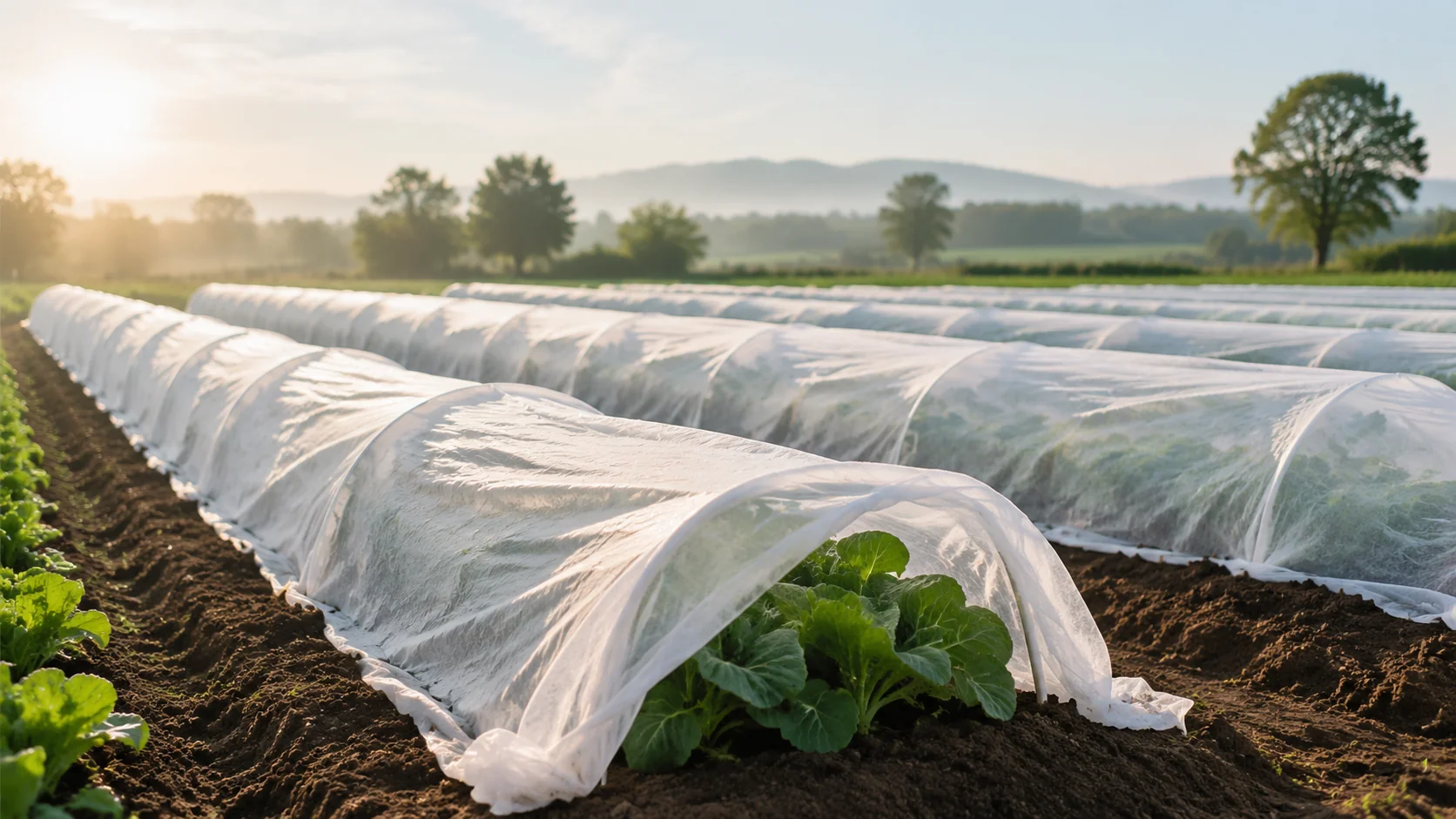
Nonwoven Fabric for Agriculture Crop Cover Weed Control India
Nonwoven fabric for agriculture crop cover weed control India is an essential raw material for greenhouse operators, nurseries, and large-scale crop producers. Favourite Fab manufactures and supplies spunbond and thermally bonded nonwoven fabrics purpose-built for agri-horticultural use. We supply upstream — directly to manufacturers, distributors, and large-scale agri-product converters across India and export markets.
What Is Agricultural Nonwoven Fabric
Agricultural nonwoven fabric is a permeable, lightweight sheeting material used as crop covers, mulch mats, and weed control barriers. It allows air, water, and filtered sunlight to pass through while protecting crops from frost, insects, and wind damage. This creates a microclimate that accelerates germination and early growth.
Spunbond polypropylene (PP) nonwoven is the most widely used type. It is UV stabilised for 1 to 4 seasons depending on grade. Weight ranges from 10 gsm (ultra-light frost fleece) to 50 gsm (heavy weed suppression mat). Each application requires a different balance of light transmittance, water permeability, and tensile strength.
Weed control nonwoven acts as a physical barrier preventing weed germination. Unlike chemical herbicides, it leaves no residue. It is widely used in berry farms, vineyards, tree nurseries, and vegetable production systems.
Specifications and Grade Options
| Parameter | Specification | Detail |
|---|---|---|
| GSM Range | 10–50 gsm | 10–17 gsm for frost protection; 30–50 gsm for weed control |
| Material | 100% PP Spunbond | Virgin and recycled grades available |
| UV Stabilisation | 1–4 seasons | Specify number of seasons at order placement |
| Light Transmittance | 70–90% | Higher for light frost fleece; lower for shading cloth |
| Water Permeability | 300–800 l/m²/s | Allows rainfall through; prevents surface runoff |
| Width | 1.6 m, 3.2 m, 4.2 m | Wide widths for large field coverage |
| Colour | White, Black, Brown | Black for weed suppression; white for frost/light cover |
Why Nonwoven Fabric Is Used in Agriculture and Horticulture
Nonwoven crop covers reduce frost damage risk by 2–5°C compared to uncovered crops. This extends the growing season in high-altitude and temperate regions. Vegetable growers report 20–30% yield improvement using season extension covers.
Weed control nonwoven eliminates herbicide costs in tree nurseries and berry farms. Black PP mulch mat suppresses 95%+ of weed species while retaining soil moisture. This reduces irrigation frequency and labour for hand-weeding operations.
For erosion control along embankments and slopes, heavier nonwoven grades (80–120 gsm) anchor topsoil while allowing root establishment. These are closely related to our erosion control nonwoven fabrics. Road construction projects use similar geotextile grades — see our road construction nonwoven page for those specifications.
Agricultural nonwoven is also used as nursery seedling trays, seedbed covers, and tree guards. The material protects young plants from mechanical damage, pests, and wind without requiring pesticide application.
Why Source From Favourite Fab
- MOQ-friendly — suitable for small and large manufacturers
- Export-ready — ships raw materials to 50+ countries
- ISO certified manufacturing facility
- 10+ years supplying the hygiene and medical industry
- Custom specifications available on request
- UV-stabilised grades with season-specific certification available
Pricing and MOQ
Agricultural nonwoven is priced on a per-kg or per-roll basis depending on volume. MOQ starts at 500 kg per grade and colour. Seasonal demand peaks in Q4 (Rabi season) and Q1 (Kharif). Plan orders 4–6 weeks ahead of peak season. We offer blanket purchase agreements for regular buyers.
Our full nonwoven fabric range and our PE-PP bico spunbond fabric are also suitable for agri-packaging and root protection applications. Contact us for a consolidated quote.
How to Order
- Send your material requirements to sale@favouritehub.com
- Receive a quote and sample within 48 hours
- Confirm order and production begins
Frequently Asked Questions
Q: What GSM nonwoven is best for frost protection in Indian winters?
A: 17–30 gsm white PP spunbond is widely used for frost fleece in Indian high-altitude and northern plain farms. It provides 2–4°C temperature buffering. For severe frost areas, double-layer 30 gsm fabric is recommended. Favourite Fab can supply both options with UV stabilisation.
Q: How long does agricultural nonwoven last in the field?
A: UV stabilisation determines lifespan. 1-season grades are cost-effective for annual crops. 3–4-season grades suit permanent berry or vineyard installations. Specify your intended seasons of use when ordering so we provide the correct UV additive level.
Q: Can I get wide-width fabric for large strawberry or berry farms?
A: Yes. We supply fabric up to 4.2 m wide for field-scale applications. Wide widths reduce overlap joins and installation labour. Custom widths are available for orders above 5 MT.
Q: Is agricultural nonwoven safe for organic certified farms?
A: Polypropylene nonwoven contains no harmful residues and does not leach chemicals into soil or groundwater. It is compatible with organic farming systems. We can provide material safety documentation on request.
Q: Do you supply black weed control nonwoven for tree nurseries?
A: Yes. Black PP nonwoven in 30–50 gsm is available for mulch mat and weed suppression applications. It is UV stabilised and perforated on request for tree pit applications. MOQ 500 kg per SKU.
Contact Favourite Fab
Email: sale@favouritehub.com
WhatsApp: +91-8800775462
Send your material specifications today for a same-day quote.

Gaurav Garg
I'm Gaurav Garg, CEO of Favourite Fab, a company on a mission to revolutionize the nonwoven industry with sustainable practices. We work hand-in-hand with manufacturers and suppliers who share our commitment to eco-friendly production. With a deep interest in textile innovation, I'm passionate about educating consumers about sustainable material options and their potential to transform the nonwoven landscape.


