

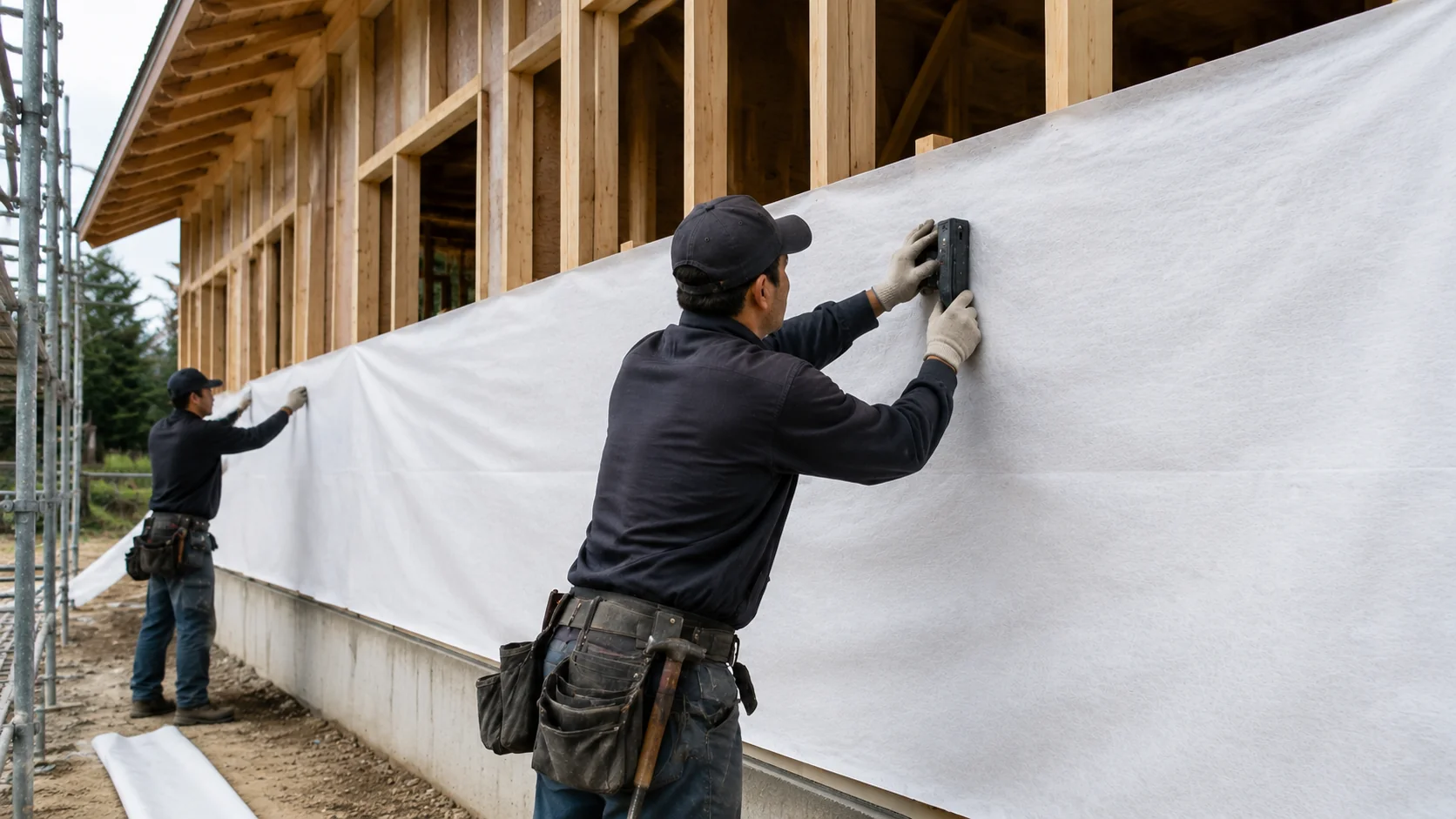
Nonwoven Fabric for Construction Industry Geotextile House Wrap India
Nonwoven fabric for construction industry geotextile house wrap India covers a wide range of applications — from building envelope membranes to road subbase separation, drainage blankets, and erosion protection. Favourite Fab supplies needle-punched, thermally bonded, and spunbond nonwoven fabrics to construction material manufacturers, geotextile converters, and civil engineering product companies. We are an upstream B2B raw material supplier only.
What Is Construction Nonwoven Fabric
Construction nonwoven fabric serves as a functional engineering material rather than an aesthetic product. In building envelopes, breathable nonwoven house wrap controls moisture vapour transmission while blocking wind-driven rain. This protects the structural wall cavity from condensation damage and mould growth.
In civil and geotechnical applications, needlepunch nonwoven geotextile performs separation, filtration, drainage, and reinforcement functions simultaneously. It prevents fine soil particles from migrating into drainage aggregate while allowing water to pass freely. This maintains long-term drainage performance beneath roads, retaining walls, and embankments.
Heavier grades (300–600 gsm) provide tensile reinforcement at soft soil interfaces. They distribute load across weak subgrades, reducing differential settlement. Construction projects in flood-prone and soft-soil regions across India routinely specify geotextile nonwoven in their civil works drawings.
Specifications and Grade Options
| Parameter | Specification | Detail |
|---|---|---|
| GSM Range | 80–600 gsm | House wrap 80–120 gsm; geotextile 150–600 gsm |
| Fabric Type | Needlepunch, Spunbond, Thermally bonded | Needlepunch for geotextile; spunbond for house wrap |
| Fibre | PP, PET, PE-PP bico | PET preferred for long-term civil applications |
| Tensile Strength | 5–40 kN/m | Per IS 13162 / ASTM D 4595 |
| Puncture Resistance | 200–2000 N | Higher for heavy geotextile grades under aggregate |
| Water Flow Rate | 40–200 l/m²/s | Critical for drainage applications |
| UV Resistance | Standard and stabilised grades | UV stabilised required for exposed temporary works |
Why Nonwoven Fabric Is Used in the Construction Industry
Nonwoven geotextile is specified in Indian road construction under IRC:SP:59 and BIS standards. It extends pavement life by preventing subgrade contamination into road base layers. This reduces maintenance frequency and lifecycle cost across national highway and rural road projects.
House wrap nonwoven protects building cavities from moisture accumulation. Buildings without proper vapour-permeable wrapping suffer from interstitial condensation, leading to structural timber decay and mould. Nonwoven house wrap solves this at minimal cost relative to total construction budget.
Retaining walls and slope stabilisation projects use nonwoven drainage blankets behind the wall face. The fabric allows water drawdown through the fill while retaining fine soil particles. This prevents hydrostatic pressure build-up that causes wall failure. For road-specific applications, see our nonwoven fabric for road construction. Our full nonwoven fabric range covers all construction grades. Related acoustic insulation applications are detailed on our acoustic insulation nonwoven page.
Our PE-PP bico spunbond fabric is suitable for vapour control layers and secondary waterproofing in roofing and podium slab applications.
Why Source From Favourite Fab
- MOQ-friendly — suitable for small and large manufacturers
- Export-ready — ships raw materials to 50+ countries
- ISO certified manufacturing facility
- 10+ years supplying the hygiene and medical industry
- Custom specifications available on request
- Wide-width rolls available for large geotextile installation projects
Pricing and MOQ
Construction grade nonwoven is priced per kg or per roll based on width, GSM, and fibre specification. MOQ starts at 1 MT for standard geotextile grades. Project-specific quotes are available for large infrastructure tenders. We provide material certifications and test reports required for government project submissions.
Blanket supply agreements with staggered delivery are available for construction companies managing multiple site schedules. Contact our B2B sales team for tender-specific pricing.
How to Order
- Send your material requirements to sale@favouritehub.com
- Receive a quote and sample within 48 hours
- Confirm order and production begins
Frequently Asked Questions
Q: What geotextile GSM is required for national highway road projects in India?
A: IRC:SP:59 guidelines typically specify 150–300 gsm needlepunch nonwoven geotextile for subbase separation. Heavier grades (300–500 gsm) are used for soft soil reinforcement applications. Favourite Fab can supply both grades with test reports conforming to IS 13162 series.
Q: What is the difference between woven and nonwoven geotextile?
A: Woven geotextile provides higher tensile strength per unit weight and is preferred for steep slope reinforcement. Nonwoven geotextile provides better filtration, drainage, and separation due to its random fibre structure and higher porosity. Most construction projects use both types in different layers. Favourite Fab supplies nonwoven grades for filtration and drainage functions.
Q: Can you supply house wrap nonwoven that meets ASTM E1677?
A: Yes. We supply breathable spunbond nonwoven for building envelope applications. Provide your target vapour permeance and water resistance requirements and we will advise on the appropriate grade and relevant standard compliance.
Q: Do construction nonwoven rolls come in wide widths for large sites?
A: Yes. Geotextile rolls are available in widths up to 5 m. Wider rolls reduce overlap joins, speeding installation and reducing material waste. Specify your installation equipment capability when ordering.
Q: Is PET or PP better for long-term civil construction applications?
A: PET (polyester) is preferred for permanent civil works because it has higher creep resistance, better long-term tensile retention, and lower sensitivity to biological degradation. PP is cost-effective for short-term or temporary applications. Favourite Fab supplies both. We recommend PET for applications with design life above 25 years.
Contact Favourite Fab
Email: sale@favouritehub.com
WhatsApp: +91-8800775462
Send your material specifications today for a same-day quote.

Gaurav Garg
I'm Gaurav Garg, CEO of Favourite Fab, a company on a mission to revolutionize the nonwoven industry with sustainable practices. We work hand-in-hand with manufacturers and suppliers who share our commitment to eco-friendly production. With a deep interest in textile innovation, I'm passionate about educating consumers about sustainable material options and their potential to transform the nonwoven landscape.


