

Nonwoven Fabric for Erosion Control Biodegradable Geotextile India — Favourite Fab
Nonwoven fabric for erosion control protects exposed soil surfaces on slopes, embankments, riverbanks, and disturbed land from rainfall impact, surface runoff, and wind erosion. Favourite Fab supplies both biodegradable natural-fibre nonwoven and durable PP nonwoven geotextile mats to civil engineers, landscaping contractors, and erosion control product manufacturers across India and export markets. Our materials stabilise soil surfaces, support vegetation establishment, and prevent sediment loss during and after construction activity.
What Is Nonwoven Fabric for Erosion Control
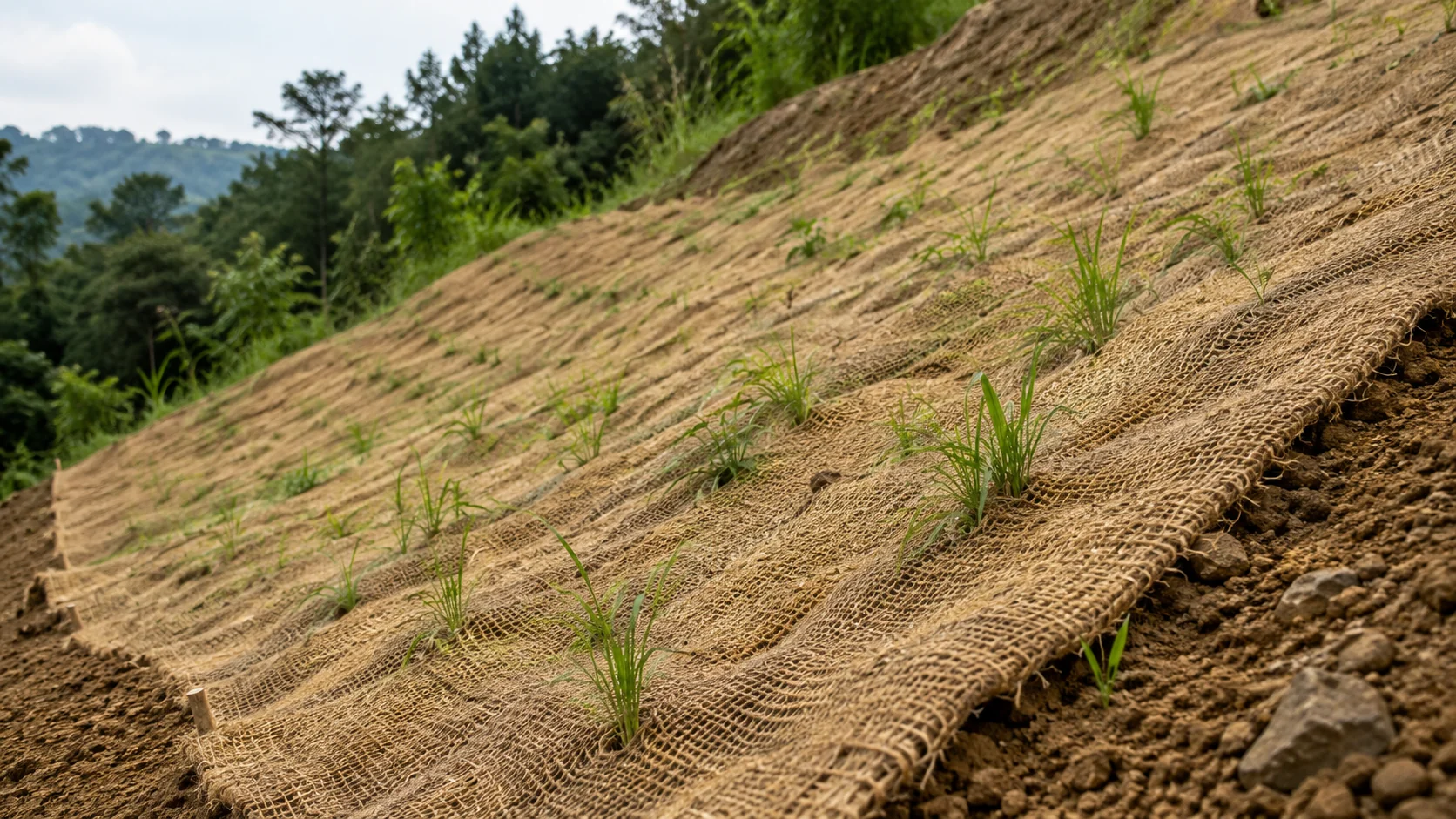
Erosion control nonwoven acts as a surface protection layer applied directly to bare soil. The fabric absorbs rainfall energy before it can detach soil particles. It slows surface runoff velocity, reducing its transport capacity for soil particles. And it retains soil moisture, creating conditions favourable for seed germination and root establishment.
Biodegradable erosion control nonwoven is made from natural fibres — jute, coir, straw, or wood pulp — that decompose over a defined service period. As the fabric biodegrades, established vegetation roots take over the slope stabilisation function. The fibre decomposition adds organic matter to the soil surface, improving long-term soil structure and fertility.
Permanent PP nonwoven erosion control fabric is used where vegetation alone cannot provide adequate long-term stabilisation. This applies to very steep slopes, rocky embankments, riverbank toe protection, and sites with chronic erosion risk. PP fabric retains full mechanical performance indefinitely, anchored to the slope by pins, staples, or buried edges.
Specifications and Grade Options
| Parameter | Specification | Detail |
|---|---|---|
| Material Options | PP needle-punched (permanent) / Jute or coir (biodegradable) | Selected by design life and revegetation requirement |
| Basis Weight | 200–800 GSM | Higher GSM for steep slopes and high-energy rainfall zones |
| Tensile Strength (MD) | 5–30 kN/m | Resists hydraulic drag and slope gravity forces |
| Elongation at Break | 40–100% | Accommodates surface irregularities without tearing |
| Biodegradable Service Life | 6 months – 3 years | Adjusted by fibre type and blend ratio |
| Water Absorption | Rapid — within 2 seconds | Immediate rainfall energy absorption on application |
| UV Resistance (PP grades) | UV stabilised to 2,500 kLy | Suitable for permanent exposed slope protection |
| Roll Width | 1–4 m | Wide rolls speed installation on large embankments |
Why Nonwoven Fabric Is Used in Erosion Control
Nonwoven geotextile mats absorb the kinetic energy of rainfall before it can detach soil particles. This energy absorption is the first line of defence against erosion. Bare soil hit by raindrops experiences splash detachment that mobilises fine particles for transport by runoff. A nonwoven mat eliminates direct raindrop impact on the soil surface entirely.
The three-dimensional fibre matrix of needle-punched nonwoven slows surface runoff by increasing hydraulic resistance. Lower runoff velocity means less transport capacity for sediment. Even where some surface flow occurs, the nonwoven acts as a physical barrier that filters suspended particles before they leave the site. This function is critical on construction sites subject to environmental compliance requirements.
Biodegradable nonwoven mats support vegetation establishment by retaining moisture at the soil surface during the critical early germination period. The mat creates a microclimate that reduces evaporation, moderates soil temperature extremes, and protects emerging seedlings from wind damage. Once root systems are established, the biodegrading mat transfers slope stability function to the vegetation root network.
For road construction geotextile applications see our nonwoven fabric for road construction page. Customers in agriculture and horticulture will also find relevant grades on our nonwoven fabric for agriculture and horticulture page. For the full range of geotechnical nonwoven grades we supply, including drainage and filtration composites, our PE-PP bicomponent spunbond nonwoven is often specified. Browse our main nonwoven fabric category for the complete range.
Why Source From Favourite Fab
- MOQ-friendly — suitable for small and large manufacturers
- Export-ready — ships raw materials to 50+ countries
- ISO certified manufacturing facility
- 10+ years supplying the hygiene and medical industry
- Custom specifications available on request
Pricing and MOQ
Favourite Fab prices erosion control nonwoven by GSM, material type, roll width, and project volume. Biodegradable natural-fibre grades and permanent PP grades are quoted separately. We support both product manufacturer supply and direct project supply through distributor channels. Contact our team for current pricing and availability for your project specification.
How to Order
- Send your material requirements to sale@favouritehub.com
- Receive a quote and sample within 48 hours
- Confirm order and production begins
Frequently Asked Questions
Q: What is the difference between biodegradable and permanent erosion control nonwoven?
A: Biodegradable grades (jute, coir, straw blends) decompose within 6 months to 3 years. They are used where vegetation will take over stabilisation once established. Permanent PP grades retain full strength indefinitely and are used where vegetation alone is insufficient — steep slopes, riverbanks, or chronically eroding sites.
Q: What GSM is required for steep slope erosion control?
A: Slopes above 1:1.5 gradient in high-rainfall zones typically require 400–600 GSM needle-punched nonwoven for adequate hydraulic resistance and mechanical anchoring. Flatter slopes in moderate rainfall areas may use 200–300 GSM. Favourite Fab can recommend grades based on slope angle and design rainfall intensity.
Q: How is erosion control nonwoven anchored to a slope?
A: Standard installation uses U-shaped steel or bamboo pins at 1–2 m spacing across the slope. Edges and seams are buried in anchor trenches at the crest. On very steep slopes, a combination of pins, anchor trenches, and overlapping rolls provides full retention against hydraulic drag and gravity.
Q: Can erosion control nonwoven be seeded before installation?
A: Yes. Seed and fertiliser can be applied to the prepared soil surface before mat placement. Alternatively, hydroseed can be applied over the mat after installation. Both methods are effective. The mat retains moisture at the seed-soil interface regardless of seeding sequence.
Q: Is PP nonwoven geotextile effective for riverbank erosion control?
A: Yes for bank protection above the waterline and in the splash zone. For submerged riverbank toe protection, geotextile is typically combined with riprap or gabion mattresses. The nonwoven provides a filter layer between the subgrade and the armour that prevents scour of fine material through the stone layer.
Q: Do you supply erosion control nonwoven for export markets?
A: Yes. We export to Southeast Asia, the Middle East, and East Africa — regions with high erosion risk from monsoon and tropical rainfall. Export shipments include material test reports, packing declarations, and certificates of origin. Contact us for export pricing and freight terms.
Contact Favourite Fab
Email: sale@favouritehub.com
WhatsApp: +91-8800775462
Send your material specifications today for a same-day quote.

Gaurav Garg
I'm Gaurav Garg, CEO of Favourite Fab, a company on a mission to revolutionize the nonwoven industry with sustainable practices. We work hand-in-hand with manufacturers and suppliers who share our commitment to eco-friendly production. With a deep interest in textile innovation, I'm passionate about educating consumers about sustainable material options and their potential to transform the nonwoven landscape.


