

Nonwoven Fabric for Garment Interlining Fusible Sew-In India — Favourite Fab
Nonwoven fabric for garment interlining is the upstream raw material that gives structured garments their shape, body, and dimensional stability. Favourite Fab supplies fusible and sew-in nonwoven interlining base fabrics to garment manufacturers, interlining converters, and apparel input suppliers across India and international markets. Our materials are engineered for consistent bonding performance, wash durability, and hand-feel compatibility across a wide range of outer shell fabrics.
What Is Nonwoven Fabric for Garment Interlining
Garment interlining is a hidden layer bonded or sewn between the outer shell fabric and the lining. It adds structural support to collars, cuffs, facings, waistbands, and front plackets. Nonwoven interlining is the dominant type used in modern garment manufacturing due to its consistent properties, ease of processing, and cost efficiency at scale.
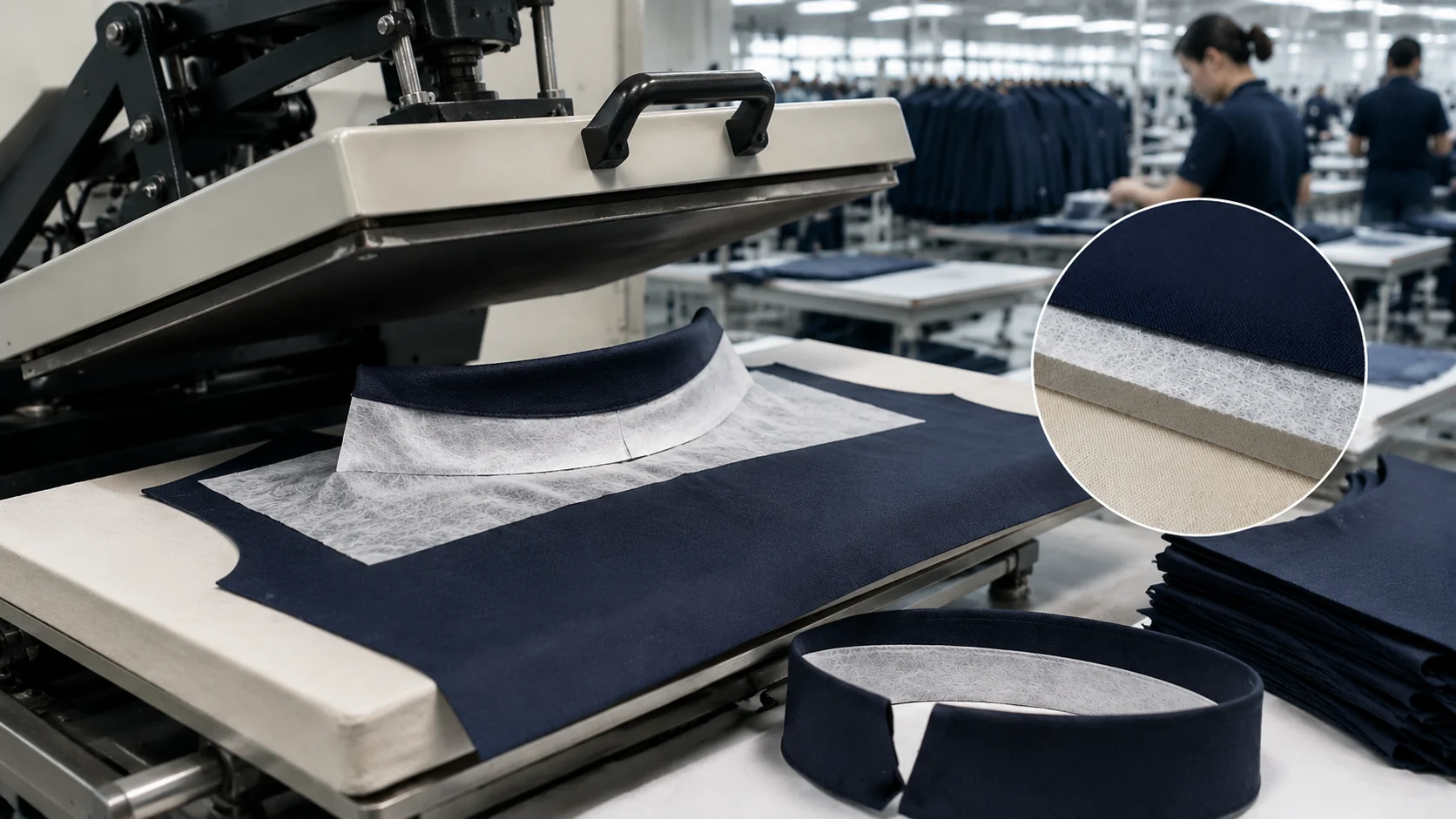
Fusible nonwoven interlining carries a thermoplastic adhesive coating on one face. When pressed under heat and pressure, the adhesive bonds the interlining permanently to the outer fabric. Sew-in interlining has no adhesive and is attached by stitching. Both types use a nonwoven base fabric that provides the structural contribution to the finished garment panel.
The nonwoven base material determines the hand, drape, weight, and wash performance of the finished interlining. Fibre type, bonding method, and GSM are selected to match the outer fabric weight and the structural requirement of each garment panel. Favourite Fab supplies base fabrics across the full specification range needed by interlining manufacturers.
Specifications and Grade Options
| Parameter | Specification | Detail |
|---|---|---|
| Base Fibre | PP, PET, Viscose, or blends | Selected by hand-feel and wash requirements |
| Basis Weight | 20–120 GSM | Light for shirts, heavy for jackets and coats |
| Bonding Type | Thermal bonded, chemical bonded, stitch bonded | Thermal bonded most common for interlining |
| Adhesive Coat Weight | 8–25 GSM (for fusible grades) | PA, PES, or LDPE hotmelt available |
| Wash Resistance | 40°C–60°C domestic; up to 95°C industrial | Grade selected by end-use wash requirement |
| Shrinkage (warp/weft) | ≤1.5% / ≤1.5% after 3 washes | Critical for collar and placket stability |
| Roll Width | 0.9–1.6 m | Custom widths for automated cutting lines |
| Colour | White, off-white, black, grey | Custom colours available for large volumes |
Why Nonwoven Fabric Is Used in Garment Interlining
Nonwoven interlining offers isotropic structure — it has similar properties in all directions. This isotropy prevents distortion of garment panels after cutting and sewing. Woven interlinings have grain direction that limits panel orientation on the cutting table. Nonwoven eliminates this constraint and reduces fabric waste in cutting.
Thermal-bonded nonwoven base fabrics are dimensionally stable at pressing temperatures up to 200°C. They do not shrink or distort during the fusing press operation that bonds the adhesive to the shell fabric. This stability ensures accurate finished panel dimensions critical for collar and cuff construction.
The open fibre structure of nonwoven interlining allows adhesive penetration during fusing without strike-through to the outer fabric surface. Controlled adhesive penetration is essential for high-quality fusible interlining. Favourite Fab base fabrics are produced with consistent porosity to support reliable fusing performance across different adhesive systems.
For complementary apparel nonwoven applications, see our nonwoven fabric for shoe components and our main spunbond nonwoven fabric category. Apparel manufacturers requiring medical-grade fabric for protective garments can also explore our spunbond nonwoven for surgical gowns. See our full nonwoven fabric range for the complete portfolio.
Why Source From Favourite Fab
- MOQ-friendly — suitable for small and large manufacturers
- Export-ready — ships raw materials to 50+ countries
- ISO certified manufacturing facility
- 10+ years supplying the hygiene and medical industry
- Custom specifications available on request
Pricing and MOQ
Favourite Fab offers competitive wholesale pricing on all garment interlining nonwoven base fabrics. Pricing varies by fibre type, GSM, bonding method, and roll width. We support sampling requests for new product development and offer volume pricing for committed monthly purchase quantities. Contact our sales team for current pricing and lead times.
How to Order
- Send your material requirements to sale@favouritehub.com
- Receive a quote and sample within 48 hours
- Confirm order and production begins
Frequently Asked Questions
Q: What GSM nonwoven is used for shirt collar interlining?
A: Shirt collar interlining typically uses 35–55 GSM thermal-bonded nonwoven base fabric. The lower end suits lightweight dress shirts. Heavier formal shirts may use up to 60 GSM. Favourite Fab can supply samples across this range for your development trials.
Q: What is the difference between fusible and sew-in nonwoven interlining?
A: Fusible interlining has a thermoplastic adhesive coating that bonds to the shell fabric under heat and pressure. Sew-in interlining has no adhesive and is attached by stitching. Favourite Fab supplies base fabrics suitable for both types. The adhesive coating is applied by the interlining converter, not by Favourite Fab.
Q: Can your nonwoven base fabric withstand repeated home washing?
A: Yes. Our thermal-bonded PP and PET interlining base fabrics maintain dimensional stability through 20+ wash cycles at 40°C–60°C when correctly fused. Wash performance depends on correct fusing parameters and adhesive system selection.
Q: Do you supply interlining base fabrics for denim and heavy outerwear?
A: Yes. For heavy outerwear we supply 80–120 GSM needle-punched or thermally-bonded nonwoven. These grades provide the body required for structured jacket fronts, lapels, and waistbands on heavy fabrics.
Q: Is viscose-blend nonwoven available for softer hand-feel interlining?
A: Yes. Viscose-polyester blend nonwoven is available for applications where soft drape and natural hand-feel are required. This grade is common in women’s wear and lightweight formal shirts.
Q: What is the lead time for custom-width interlining nonwoven rolls?
A: Standard widths are available from stock. Custom slit widths are produced within 5–10 working days depending on current production schedule and order volume.
Contact Favourite Fab
Email: sale@favouritehub.com
WhatsApp: +91-8800775462
Send your material specifications today for a same-day quote.

Gaurav Garg
I'm Gaurav Garg, CEO of Favourite Fab, a company on a mission to revolutionize the nonwoven industry with sustainable practices. We work hand-in-hand with manufacturers and suppliers who share our commitment to eco-friendly production. With a deep interest in textile innovation, I'm passionate about educating consumers about sustainable material options and their potential to transform the nonwoven landscape.


