

Nonwoven Fabric for Road Construction Geotextile Separation Filtration India — Favourite Fab
Nonwoven fabric for road construction serves as a geotextile layer that separates subgrade soil from aggregate base courses, prevents fines migration, and extends road service life. Favourite Fab supplies needle-punched and thermally-bonded nonwoven geotextile fabrics to civil contractors, road construction companies, and geotextile distributors across India and export markets. Our materials meet the mechanical and hydraulic requirements demanded by highway, rural road, and infrastructure projects.
What Is Nonwoven Fabric for Road Construction
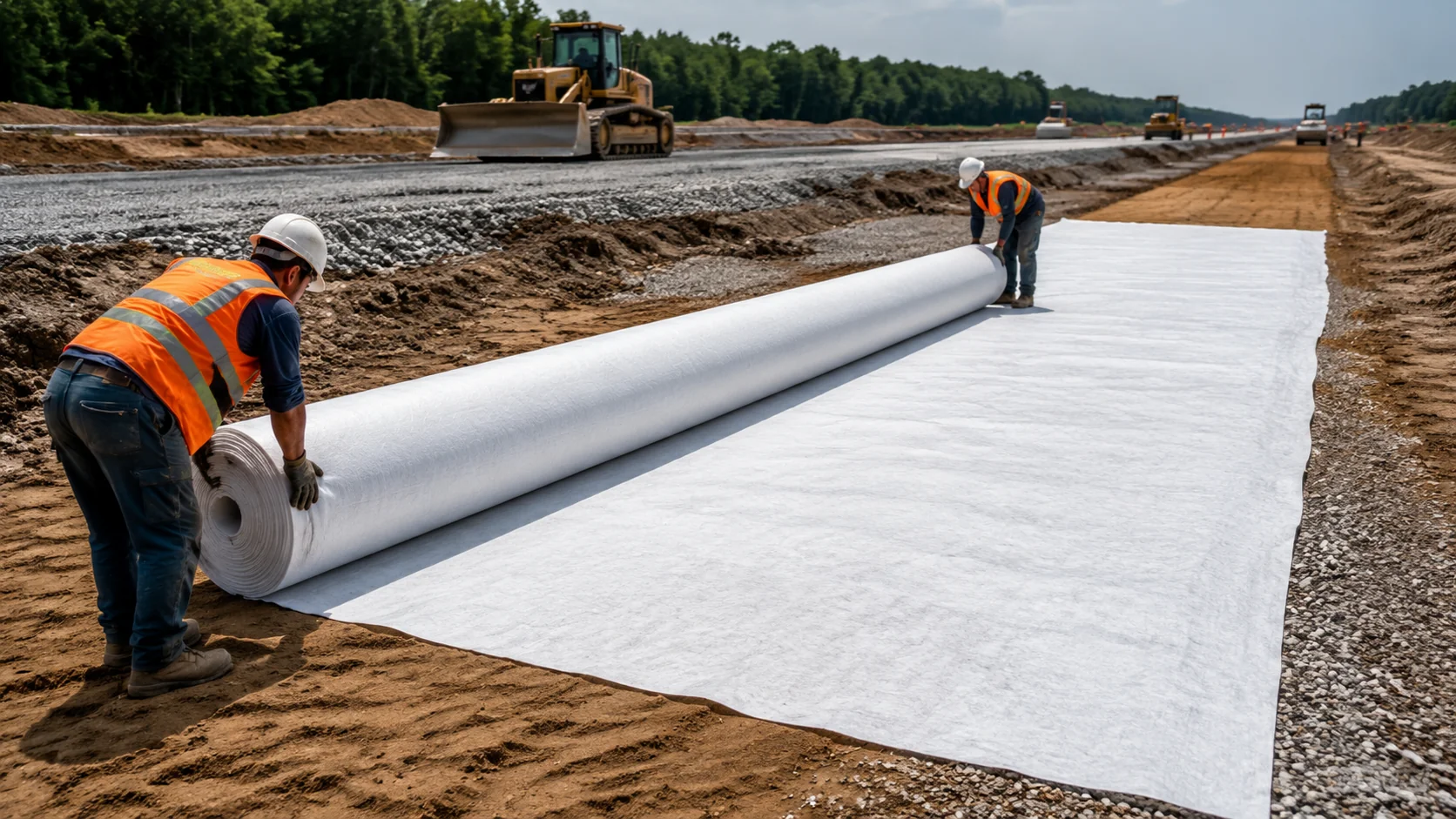
Road construction nonwoven geotextile is placed directly on prepared subgrade before aggregate base layers are spread and compacted. The nonwoven layer performs two simultaneous functions: separation and filtration. Separation prevents subgrade soil from pumping upward into the aggregate under traffic loading. Filtration allows water to drain through the nonwoven without carrying fine soil particles with it.
Without a separation geotextile, subgrade fines migrate into the aggregate base under repeated traffic loading. This contamination reduces aggregate bearing capacity, causes rutting, and accelerates road deterioration. A correctly specified nonwoven geotextile maintains the structural separation between subgrade and aggregate throughout the design life of the pavement.
Indian road construction projects — from national highways under NHAI specifications to PMGSY rural roads — increasingly specify geotextile separation layers. Nonwoven PP geotextile is the dominant material used due to its cost efficiency, chemical resistance, and consistent hydraulic performance across a wide range of site conditions.
Specifications and Grade Options
| Parameter | Specification | Detail |
|---|---|---|
| Material | 100% PP needle-punched nonwoven | UV-stabilised grades available for exposed applications |
| Basis Weight | 80–400 GSM | Heavier grades for soft subgrade and high-load roads |
| Tensile Strength (MD/CD) | 8–35 kN/m | Meets MORTH and BIS specifications for road geotextiles |
| Elongation at Break | 50–80% | Accommodates subgrade deformation without tearing |
| Apparent Opening Size (AOS) | 0.063–0.212 mm | Selected by subgrade particle size distribution |
| Permittivity | 0.5–2.0 s⁻¹ | Adequate hydraulic flow for drainage without piping |
| CBR Puncture Resistance | ≥1.5 kN | Withstands aggregate angularity during placement |
| Roll Width | 2–6 m | Wide rolls reduce overlap seams on large projects |
Why Nonwoven Fabric Is Used in Road Construction
Nonwoven geotextile outperforms woven geotextile in filtration applications because its random fibre structure provides a tortuous flow path that retains fine particles. Woven geotextiles have uniform apertures that can allow fine migration under high hydraulic gradients. Nonwoven’s variable pore structure self-filters fine particles while maintaining permeability for free water drainage.
Needle-punched PP nonwoven provides high elongation at break — typically 50–80%. This elongation allows the geotextile to accommodate subgrade settlement and differential movement without tearing. In areas with soft or variable subgrade, this flexibility prevents separation failure that would occur with a stiffer woven product.
PP geotextile is chemically inert to soil chemicals, groundwater minerals, and microbiological activity. Unlike natural fibre alternatives, PP does not biodegrade, rot, or lose strength over the design life of a road. This permanence makes PP nonwoven the preferred choice for buried road applications where inspection and replacement are not feasible.
For related geotechnical nonwoven applications see our nonwoven fabric for erosion control and our nonwoven fabric for the construction industry pages. Road construction projects using our geotextile often also source our PE-PP bicomponent spunbond nonwoven for drainage composites and protection layers. Browse our main nonwoven fabric range for the complete product portfolio.
Why Source From Favourite Fab
- MOQ-friendly — suitable for small and large manufacturers
- Export-ready — ships raw materials to 50+ countries
- ISO certified manufacturing facility
- 10+ years supplying the hygiene and medical industry
- Custom specifications available on request
Pricing and MOQ
Favourite Fab supplies road construction nonwoven geotextile at competitive wholesale pricing based on GSM, roll width, and project volume. We accommodate both project-specific supply requirements and standing orders for geotextile distributors. Bulk project pricing is available with delivery scheduling aligned to your construction programme. Contact our sales team for a current quotation.
How to Order
- Send your material requirements to sale@favouritehub.com
- Receive a quote and sample within 48 hours
- Confirm order and production begins
Frequently Asked Questions
Q: What GSM geotextile is required for a standard rural road project?
A: PMGSY and rural road projects typically specify 150–200 GSM needle-punched nonwoven for separation layers on medium-strength subgrade. For weak subgrade (CBR below 3%), 200–300 GSM is recommended. Favourite Fab can assist with specification review based on your subgrade test data.
Q: Does your geotextile meet MORTH and BIS specifications?
A: Yes. Our needle-punched PP geotextiles are produced to meet BIS IS:17229 and MORTH Section 700 specifications for geosynthetics in road construction. Test reports are available for each production lot on request.
Q: What is the correct overlap for geotextile seams in road construction?
A: Standard practice requires a minimum 300 mm overlap for separation applications on firm subgrade. For soft subgrade, overlap should increase to 500–1000 mm or rolls should be sewn. Your project specification and site soil conditions determine the exact requirement.
Q: Can geotextile be used under rigid concrete road pavements?
A: Yes. Nonwoven geotextile is used under rigid pavements as a separation layer between subbase and subgrade. It also serves as a capillary break to prevent moisture rise. Our 150–250 GSM grades are commonly used in this application.
Q: How is geotextile protected during aggregate placement?
A: Aggregate should be pushed forward over the geotextile using tracked equipment — not dropped from height. Our CBR puncture resistance values ensure the geotextile withstands normal aggregate placement loads. Avoid driving directly on unprotected geotextile with wheeled plant.
Q: Do you supply geotextile for highway projects in large quantities?
A: Yes. We supply large infrastructure projects with scheduled deliveries aligned to construction programmes. Wide roll widths (up to 6 m) reduce seam frequency and installation time. Contact us with your project schedule and estimated quantities for a project-specific supply proposal.
Contact Favourite Fab
Email: sale@favouritehub.com
WhatsApp: +91-8800775462
Send your material specifications today for a same-day quote.

Gaurav Garg
I'm Gaurav Garg, CEO of Favourite Fab, a company on a mission to revolutionize the nonwoven industry with sustainable practices. We work hand-in-hand with manufacturers and suppliers who share our commitment to eco-friendly production. With a deep interest in textile innovation, I'm passionate about educating consumers about sustainable material options and their potential to transform the nonwoven landscape.


