Parallel Laid Spunlace Nonwoven Fabric Manufacturer India
By Gaurav Garg·April 10, 2026·9 min read
Share
B2B Raw Material Supplier · India
Parallel Laid Spunlace Nonwoven Fabric — Manufacturer & Supplier India
Favourite Fab supplies parallel laid spunlace nonwoven fabric in bulk to wet wipe manufacturers, hygiene product OEMs, cosmetic wipe converters, and feminine hygiene producers across India and 50+ export markets. Parallel laid is the standard, cost-optimised web structure for spunlace nonwoven — the correct specification for the majority of single-direction converting applications where maximum MD tensile and minimum material cost are the primary drivers.
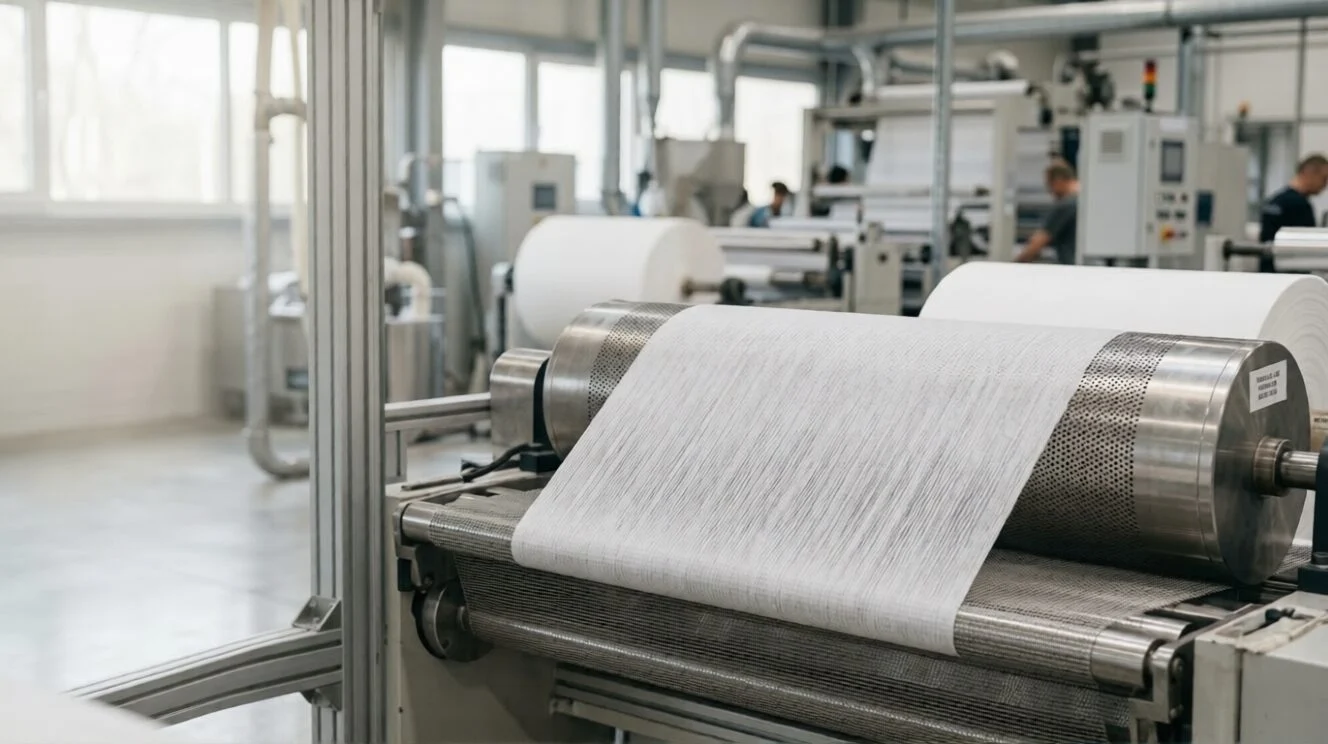
Parallel laid spunlace nonwoven fabric is produced by feeding a single-pass carded fibre web directly into the hydroentanglement process without cross-lapping. In the carding process, fibres are predominantly oriented in the machine direction (MD). The resulting spunlace fabric has a strongly anisotropic structure: significantly higher tensile strength in the machine direction than in the cross direction (CD).
Parallel laid is the baseline web-formation method for spunlace production. It is the simplest, fastest, and most cost-effective approach — no cross-lapping equipment is required, the production line runs at higher speed than cross-lapped variants, and the fibre-to-product yield is maximised. For converting lines that unwind and process the fabric in a single direction — the MD — parallel laid spunlace is the optimal specification.
The MD:CD tensile ratio for parallel laid spunlace typically ranges from 3:1 to 6:1 depending on fibre type, GSM, and hydroentanglement conditions. This ratio is not a defect — it is a deliberate outcome of the web structure that makes parallel laid the right choice for specific converting applications, and the wrong choice for others.
💰
Lowest Cost at Equivalent GSM — The Primary AdvantageParallel laid spunlace is 5–20% lower cost than semi-cross and 10–20% lower cost than full cross-lapped at the same GSM and fibre specification. The cost difference comes from faster production line speed, simpler equipment (no cross-lapper), and higher fibre utilisation efficiency. For volume buyers, this cost advantage compounds significantly over a year’s procurement.
⚡
High MD Tensile — Optimal for Unwind-and-Process ConvertingParallel laid fabric has the highest machine-direction tensile of the three web structures at equivalent GSM. This makes it the optimal choice for converting lines where the fabric is unwound, fed, cut, and folded entirely in the MD. High MD tensile reduces web breaks at unwind and improves registration accuracy on high-speed cutting lines.
🧵
Softer Hand-Feel in CD — Consumer BenefitThe lower fibre density in the cross direction gives parallel laid spunlace a softer, more flexible hand-feel when flexed across the width. For facial wipes, cosmetic sheets, and premium personal care wipes, this softness is a feature — not a limitation.
🎯
Specify Parallel Laid When — the Decision RuleSpecify parallel laid when: (1) your converting line applies tension and cutting force only in the MD; (2) your GSM is 50 gsm or below and CD tear-out is not a current quality complaint; (3) cost reduction is material to your business; (4) your application is facial, cosmetic, or light hygiene wipes. Switch to semi-cross or cross-lapped when CD tearing or web drift is observed.
• GSM is 60 gsm or above (cross-lapping required for heavy web coherence)
• Medical wound care, underpads, or applications with omnidirectional force
• Converting line has significant lateral tension that parallel and semi-cross cannot handle
Technical Specifications
Parallel Laid Spunlace — Full Specification Range
All specifications are for standard wholesale orders. Parallel laid is available across all common fibre types and GSM. Custom parameters confirmed at enquiry.
Parameter
Standard Range
Notes for Buyers
GSM (Weight)
20 – 80 gsm
Most commonly specified in 20–50 gsm; above 60 gsm cross-lapping is recommended for web coherence
Absorption equivalent to cross-lapped at the same fibre composition and GSM
Roll Width
10 cm – 340 cm
Common slit widths for wipe converting: 30, 50, 100, 160, 220, 320 cm
Roll Length
800 – 3,500 m per roll
Parallel laid lines run at higher speed — longer roll lengths typically available versus cross-lapped at equivalent GSM
Certifications
ISO certified; OEKO-TEX compatible; biodegradable grades available
COA, MSDS, and MD/CD tensile values per batch; third-party test reports on request
Buyer Industries
Parallel Laid Spunlace — B2B Applications
Parallel laid is the dominant spunlace web structure for volume hygiene and cosmetic wipe applications where the converting process is MD-optimised.
🧻 Standard Wet Wipes
30–50 gsm
Baby wipes, household wipes, and personal care wipes at 30–50 gsm where the converting line is MD-pull and CD tear-out is not a quality complaint. The largest volume application for parallel laid spunlace globally.
💆 Facial & Cosmetic Wipes
20–35 gsm
Sheet masks, cleansing cloths, makeup removal wipes, and facial tissue at 20–35 gsm. At this GSM range, parallel laid’s lower CD tensile is not a converting problem, and its cost advantage is most pronounced.
🌸 Sanitary Pad Top Sheet
25–45 gsm
Top sheet for sanitary pads and panty liners on standard MD-pull pad converting lines. The high MD tensile of parallel laid reduces web breaks on high-speed pad assembly machines.
👶 Baby Care
25–40 gsm
Baby wipe substrate, diaper top sheet alternatives, and baby care wipes for volume production at cost-sensitive price points. Parallel laid at 30–40 gsm with 70/30 viscose-PET is the standard specification.
💅 Personal Care
20–35 gsm
Cotton pads, makeup remover pads, intimate care wipes, and travel wipes. Lightweight parallel laid at 20–30 gsm delivers the right hand-feel and absorbency at lowest material cost for personal care applications.
🩺 Light Medical / Hygiene
35–55 gsm
Patient prep wipes, medical surface wipes, and hospital bed hygiene wipes where CD tensile requirement is low and the converting process is MD-pull. Above 55 gsm, evaluate semi-cross or cross-lapped.
Supplier Credentials
Why Manufacturers Source Parallel Laid Spunlace From Favourite Fab
Parallel laid spunlace is Favourite Fab’s highest-volume product. We supply consistent GSM, uniform MD tensile, and tight basis weight tolerance across every roll.
50+Export MarketsParallel laid spunlace exported in large volumes to wipe converters in Southeast Asia, Middle East, Africa, and Europe
±3%GSM ToleranceTight basis weight tolerance across the full roll width — reduces weight-per-wipe variation on automated converting lines
ISOCertifiedMD and CD tensile values reported on every batch COA; OEKO-TEX compatible grades available
48hSample DispatchSample rolls dispatched within 48 hours for converting line trial and tensile qualification testing
1
Send Your SpecificationInclude GSM, fibre type, roll width, surface pattern, and monthly volume. State if you are experiencing CD tearing so we can advise on web structure.
2
Receive Quote & Sample RollPricing within 24 hours. Sample roll with COA (MD tensile, CD tensile, GSM, absorbency) dispatched within 48 hours for your converting line trial.
3
Confirm & DispatchOrder confirmed on PO receipt. Full COA per batch. Export documentation for international orders. Consistent roll parameters for automated converting line compatibility.
ISO CertifiedMD & CD Tensile on COAAll Fibre Types50+ Countries±3% GSM ToleranceGSM 20–80
Procurement FAQ
Frequently Asked Questions — Parallel Laid Spunlace
What does “parallel laid” mean in spunlace nonwoven?+
Parallel laid refers to the web-formation method used before hydroentanglement. In parallel laid production, a single-pass carded fibre web is fed directly into the hydroentanglement manifolds without any cross-lapping step. During carding, fibres are predominantly aligned in the machine direction. The resulting fabric has a strongly anisotropic tensile structure, with MD tensile typically 3–6 times higher than CD tensile. This is the baseline standard method for spunlace production and the most cost-effective web structure.
When should I switch from parallel laid to semi-cross or cross-lapped?+
Switch to semi-cross when you experience CD tear-out from wipe packs, width drift on your converting line, or when your converting process applies any lateral tension. Switch to full cross-lapped when your GSM is above 60 gsm, your application is industrial or medical, or when semi-cross has been tried and is still insufficient. If you are not experiencing any quality issue with parallel laid, remain on parallel laid — the cost saving is real and the upgrade is only warranted when a specific performance requirement cannot be met.
What is the MD:CD tensile ratio for parallel laid spunlace?+
Parallel laid spunlace typically achieves an MD:CD ratio of 3:1 to 6:1, depending on fibre type, GSM, and hydroentanglement parameters. 100% viscose at 30 gsm might achieve 4:1–5:1; 70/30 viscose-PET at 40 gsm might achieve 3:1–4:1 due to the polyester fibres’ tendency to entangle more randomly. If you need a specific ratio, state this requirement at the time of specification.
Is parallel laid spunlace available in all fibre types?+
Yes. Parallel laid is a web-formation method, not a fibre specification. Favourite Fab supplies parallel laid spunlace in viscose, polyester, viscose/polyester blend, bamboo, cotton, lyocell, and organic cotton. Specify both fibre type and web structure independently when enquiring.
How much cheaper is parallel laid versus cross-lapped at the same GSM?+
Parallel laid is typically 10–20% lower in cost than full cross-lapped at equivalent GSM and fibre specification. Semi-cross falls between the two at 5–12% premium over parallel laid. At high monthly procurement volumes, this cost difference is meaningful — confirm current quotes for both web structures before committing to cross-lapped specification where parallel laid is sufficient.
What is the MOQ for parallel laid spunlace?+
MOQ for standard parallel laid grades starts from 500 kg per specification. As the most commonly produced web structure, standard parallel laid grades have the lowest MOQ of the three web structures. Contact us with your full specification for an accurate MOQ and pricing.
Source Parallel Laid Spunlace Nonwoven Fabric in Bulk
Send your GSM, fibre type, and roll width — receive a quote and sample within 48 hours.
I'm Gaurav Garg, CEO of Favourite Fab, a
company on a mission to revolutionize the nonwoven industry with sustainable practices. We work
hand-in-hand with manufacturers and suppliers who share our commitment to eco-friendly production.
With a deep interest in textile innovation, I'm passionate about educating consumers about
sustainable material options and their potential to transform the nonwoven landscape.
This article is published by Favourite Fab — a registered member of the Asia Nonwoven Fabrics Association (ANFA), member code IN-87. Our technical content is backed by manufacturing experience since 2011 and active industry participation.