

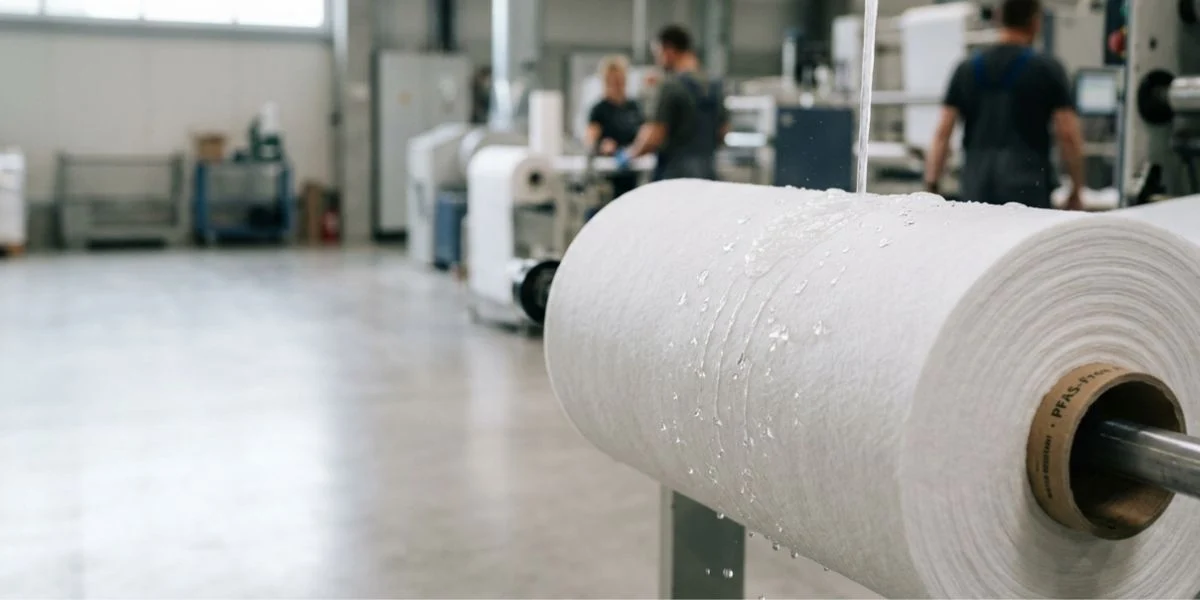
PFAS Free Water Resistant Nonwoven Fabric Manufacturer
The global elimination of PFAS (per- and polyfluoroalkyl substances) from industrial and consumer materials is accelerating across medical, food packaging, and protective textile supply chains. For procurement teams and OEM manufacturers seeking PFAS free water resistant nonwoven fabric, the challenge is finding substrates that maintain barrier performance without fluorinated chemical treatments. Favourite Fab manufactures breathable barrier nonwoven fabrics using PFAS-free water repellency technologies — delivering the functional performance your application demands without the regulatory and environmental risk of PFAS chemistry.
Why PFAS-Free Barrier Nonwoven Is Now a Procurement Requirement
PFAS compounds have been widely used in nonwoven fabrics to provide water, oil, and stain resistance. Regulatory pressure has made PFAS elimination urgent across multiple sectors:
- Medical devices and packaging: FDA has issued guidance on PFAS in medical products; hospital procurement is proactively eliminating PFAS from surgical textile supply chains
- Food packaging: FDA phase-out of PFAS in food contact materials impacts nonwoven-based food packaging and filtration applications
- EU REACH restriction: The universal PFAS restriction under REACH affects manufacturers supplying European markets
- US state legislation: Multiple US states have enacted PFAS bans in consumer products and packaging, with more in progress
- Corporate sustainability commitments: Major brand owners are independently requiring PFAS-free supply chains ahead of regulatory deadlines
Favourite Fab PFAS-Free Water Resistant Nonwoven — Product Range
Our PFAS-free barrier nonwoven fabrics are produced using hydrocarbon-based and silicone-based water repellency treatments that deliver effective moisture barrier performance without fluorinated chemistry.
| Fabric Type | Base Construction | GSM Range | Water Column (min) | Breathability | PFAS Status |
|---|---|---|---|---|---|
| SMS-PFAS-Free | Spunbond-Meltblown-Spunbond | 20–70 gsm | 20 cm H₂O | High — MVTR >2500 g/m²/24h | PFAS-Free ✓ |
| SMMS-PFAS-Free | Spunbond-MM-Spunbond | 30–80 gsm | 30 cm H₂O | High — MVTR >2000 g/m²/24h | PFAS-Free ✓ |
| Laminate-PFAS-Free | Spunbond + Breathable Film | 40–120 gsm | 50+ cm H₂O | Moderate — MVTR >800 g/m²/24h | PFAS-Free ✓ |
| Meltblown-PFAS-Free | Meltblown PP | 15–50 gsm | 15 cm H₂O | Very High — filtration grade | PFAS-Free ✓ |
Applications: Where PFAS-Free Barrier Nonwoven Is Used
PFAS-free water resistant nonwoven fabrics serve a growing range of industrial and medical applications where barrier performance is required alongside environmental compliance:
- Surgical drapes and gowns: PFAS-free SMS/SMMS meeting AAMI PB70 barrier standards
- Medical packaging: Sterile barrier packaging for devices and instruments
- Food service packaging: Grease and moisture-resistant wraps, trays, and bags without PFAS treatment
- Filtration media: PFAS-free meltblown for liquid and air filtration applications
- Industrial protective clothing: Coveralls and workwear requiring water repellency without fluorochemicals
- Agricultural covering: Crop protection nonwovens where chemical runoff from PFAS treatment is prohibited
Certifications and Compliance Documentation
We provide buyers with comprehensive documentation to support PFAS-free claims in regulatory submissions and customer declarations:
- PFAS-free declaration from our finishing chemical suppliers (chain of custody)
- Raw material certificates confirming absence of fluorinated chemistry in fiber production
- Standard physical test reports (hydrostatic head, MVTR, tensile, GSM)
- REACH compliance statements for EU market supply
- Available third-party testing at accredited laboratories on request
Frequently Asked Questions
Can PFAS-free nonwoven achieve the same water resistance as PFAS-treated fabric?
For most applications, yes. PFAS-free hydrocarbon and silicone-based repellency treatments deliver water column resistance and moisture barrier performance sufficient for medical, packaging, and light industrial applications. For very high barrier requirements (oil resistance, heavy chemical splash), performance may differ. Our technical team can review your specific barrier requirements and recommend the appropriate fabric grade.
Is PFAS-free nonwoven more expensive than conventional barrier fabric?
PFAS-free treatments are commercially available and our pricing remains competitive. The cost difference between PFAS and PFAS-free fabric grades varies by specification. Contact our sales team for a direct price comparison based on your volume and specification. Competitive wholesale pricing is available for bulk orders.
What certifications confirm that nonwoven fabric is genuinely PFAS-free?
Currently, there is no single universal certification standard for PFAS-free nonwovens. Brands typically rely on supplier declarations supported by third-party chemical analysis. We provide supplier chain documentation and can facilitate third-party PFAS testing at accredited laboratories for regulatory or customer declaration purposes.
Do you supply PFAS-free meltblown for filtration applications?
Yes. Our PFAS-free meltblown grades are available for liquid and air filtration applications. Specifications including fiber diameter, GSM, and efficiency ratings are available for review. Contact our technical sales team with your filtration application requirements for a matched product recommendation.
Source PFAS-Free Barrier Nonwoven from Favourite Fab
Regulatory timelines for PFAS elimination are tightening across every sector that uses barrier nonwoven fabrics. Favourite Fab gives procurement teams a direct manufacturing source for PFAS free water resistant nonwoven fabric with verified fluorochemical-free chemistry, competitive wholesale pricing, and full compliance documentation. Request fabric samples and a wholesale quotation today to future-proof your supply chain.
Related B2B Resources

Gaurav Garg
I'm Gaurav Garg, CEO of Favourite Fab, a company on a mission to revolutionize the nonwoven industry with sustainable practices. We work hand-in-hand with manufacturers and suppliers who share our commitment to eco-friendly production. With a deep interest in textile innovation, I'm passionate about educating consumers about sustainable material options and their potential to transform the nonwoven landscape.


