

Meltblown Nonwoven Fabric Manufacturer India — Favourite Fab supplies premium meltblown nonwoven fabric to face-mask producers, HEPA filter manufacturers, oil-absorbent product converters, and cleanroom suppliers across India and global markets. Meltblown nonwoven fabric is the high-efficiency micro-fiber barrier media used in N95/KN95 respirators, surgical face mask filter cores, HVAC filters, liquid filtration cartridges, and industrial oil sorbents. We supply 20-50 GSM electret-charged BFE99/PFE99 meltblown rolls, BFE95 standard meltblown, and oil-absorbent grades. MOQ 200 kg, lead time 7-12 days from Agra.
What is Meltblown Nonwoven Fabric?
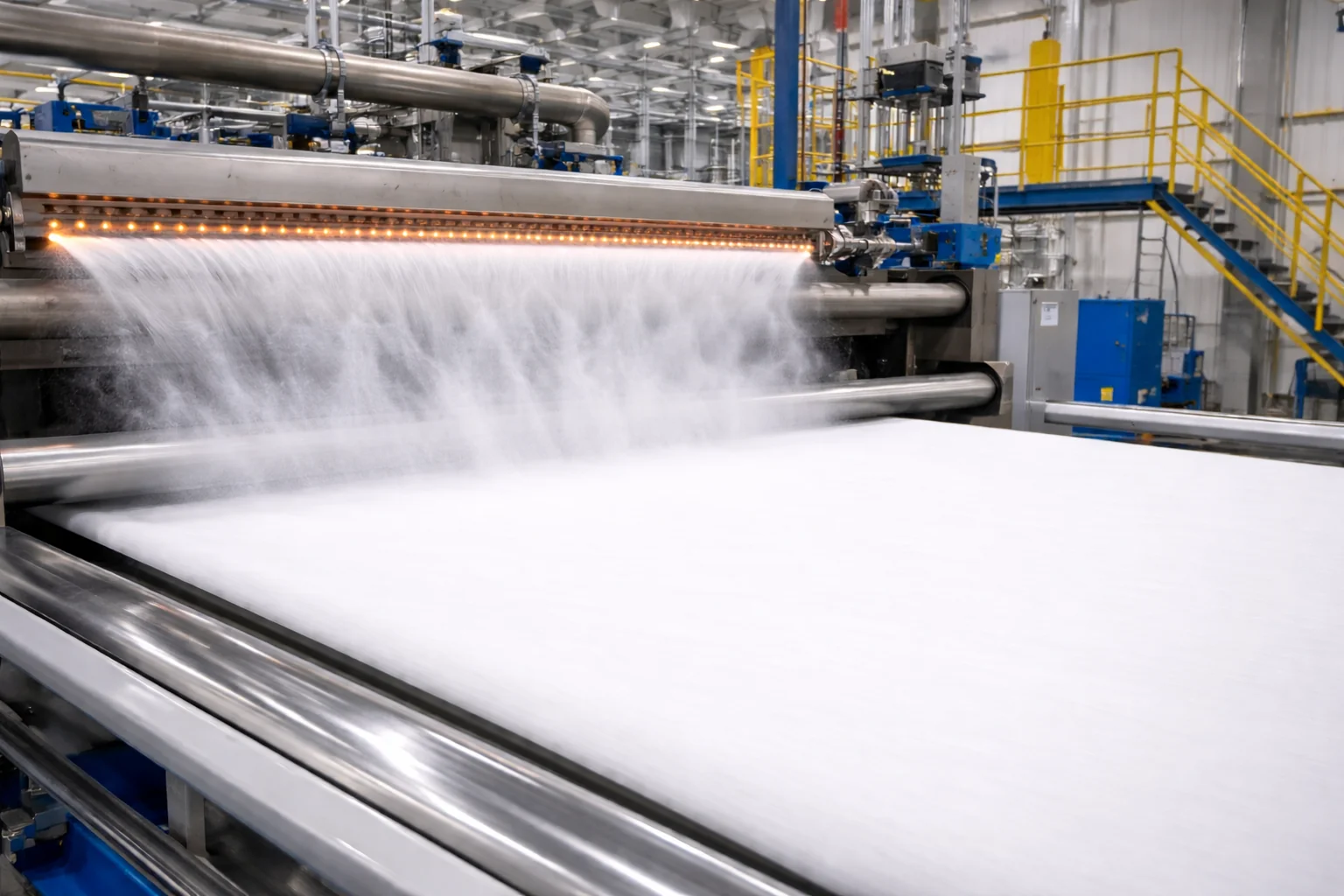
Meltblown nonwoven fabric is a micro-fiber web produced by extruding molten polypropylene through fine spinneret holes while high-velocity hot air streams blow the fibers into ultra-fine filaments (typically 1-5 microns, sometimes sub-micron). The fibers are randomly deposited on a moving collector to form a web of intermeshed micro-fibers without thermal bonding. The resulting fabric has extremely fine pore structure, very high surface area per gram, and outstanding filtration efficiency for both particles and bacteria. After production, meltblown is electret-charged (corona-charged) to add electrostatic capture, dramatically increasing sub-micron particulate filtration. Meltblown is the active filter media in N95, KN95, FFP2, FFP3 respirators, surgical face mask filter cores, HEPA-grade air filters, and BFE99/PFE99 hygiene filtration. It also serves as oil-only absorbent media for spill response and industrial cleanups.
How Meltblown Nonwoven Fabric is Manufactured
Meltblown manufacturing converts high-MFI polypropylene granules into micro-fiber fabric in a single continuous process:
- Polymer feeding: High-MFI PP granules (MFI 1200-2000, the higher the MFI the finer the fiber) are loaded into hoppers; additives like nucleating agents and electret-enhancers are dosed.
- Extrusion: Granules are melted in a screw extruder at 240-300°C and metered through gear pumps to the meltblown die.
- Meltblown die: Molten polymer is forced through a row of capillary holes (0.3-0.4 mm) while two converging streams of high-velocity hot air (200-300 m/s, 280-320°C) attenuate and break up the polymer streams into micro-fibers.
- Fiber attenuation: The high-velocity air drafts the fibers down to 1-5 micron diameter (much finer than spunbond’s 15-30 micron), forming a fine cloud of randomly oriented micro-fibers.
- Web formation: Fibers are deposited on a perforated collector drum or screen with vacuum suction holding them in place.
- Self-bonding: Residual heat and entanglement create natural inter-fiber bonds — no thermal calendaring needed (which would crush the fine pore structure).
- Electret charging: The web passes through a corona discharge station where electrostatic charge is implanted into the dielectric PP fibers, creating a permanent electret with sub-micron particle attraction.
- Slitting and winding: Slit to customer width and wound into rolls of 1,000-3,000 meters (lower than spunbond due to higher loft).
Quality is monitored by online basis-weight gauges, real-time TSI 8130 filtration testers (PFE/BFE), and visual cameras. Favourite Fab partner mills run Reicofil and Biax-Fiberfilm meltblown lines.
Specifications & Standards
| Parameter | Specification |
|---|---|
| GSM range | 20-50 GSM (20, 25, 30, 35, 40, 45, 50 standard; up to 250 GSM for oil sorbents) |
| Width | 1.6m, 2.4m; slit widths from 50mm |
| Fiber composition | 100% polypropylene (PP), 1-5 micron fiber |
| Tensile strength | MD: 5-15 N/5cm, CD: 4-12 N/5cm (low — meltblown is fragile alone) |
| Treatment | Electret-charged (default for filtration), uncharged for oil sorbents |
| Color | White (standard), light blue, custom on request |
| Certifications | BFE95/BFE99, PFE99, ISO 9001, NIOSH N95-grade media, EN 14683 Type II/IIR media |
| HSN code | 5603.11 / 5603.12 |
| MOQ | 200 kg per SKU |
| Lead time | 7-12 days standard, 15 days BFE99 charged |
Applications & End Uses
- Face mask filter media: 25-30 GSM electret-charged meltblown is the active filter layer in 3-ply surgical masks (BFE95/BFE99) and KN95/N95 respirators (PFE99+). One face mask uses 1-2 layers of meltblown.
- Air filtration: HEPA and ULPA-grade meltblown for HVAC filters, automotive cabin filters, vacuum cleaner bags, and air purifier replacement cartridges.
- Liquid filtration: Pleated cartridges for water, oil, fuel, and chemical filtration. Pore-graded structures from 0.5 to 100 micron.
- Oil sorbents: Hydrophobic, oleophilic high-loft meltblown (150-250 GSM) for industrial oil-spill cleanup, marine spill response, and machine-shop oil absorption. Absorbs 15-25x its weight in oil.
- Hygiene barrier layers: Liquid-barrier middle layers in adult incontinence pads, premium feminine care, and medical absorbent products.
- Cleanroom and pharma: Cleanroom wipes, pharmaceutical gowns (combined with spunbond as SMS), and pre-filters for HEPA cleanrooms.
- Specialty: Battery separators, acoustic insulation, lab filter discs, and tea bag overlay.
Why Source Meltblown Nonwoven Fabric from Favourite Fab
- Direct manufacturer pricing: No middlemen — competitive wholesale pricing with volume tiers; meltblown pricing tracks PP and electret-stabilizer benchmarks.
- Low MOQ: 200 kg per SKU — accessible to face-mask startups and filter prototype runs.
- Filtration certified: BFE95/BFE99/PFE99 test reports per ASTM F2101 and EN 14683; NIOSH N95-grade media available.
- Electret stability: Charged media maintains efficiency over storage; we ship in moisture-barrier packaging with desiccants.
- Custom GSM and treatment: Tailored basis weight, charge level, and finish for face masks, oil sorbents, or specialty filters.
- 24-hour quote turnaround: Sample swatches couriered within 48 hours via WhatsApp +91-8800775462 or sale@favouritehub.com.
Comparison with Other Nonwovens
| Property | Meltblown | Spunbond | SMS | HEPA paper |
|---|---|---|---|---|
| Fiber diameter | 1-5 micron | 15-30 micron | Mixed | Sub-micron |
| BFE % | 95-99+ | 10-20 | 95-99 | 99.97+ |
| Strength | Very Low | High | High | Low |
| Best use | Filter core | Outer covers | Surgical gowns | HEPA filters |
Quality Testing & Certifications
- ISO 9001:2015 quality management system
- BFE95/BFE99 per ASTM F2101 (Bacterial Filtration Efficiency)
- PFE99 per ASTM F2299 (Particulate Filtration Efficiency, 0.1 micron NaCl)
- EN 14683 Type II/IIR compliance for medical face mask media
- NIOSH 42 CFR 84 N95 media grade (TSI 8130A test, 0.3 micron, 85 LPM)
- In-house QC: GSM, basis weight, fiber diameter (SEM), filtration efficiency, pressure drop, hydrostatic head
- Third-party certification: SGS, Intertek, Nelson Labs, TUV
- Batch-level COA, MSDS, electret-charge certification per shipment
Pricing, MOQ & Lead Time
Meltblown nonwoven fabric is priced per kilogram, with rates determined by GSM, charge level, filtration grade (BFE95 vs BFE99 vs PFE99), and order volume. Charged BFE99/PFE99 grades carry a premium over uncharged oil-sorbent grades. We offer competitive wholesale pricing aligned with PP polymer benchmarks and meltblown line capacity. MOQ is 200 kg per SKU for standard charged BFE99 25 GSM (face mask grade); 500 kg for custom-GSM or specialty applications. Standard lead time is 7-12 days for BFE95; 12-15 days for BFE99 (additional QC and aging tests for charge stability). Payment: TT, LC at sight, or approved credit. We ship FOB Mundra/JNPT for exports and ex-Agra for domestic. Packaging includes moisture-barrier liners and desiccants to preserve electret charge during transit. For binding quotes with current pricing and certification copies, contact sale@favouritehub.com or WhatsApp +91-8800775462.
Related Process Guides — Meltblown
Explore detailed manufacturing and material guides connected to meltblown nonwoven fabric production.
- Meltblown process guide
- Electrospinning nanofibre
- Solution blow spinning
- Reemay substitute meltblown
- HEPA / HVAC filtration media
Frequently Asked Questions
How many layers of meltblown are in a face mask?
A standard 3-ply surgical mask uses one layer of 25 GSM BFE99 meltblown sandwiched between two spunbond layers. KN95 and N95 respirators use 1-2 layers of higher-efficiency PFE99 meltblown.
What is electret-charged meltblown?
Electret meltblown is corona-treated to implant a permanent electrostatic charge into the PP fibers, dramatically increasing sub-micron particle capture without raising air-flow resistance. Critical for N95/BFE99 performance.
How long does the electret charge last?
Properly stored electret meltblown retains over 90% of charge for 18-24 months. Storage in dry, sealed packaging with desiccants maximises shelf life. Humid storage degrades performance.
Can I use meltblown alone as a fabric?
No — meltblown alone is too fragile (low tensile strength) for most applications. It is always laminated or paired with spunbond, scrim, or pleat-pack structures for converting.
What is the difference between BFE95 and BFE99?
BFE95 captures ≥95% of bacteria-sized particles (3 micron); BFE99 captures ≥99%. PFE99 captures ≥99% of sub-micron particles (0.1-0.3 micron) — the standard for N95-equivalent performance.
Do you supply oil-only absorbent meltblown?
Yes, hydrophobic high-loft meltblown (150-250 GSM) for oil spill pads, booms, and pillows. Absorbs oil while repelling water. Available in pads, sheets, and roll form.
What is the HSN code for meltblown nonwoven fabric?
Meltblown falls under HSN 5603.11 or 5603.12 depending on basis weight. GST is 12% on most filter-media grades.
Related Resources
- Non Woven Fabric Manufacturer India — Hero Pillar
- Why Choose Favourite Fab Nonwoven
- Non Woven Fabric Price List
- Meltblown Fabric Product Page
- SMS Non Woven Fabric Manufacturer India
- SMMS Non Woven Fabric Manufacturer India
Related B2B Resources

Gaurav Garg
I'm Gaurav Garg, CEO of Favourite Fab, a company on a mission to revolutionize the nonwoven industry with sustainable practices. We work hand-in-hand with manufacturers and suppliers who share our commitment to eco-friendly production. With a deep interest in textile innovation, I'm passionate about educating consumers about sustainable material options and their potential to transform the nonwoven landscape.


