

SMS Composite Nonwoven Fabric — Spunbond Meltblown Structure Guide India
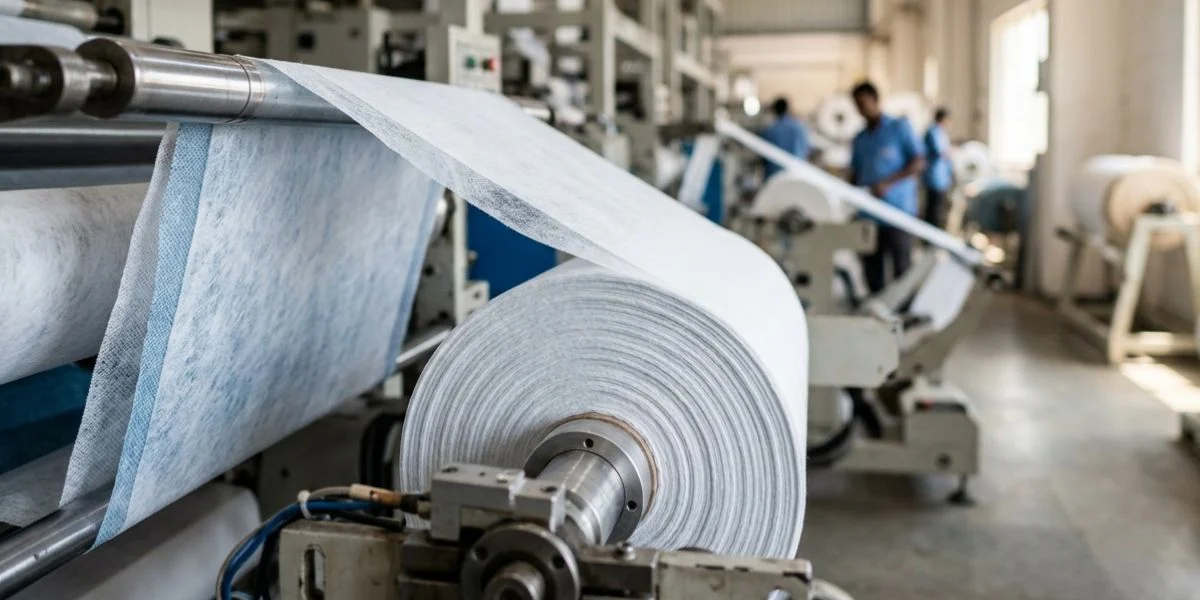
SMS composite nonwoven fabric (Spunbond-Meltblown-Spunbond) is a multi-layer nonwoven structure where the inner meltblown layer provides barrier and filtration performance while the outer spunbond layers provide strength, durability, and tactile properties. The composite structure is produced inline — spunbond and meltblown layers are deposited sequentially on a single production line and thermally bonded together, creating an integrated fabric with properties impossible to achieve with any single layer. SMS composites are the foundation of modern medical protection nonwovens.
Technical Specifications
| Parameter | Specification |
|---|---|
| Structure | S+M+S (inline composite) |
| GSM range | 20–70 GSM |
| BFE | 98–99.9% |
| Hydrostatic head | 20–120 cmH₂O |
| Variants | SMS, SMMS, SSMMS, SSMMSS |
| Width | 160–260 cm |
| MOQ | 500 kg |
Applications
Surgical gowns, medical drapes, face masks, sterile packaging, isolation apparel, HVAC pre-filter layers.
Source from Favourite Fab
Direct manufacturer Agra, India. Custom GSM/width. COA per batch. Sample 3–5 days. See: spunbond nonwoven fabric manufacturer India. Related: medical nonwoven fabric.
Frequently Asked Questions
What are the variants of SMS composite nonwoven?
SMS (3-layer), SMMS (4-layer, 2 meltblown), SSMMS (5-layer, 2 meltblown + 2 spunbond), SSMMSS (6-layer). More layers = higher barrier and BFE. SMS for Level 1–2 medical. SSMMS for Level 3–4. SSMMSS for maximum barrier specialty applications.
Can SMS composite be produced in different spunbond-to-meltblown ratios?
Yes. The ratio of spunbond to meltblown GSM within the total SMS weight determines the balance of strength vs barrier. Higher meltblown ratio: better BFE and hydrostatic head. Higher spunbond ratio: better tensile and abrasion resistance. Specify your required BFE and tensile when ordering.
Is SMS nonwoven recyclable?
Yes — SMS is 100% PP (all layers spunbond and meltblown are PP), making it theoretically mono-material recyclable. However, contamination from medical use means most SMS medical products go to incineration. Uncontaminated SMS manufacturing waste is recyclable via PP recycling streams.
B2B Applications & End-Uses
SMS composite nonwoven fabric is the globally dominant substrate for disposable protective apparel and sterile field management in healthcare, because its three-layer architecture delivers a unique combination of liquid barrier performance, bacterial filtration, and mechanical durability that no single-technology nonwoven can match. Surgical gown manufacturers producing EN 13795-compliant gowns for critical-zone applications specify SMS fabrics where the hydrostatic head resistance must exceed 20 cm H2O in the critical zone, a requirement that the meltblown middle layer satisfies through its tight sub-5-micron fibre pore structure.
Disposable coverall and protective workwear manufacturers for chemical, pharmaceutical, and food processing environments use SMS fabric in 40–60 GSM total weight because the meltblown barrier layer prevents liquid aerosol penetration while the two spunbond outer layers provide sufficient tensile and seam strength for stitched or ultrasonically welded garment construction. Sterile drape converters producing surgical field drapes, fenestrated drapes, and instrument wraps for hospital central sterile supply departments (CSSD) rely on SMS hydrostatic head performance for AAMI PB70 Level 1 and Level 2 barrier classification.
Single-use mattress cover, pillow cover, and patient bedding manufacturers producing hygiene products for hospital and long-term care facility procurement specify SMS fabric to combine the easy-clean, liquid-repellent outer surface provided by the outer spunbond layer with the bacterial barrier of the meltblown core, reducing healthcare-associated infection (HAI) risk vectors associated with soiled reusable textile bedding.
Certifications & Quality Assurance
Favourite Fab’s SMS composite nonwoven is tested for Bacterial Filtration Efficiency (BFE) using the ASTM F2101 method, with results expressed as the percentage of Staphylococcus aureus aerosol particles filtered by the meltblown layer at a specified flow rate. Grades with a meltblown layer weight of 10 GSM or above achieve BFE greater than 98%, qualifying them for use in surgical mask filtration layer applications where national standards reference BFE as the primary barrier metric.
Hydrostatic head is measured per ISO 811 (or AATCC 127) on the full SMS composite, with results reported in centimetres of water column. Total SMS GSM is verified by EDANA ERT 40.3 on a minimum of 12 sampling positions per roll to confirm that the meltblown fraction has been consistently deposited across the full production width — critical because edge-to-edge meltblown uniformity directly determines barrier consistency across every garment or drape cut from the roll. Particle shedding from the inner spunbond surface is tested per ISO 9073-10 for applications where lint contamination of the surgical field is a risk.
ISO 9001:2015 covers the full SMS production process, including the meltblown die maintenance and calibration records that are the primary quality assurance lever for meltblown layer weight consistency. Third-party laboratory reports for BFE, hydrostatic head, and differential pressure (breathability, per EN 14683) are available on request.
More Questions Answered
How should a buyer specify SMS nonwoven to get consistent meltblown barrier performance across production batches?
The most robust specification approach is to define the total SMS GSM, the meltblown layer weight as a fraction of total GSM, and the minimum hydrostatic head performance measured on the finished composite — rather than specifying only total GSM and relying on the supplier to determine the layer weight ratio. For example, a specification of “40 GSM SMS, meltblown fraction 10 GSM (25%), hydrostatic head ≥ 35 cm H2O per ISO 811” constrains both the structure and the performance outcome. This matters because two rolls with identical total GSM but different meltblown fractions (for example, 40 GSM with 5 GSM meltblown versus 40 GSM with 12 GSM meltblown) will have significantly different hydrostatic head and BFE values. Including the hydrostatic head limit in the purchase specification creates a contractually enforceable performance criterion that is independent of how the supplier manages its layer ratio internally. Favourite Fab’s standard SMS grades are documented with both layer weight breakdown and performance test data; non-standard meltblown fractions can be produced with a lead time of 15–20 working days for development samples.
What is the difference between SMS and SMMS nonwoven, and when is SMMS the better specification?
SMMS nonwoven adds a second meltblown layer — the architecture is Spunbond + Meltblown + Meltblown + Spunbond — compared to the single meltblown core in SMS. The primary advantage of SMMS is that the two thinner meltblown layers are each easier to produce with uniform fibre distribution than a single thick meltblown layer of equivalent total weight; this improves the cross-direction consistency of the barrier performance across the full roll width. SMMS also allows a different fibre diameter to be used in each meltblown layer, enabling a gradient pore structure that can improve BFE without proportionally increasing differential pressure (breathability). SMMS is typically specified for surgical gown and drape applications at higher performance levels — AAMI PB70 Level 3 or Level 4 — where the barrier demands require total meltblown weight above 15 GSM and any non-uniformity in a single meltblown layer would create unacceptable weak zones. Favourite Fab currently produces SMS as the standard commercial format; SMMS can be discussed for high-volume requirements above 5 MT per month where the additional process complexity is justified by the performance requirement.

Gaurav Garg
I'm Gaurav Garg, CEO of Favourite Fab, a company on a mission to revolutionize the nonwoven industry with sustainable practices. We work hand-in-hand with manufacturers and suppliers who share our commitment to eco-friendly production. With a deep interest in textile innovation, I'm passionate about educating consumers about sustainable material options and their potential to transform the nonwoven landscape.


