

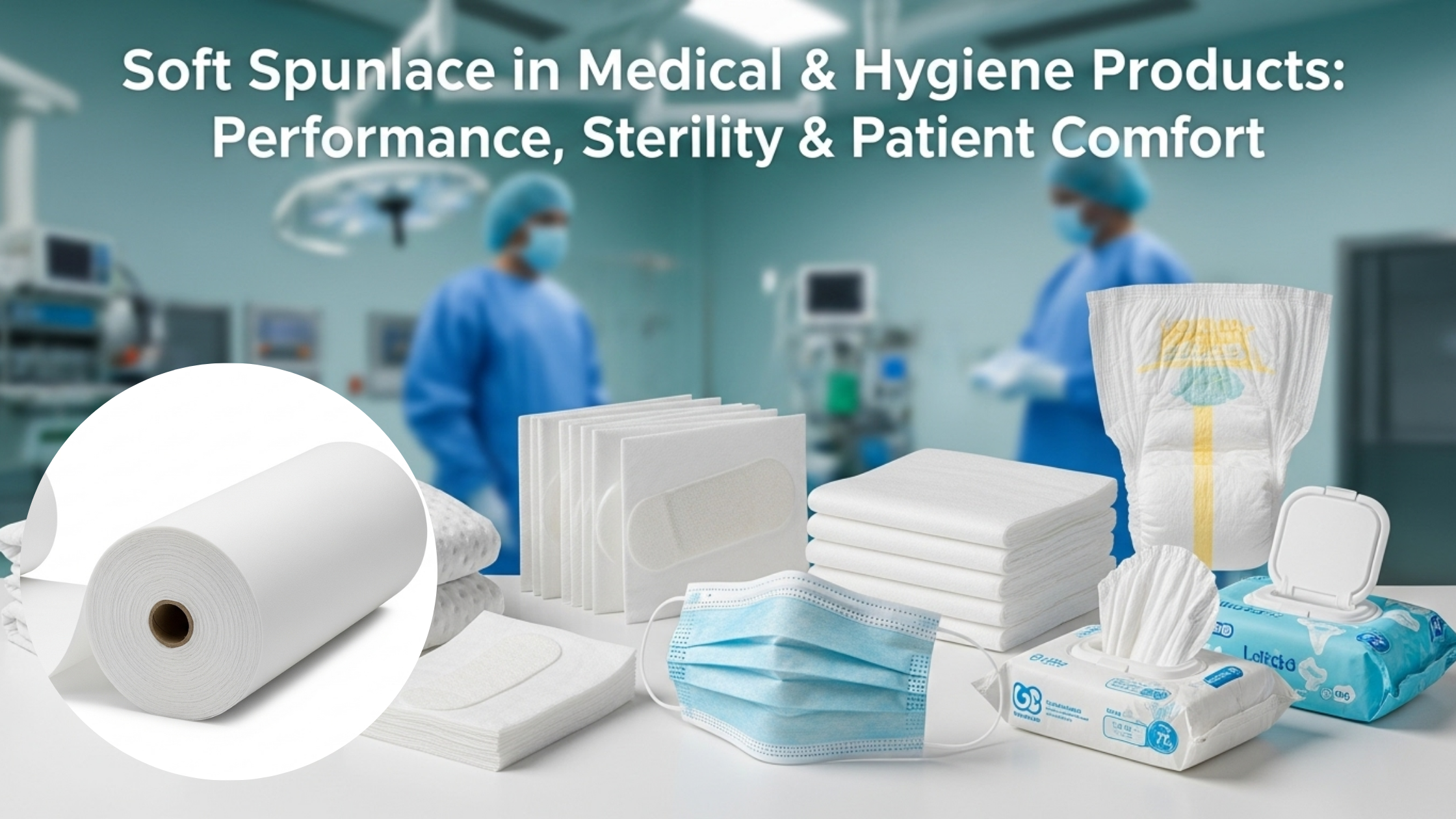
Source soft spunlace from Favourite Fab — India’s trusted spunlace nonwoven fabric India supplier, ISO certified, export ready.
B2B Applications & End-Uses
Spunlace nonwoven occupies a technically demanding position in medical and hygiene product supply chains: it must simultaneously meet skin-contact safety standards for patient-facing applications while delivering sufficient structural performance for converting and end-use reliability. Soft spunlace — characterised by hydroentangled construction without chemical binders, typically in viscose, lyocell, or viscose/polyester blends — is the preferred substrate across several critical medical and hygiene product categories.
In wound care, spunlace is used as the wound contact layer in non-adherent island dressings, post-operative wound pads, and primary contact dressings for moderate-exudate wounds. The low-lint characteristic — quantified by lint count per ISO 9073 or INDA IST 160.1 — is essential to avoid retained fibre in wound beds, which is a clinical risk in surgical site dressings. Viscose and lyocell grades are preferred over polyester for wound contact because their hydrophilic nature supports exudate management and their biocompatibility profile is well-established under ISO 10993.
For incontinence pad and premium sanitary pad OEMs, soft spunlace serves as the acquisition and distribution layer (ADL) beneath the topsheet, improving liquid distribution across the absorbent core. The absence of thermal bond points — which can create hard spots under pressure — is a measurable patient comfort advantage in incontinence pad constructions targeting long-wear scenarios in care home and hospital settings. Pilling resistance (measured by EDANA ERT 50.5) must be below threshold values to prevent surface degradation during wear, and Favourite Fab’s spunlace production targets pill grade 4–5 on the standard photographic scale.
Spunlace fabric is also specified for surgical swabs, lap pads, and instrument cleaning wipes in sterile field management. EO and gamma sterilisation compatibility is a baseline requirement. High-absorbency viscose grades are used in bulk fluid management during surgical procedures, where lint release into the sterile field is a controlled risk metric. OEM medical device manufacturers supplying kitted surgical packs specify spunlace swab fabric under ISO 11607 packaging requirements.
Certifications & Quality Assurance
Spunlace for medical applications is tested against ISO 10993 (Biological Evaluation of Medical Devices) for cytotoxicity, sensitisation, and irritation — the three primary biocompatibility endpoints relevant to wound contact and skin-adjacent device components. EO sterilisation compatibility is confirmed by standard EO residual testing per ISO 11135; gamma irradiation stability (tensile retention post-25 kGy dose) is documented for isotope-sterilised product supply chains.
OEKO-TEX Standard 100 certification (Class I — products for babies and sensitive skin) is maintained for spunlace grades used in hygiene and skin-contact applications. Pilling resistance (EDANA ERT 50.5), abrasion resistance, and lint count are included in standard COA for medical and hygiene supply. Customers requiring specific test method results beyond the standard COA can request additional testing under EDANA, INDA, or customer-specified methods. Retained lot samples are archived for 24 months.
More Questions Answered
What lint count values does Favourite Fab’s medical-grade spunlace achieve?
Medical-grade low-lint spunlace production targets lint counts compliant with the requirements of non-woven swab and wound dressing standards under INDA IST 160.1 and equivalent EDANA methods. Exact values depend on fibre blend and GSM — viscose-dominant grades typically achieve lower lint counts than polyester-heavy constructions. Lot-specific lint count data is available on request as part of the COA package for medical device component supply.
Is OEKO-TEX Class I certification available for all spunlace grades?
OEKO-TEX Standard 100 Class I certification covers specific production grades intended for baby and skin-sensitive product applications. Not all GSM weights and fibre blends within the spunlace range carry Class I certification — the certification applies to defined grades that have passed the full OEKO-TEX substance testing protocol. Contact our technical sales team with your specific application requirements to confirm which certified grades are available.
Can spunlace fabric be supplied in sterile form for medical device kitting?
Favourite Fab supplies spunlace in non-sterile roll form for medical device manufacturers who perform terminal sterilisation of finished devices. We do not offer pre-sterilised fabric supply directly. Customers requiring sterile-ready substrate documentation — including bioburden baseline data and sterilisation compatibility reports — should specify this at quotation stage so appropriate testing documentation can be provided alongside the material shipment.

Gaurav Garg
I'm Gaurav Garg, CEO of Favourite Fab, a company on a mission to revolutionize the nonwoven industry with sustainable practices. We work hand-in-hand with manufacturers and suppliers who share our commitment to eco-friendly production. With a deep interest in textile innovation, I'm passionate about educating consumers about sustainable material options and their potential to transform the nonwoven landscape.


