

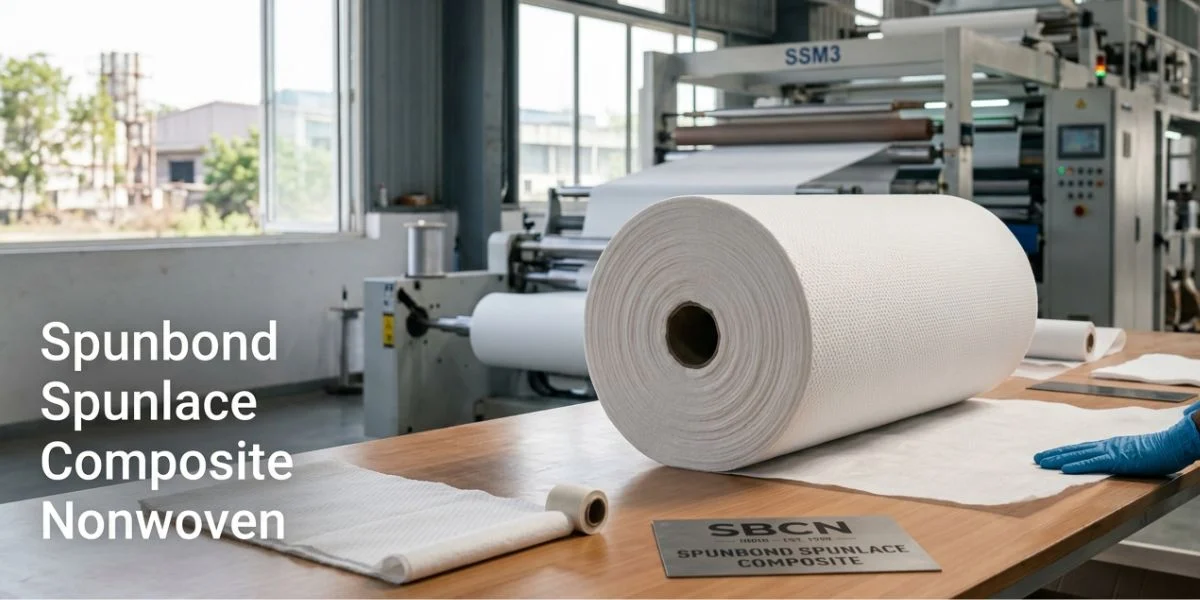
Spunbond Spunlace Composite Nonwoven — Combined Strength & Softness Manufacturer India
Spunbond-spunlace composite nonwoven combines a spunbond layer (for dimensional stability and strength) with a spunlace layer (for softness and absorbency). The spunbond component provides a consistent, dimensionally stable substrate that runs reliably on converting machinery; the spunlace surface layer delivers the softness and absorbency needed for hygiene or medical applications. This composite is used where standard spunlace lacks sufficient machine-direction strength for high-speed converting, or where standard spunbond lacks the surface softness required.
Technical Specifications
| Parameter | Specification |
|---|---|
| GSM | 40–120 GSM |
| Construction | Spunbond + spunlace (laminated or hydroentangled composite) |
| Tensile MD | 150–500 N/5cm |
| Softness | Spunlace-surface grade |
| Width | 160–260 cm |
| MOQ | 1,000 kg |
Applications
High-speed wipe converting, premium hygiene topsheets, medical absorbent composites, protective garment linings.
Source from Favourite Fab
Direct manufacturer Agra, India. Custom GSM/width. COA per batch. Sample 3–5 days. See: spunlace nonwoven fabric. Related: spunbond nonwoven fabric manufacturer India.
Frequently Asked Questions
Why use spunbond-spunlace composite instead of standalone spunlace?
Standalone spunlace can have insufficient MD tensile strength for very high-speed wipe machines (>600 m/min). Adding a spunbond layer as a carrier increases MD strength without compromising surface softness — enabling higher line speeds with fewer web breaks.
How is spunbond-spunlace composite made?
Two methods: (1) Thermal lamination — spunbond and spunlace layers bonded with adhesive or thermal bonding. (2) In-line hydroentanglement — spunbond layer fed into hydroentanglement process simultaneously with staple fibre web, creating a mechanically bonded composite.
What GSM composite is used for premium hygiene products?
40–60 GSM composites for hygiene topsheets. 60–80 GSM for medical absorbent layers. Higher GSM composites (80–120) for industrial wipe applications requiring high strength and good absorbency.
B2B Applications & End-Uses
Spunbond-spunlace composite nonwoven fabric addresses a performance gap that neither single-technology fabric can fill alone. Hygiene product manufacturers sourcing topsheet material for adult incontinence products specify composite construction to achieve a soft, skin-facing surface combined with the dimensional stability required for high-speed converting lines operating above 400 metres per minute. The spunbond layer maintains consistent caliper and prevents the material from stretching or nesting on the unwind roll, while the spunlace layer provides the fluid-permeable, cloth-like surface that meets consumer-facing softness and rewet specifications.
Medical drape and gown manufacturers use spunbond-spunlace composites for procedure drapes where one surface must absorb irrigation fluid rapidly while the opposite surface must resist strike-through and maintain a stable lay-flat geometry on the operating table. Surgical pack converters value the composite for its ability to be cut and sewn on standard textile equipment without fraying, a property the spunbond layer contributes through its thermally bonded fibre structure.
Wet wipe substrate manufacturers producing premium-tier wipes for personal care or surface disinfection markets specify composite construction when caliper consistency across the wet wipe stack is critical for automated dispensing systems. The spunbond structural layer maintains uniform thickness under compression in wipe canisters, preventing dispensing jams that occur with pure spunlace substrates in high-humidity environments.
Certifications & Quality Assurance
Favourite Fab’s spunbond-spunlace composite nonwoven is produced on a dedicated lamination line where the bonding interface between the two layers is validated in-process using peel strength testing per EDANA ERT 160. Minimum peel strength of 0.8 N/5cm is maintained across the full roll width, with edge-to-edge uniformity confirmed by testing at three positions — left edge, centre, and right edge — for every production batch.
Composite fabric rolls are tested for combined GSM (EDANA ERT 40.3), tensile strength in both MD and CD directions (EDANA ERT 20.2), elongation at break (EDANA ERT 20.2), and absorption capacity (EDANA ERT 10.4). For medical applications, biocompatibility screening per ISO 10993-5 (cytotoxicity) is available on request. Hygiene customers requiring Annex VII compliance documentation under the EU Cosmetic Products Regulation can obtain full raw material declarations covering fibre type, binder content, and processing aid residuals.
ISO 9001:2015 quality management covers the full composite production workflow from fibre receipt through finished roll inspection and packing. Each roll is labelled with a unique batch code traceable to the production shift, raw material lot, and inline quality log for full supply-chain traceability.
More Questions Answered
How is the spunbond layer bonded to the spunlace layer in composite nonwoven fabric?
Three primary bonding methods are used in commercial spunbond-spunlace composite production. Thermal point bonding uses heated calender rolls with an engraved pattern to fuse the spunbond and spunlace layers at discrete bond points, typically covering 15–20% of the fabric surface area. This method produces a firm, well-defined bond with minimal impact on the softness of the spunlace layer between bond points. Ultrasonic bonding uses high-frequency vibration to generate localised heat at the bond interface without requiring external heat, preserving the bulk and loft of the spunlace surface layer more effectively than thermal bonding. Adhesive lamination uses a hot-melt adhesive applied as a fine spray or slot coat between the two layers; this method offers the widest range of bond strength tunability but introduces adhesive as an additional material variable that must be declared in regulated applications. Favourite Fab currently offers thermal point bonding and hot-melt adhesive lamination. The choice of bonding method should be specified at the inquiry stage, as it affects lead time and minimum order quantity.
What fibre combinations are available for spunbond-spunlace composite nonwoven?
The spunbond layer is produced in polypropylene (PP), which offers the best combination of cost, dimensional stability, and thermal bondability. The spunlace layer can be specified in 100% viscose for maximum absorbency, 100% polyester (PET) for chemical resistance and low-lint performance, or a PET/viscose blend (typically 50:50 or 70:30) that balances absorbency and tensile retention after saturation. For hygiene topsheet applications requiring a defined hydrophilic or hydrophobic surface treatment, the spunlace layer can be finished with a durable topical treatment applied inline. The fibre combination should be selected based on the end-use requirement and the regulatory environment of the destination market. Favourite Fab provides technical datasheets for each standard combination and can produce development samples for new specifications with a lead time of 10–15 working days from order confirmation.
📋 Related: Spunlace Nonwoven Fabric — Full Range & Specs | All Nonwoven Products from Favourite Fab

Gaurav Garg
I'm Gaurav Garg, CEO of Favourite Fab, a company on a mission to revolutionize the nonwoven industry with sustainable practices. We work hand-in-hand with manufacturers and suppliers who share our commitment to eco-friendly production. With a deep interest in textile innovation, I'm passionate about educating consumers about sustainable material options and their potential to transform the nonwoven landscape.


