

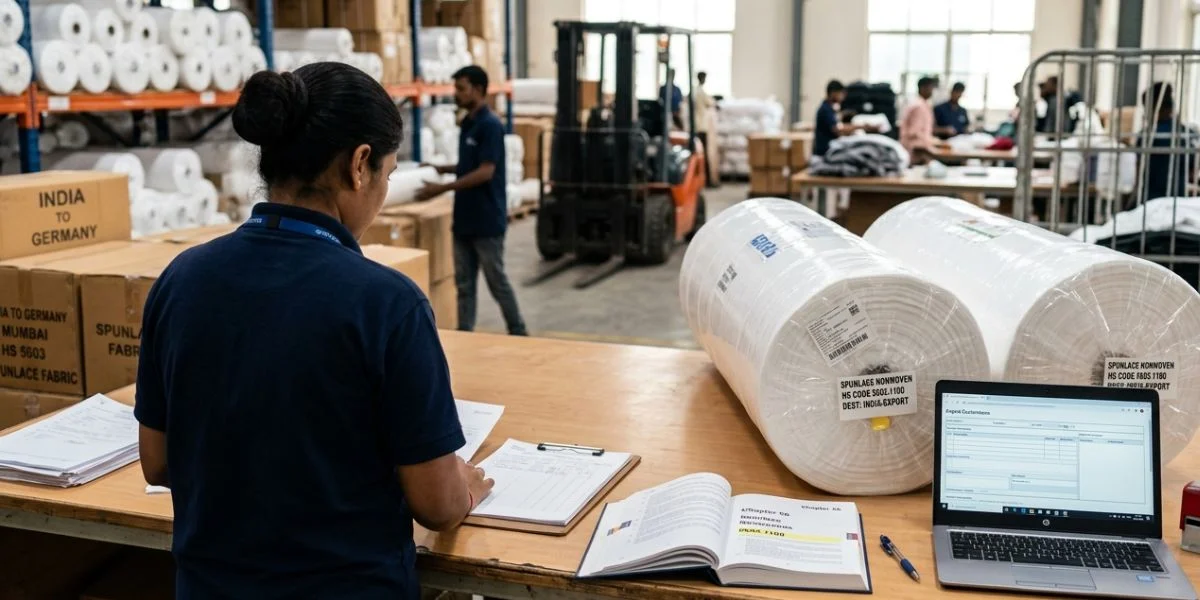
Spunlace Nonwoven Fabric HS Code India — Export Classification Guide
Correct HS (Harmonised System) code classification is essential for nonwoven fabric exports — it determines export duty, GSP eligibility, and import duty in the destination country. Spunlace nonwoven fabric falls under HS Chapter 56 (wadding, felt and nonwovens) with specific subheadings based on GSM and raw material.
Browse our full range: View all nonwoven fabric products — spunlace, spunbond, SMS, bico — with GSM, width and certification options. B2B MOQ from 500 kg.
HS Code Classification for Nonwoven Fabric
| HS Code | Description | Applicable to |
|---|---|---|
| 5603.11 | Nonwoven, <25 GSM (of man-made filaments) | Light PP spunbond, light SMS |
| 5603.12 | Nonwoven, 25–70 GSM (man-made filaments) | Standard spunbond, SMS 25–70 GSM |
| 5603.13 | Nonwoven, 70–150 GSM (man-made filaments) | Heavy spunbond, PET nonwoven |
| 5603.14 | Nonwoven, >150 GSM (man-made filaments) | Heavy industrial PET nonwoven |
| 5603.91 | Nonwoven, <25 GSM (other fibres) | Light viscose spunlace |
| 5603.92 | Nonwoven, 25–70 GSM (other fibres) | Standard spunlace (viscose/cotton blends) |
| 5603.93 | Nonwoven, 70–150 GSM (other fibres) | Heavy spunlace, needle punch (natural fibre) |
| 5603.94 | Nonwoven, >150 GSM (other fibres) | Very heavy natural fibre nonwoven |
India Export Duty on Nonwoven Fabric
Export duty on HS 5603: 0% basic customs duty on most nonwoven fabric exports from India. RoDTEP scheme provides additional incentive (rate varies by HS subheading). Confirm current rates with DGFT before shipping.
FAQ
Which HS code applies to viscose/polyester spunlace?
Viscose/polyester spunlace falls under HS 5603.91 (<25 GSM), 5603.92 (25–70 GSM), or 5603.93 (70–150 GSM) — “other fibres” category because viscose is not man-made filament. Polyester spunlace: 5603.11–5603.13 (man-made filaments).
What import duty applies to spunlace in the EU?
EU standard MFN duty on HS 5603.9x: 4% for most subheadings. Under EU GSP (India qualifies), duty reduced to 0–1.7% with EUR.1 certificate of origin.
Full range: spunlace nonwoven fabric. Related: nonwoven fabric exporter India.
B2B Applications & End-Uses
Spunlace nonwoven fabric classified under Chapter 56 of the ITC-HS schedule serves a broad range of industrial and commercial export sectors. Hygiene manufacturers exporting finished wipes to the EU declare goods under CN heading 5603, with the specific subheading determined by fibre composition and weight per square metre. Medical device OEMs exporting wound-care substrates to the United States use HTS heading 5603 with the appropriate four-digit suffix for man-made fibre content above or below the relevant weight thresholds.
Pharmaceutical packaging converters procuring spunlace for blister-pack liners and sterile barrier pouches rely on accurate HS classification to calculate applicable import duties in destination markets. Automotive interior trim suppliers converting spunlace into headliner substrates and door-panel skins require correct Chapter 56 declaration to avoid misclassification penalties at customs. Industrial wipe manufacturers supplying MRO distributors across the GCC benefit from RoDTEP credits available on Chapter 56 exports from India, improving landed cost competitiveness versus Chinese or Turkish suppliers.
Agricultural nonwoven converters producing crop-cover fleece and nursery ground cover use spunlace rolls classified at the 5603.12 level (25–70 g/m²) for lightweight grades, which carry a 12% GST rate under Indian domestic supply and attract zero basic customs duty under several bilateral FTAs when exported to ASEAN markets.
Certifications & Quality Assurance
Every jumbo roll of spunlace nonwoven fabric supplied by Favourite Fab for export shipment is accompanied by a mill test certificate (MTC) stating GSM (±5% tolerance), tensile strength in machine and cross direction per EDANA ERT 20.2, absorption capacity per EDANA ERT 10.4, and fibre composition by percentage weight. These parameters map directly to the HS subheading criteria under 5603.12, 5603.13, and 5603.14, enabling buyers and customs brokers to file accurate shipping bills at Nhava Sheva (JNPT).
Favourite Fab holds ISO 9001:2015 certification covering manufacturing, testing, and dispatch operations. Export invoices are supported by RCMC (Registration cum Membership Certificate) issued by the relevant Export Promotion Council, a mandatory document for availing RoDTEP benefit rates notified under Schedule II of the RoDTEP guidelines for Chapter 56 products. All shipments are accompanied by a certificate of origin (COO) from the Agra Chamber of Commerce, accepted under EU GSP and other preferential trade arrangements.
Buyers requiring OEKO-TEX Standard 100 certification for consumer-facing end products — such as wet wipes or cosmetic pads — may request fabric certified at Product Class II (items in contact with skin). Independent third-party test reports from accredited laboratories covering azo dyes, formaldehyde, and heavy metal limits are available on request for regulated export markets including the EU, UK, and USA.
More Questions Answered
Which HS subheading applies to spunlace nonwoven fabric above 150 g/m² for export from India?
Spunlace nonwoven fabric made from man-made fibres weighing more than 150 g/m² is classified under ITC-HS subheading 5603.14 for Indian export purposes. This subheading attracts a 12% GST rate on domestic supply and is eligible for RoDTEP benefit on export. Buyers should confirm the exact weight per square metre of the fabric they intend to import, as the boundary between 5603.13 (70–150 g/m²) and 5603.14 is determined by the weight declared on the mill test certificate, not the nominal grade description. Favourite Fab provides signed MTCs for each batch to support customs filing at Nhava Sheva or any other Indian port of export.
What Incoterm options does Favourite Fab offer for international spunlace shipments?
Favourite Fab supports FOB (Free On Board) Nhava Sheva, CIF (Cost, Insurance, Freight) to destination port, and DAP (Delivered At Place) for buyers who prefer a landed cost structure. FOB is the most common term for established importers who manage their own freight forwarders and marine insurance. CIF is preferred by first-time importers or those procuring trial quantities who want a single landed cost for comparison. DAP is available for select markets where Favourite Fab has established logistics partnerships. All export documentation including shipping bill, packing list, commercial invoice, bill of lading, and COO are prepared in-house and shared via email within 24 hours of vessel departure. Contact the export desk to request a freight indication for your destination port.
📋 Related: Spunlace Nonwoven Fabric — Full Range & Specs | All Nonwoven Products from Favourite Fab

Gaurav Garg
I'm Gaurav Garg, CEO of Favourite Fab, a company on a mission to revolutionize the nonwoven industry with sustainable practices. We work hand-in-hand with manufacturers and suppliers who share our commitment to eco-friendly production. With a deep interest in textile innovation, I'm passionate about educating consumers about sustainable material options and their potential to transform the nonwoven landscape.


