

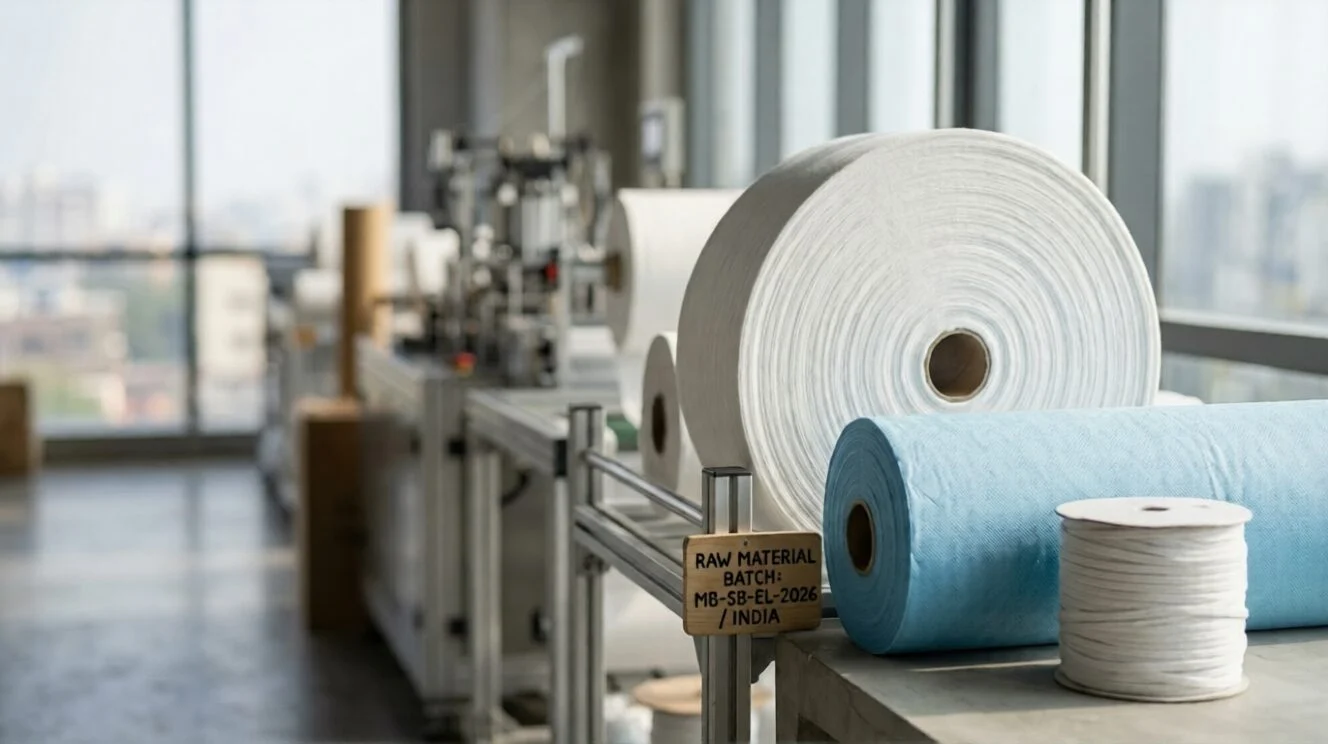
Surgical Mask Raw Material — Meltblown, Spunbond & Earloop Supplier India 2026
Surgical and 3-ply face masks remain a core PPE product for hospitals, clinics, dental practices, food processing, and consumer use across India. The industry contracted post-pandemic peak but has stabilised at a sustainable institutional baseline. For mask manufacturers, raw material selection drives both compliance (BIS, IS 16289 / IS 17334) and unit profitability — particularly meltblown filter media, where small differences in BFE (Bacterial Filtration Efficiency) and basis weight separate compliant from non-compliant product.
This guide covers all four raw material components of a 3-ply or 4-ply surgical mask, with specifications, BFE requirements, pricing, and supply options.
3-Ply Surgical Mask Construction
A standard 3-ply surgical mask has four raw material components:
- Outer layer: 25–30 GSM PP spunbond — water-resistant, coloured (blue/green)
- Middle layer: 25 GSM meltblown nonwoven — the actual filter
- Inner layer: 20–25 GSM PP spunbond — soft, hydrophilic, white
- Earloop: Spandex/nylon round elastic, 2.5 mm diameter
- Nose wire: PE-coated aluminium or galvanised iron, 3 mm wide
4-ply surgical masks add an extra meltblown filter layer for higher BFE (BFE ≥99%). N95 / KN95 masks use additional layers and electrostatic-charged meltblown.
Component 1 — Outer Layer PP Spunbond
Hydrophobic (water-resistant) coloured spunbond — typically surgical blue or mint green.
- GSM: 25–30
- Width: 175 mm slit (matches mask machine infeed) or 1.6 m master roll
- Colour: Surgical blue, mint green, white
- Treatment: Hydrophobic — sheds liquid splash
- Cost: ₹110–145/kg
Component 2 — Meltblown Filter Layer (Critical)
Meltblown is the heart of any face mask. It is a fine-fibre nonwoven (1–5 micron fibre diameter) produced by extruding molten polymer through a die under high-pressure hot air. The resulting microfibre web traps particles via mechanical filtration and electrostatic attraction.
Specifications by mask grade
| Mask Grade | Meltblown GSM | BFE Target | Standard |
|---|---|---|---|
| 3-ply surgical (Type I) | 20–25 | ≥95% | EN 14683 / IS 16289 |
| 3-ply surgical (Type II / IIR) | 25–30 | ≥98% | EN 14683 / IS 16289 |
| 4-ply surgical premium | 2 × 25 GSM | ≥99% | — |
| N95 / KN95 respirator | 30–35 (charged) | ≥95% PFE @ 0.3μm | IS 17334 / NIOSH |
Meltblown grade types
- BFE 95 grade: Standard meltblown for Type I masks. ₹450–650/kg
- BFE 99 grade: Higher-fibre-density meltblown for Type II/IIR. ₹600–900/kg
- Electret-charged meltblown: Corona-treated for N95/KN95 respirators. ₹800–1,400/kg
Meltblown is the highest-cost mask raw material — typically 40–55% of total mask BOM. Quality meltblown is what separates a real surgical mask from a non-compliant product.
Component 3 — Inner Layer PP Spunbond
Hydrophilic (skin-friendly) white spunbond — soft against skin, absorbs exhaled moisture.
- GSM: 20–25
- Width: 175 mm or 1.6 m master roll
- Colour: White
- Treatment: Hydrophilic — stays comfortable when wet
- Cost: ₹100–135/kg
Component 4 — Earloop & Nose Wire
Earloop
- Type: Round elastic, polyester-spandex blend
- Diameter: 2.5–3.0 mm
- Length per mask: ~17 cm (cut to ~18 cm with weld allowance)
- Stretch: 1:3 elongation, retains 90%+ recovery after 5 stretches
- Cost: ₹240–360/kg
- Cost per mask: ~₹0.10–0.18
Nose wire
- Type: PE-coated aluminium (most common) or galvanised iron
- Width: 3 mm
- Length: 9–10 cm per mask
- Cost: ₹220–290/kg
- Cost per mask: ~₹0.06–0.10
Total Raw Material Cost Per 3-Ply Mask
| Component | Spec | Cost per mask (₹) |
|---|---|---|
| Outer spunbond | 25 GSM, blue | ₹0.45 |
| Middle meltblown | 25 GSM, BFE 95 | ₹0.95 |
| Inner spunbond | 22 GSM, white | ₹0.40 |
| Earloop elastic | 2.5 mm round | ₹0.14 |
| Nose wire | 3 mm aluminium | ₹0.08 |
| Total RM per mask | ₹2.02 |
Add converting (₹0.40), ear-loop welding consumable, packaging (~₹0.30/mask in box), margin → finished retail price ₹3.50–8 per mask depending on grade and channel.
BIS Compliance & Standards
- IS 16289: Surgical mask standard — Type I (BFE ≥95%), Type II (BFE ≥98%), Type IIR (BFE ≥98% + splash resistance)
- IS 17334: Respiratory protective device standard for N95-equivalent
- BIS certification: Required for masks sold to government tenders
- EN 14683: European standard, often referenced for export
- ASTM F2100: US standard — Levels 1, 2, 3 by BFE and fluid resistance
HSN Code & GST
- Finished surgical masks: HSN 6307, GST 5%
- Spunbond raw material: HSN 5603, GST 12%
- Meltblown raw material: HSN 5603, GST 12%
- Earloop / elastic: HSN 5604, GST 12%
- Nose wire: HSN 7616, GST 18%
Why Source Mask Raw Material from Favourite Fab
- PP spunbond: Hydrophobic outer (blue/green) and hydrophilic inner (white) supplied from same facility
- Meltblown: BFE 95 and BFE 99 grades with COA on every batch
- Pre-slit rolls: 175 mm slit available (mask machine infeed standard)
- BIS-compliant grade: Documentation supports IS 16289 audit
- ISO 9001:2015 certified
- 500+ MT/month spunbond capacity for large mask production lines
Earloop and nose wire are sourced via partner network and quoted alongside fabric. Related: Face mask raw material category.
Frequently Asked Questions
What is the most important raw material in a surgical mask?
The meltblown filter layer. It determines BFE (Bacterial Filtration Efficiency) and is the difference between a compliant surgical mask and a non-compliant one. Meltblown is also 40–55% of total mask BOM cost.
Can I use cheaper meltblown to lower cost?
Possible but risky. Sub-spec meltblown (under 20 GSM or with insufficient electret charge) fails BFE testing — the resulting masks cannot be sold under IS 16289 / EN 14683 claims and cannot enter government or hospital tenders. Cheaper meltblown is suitable only for non-medical / consumer comfort masks.
What is the difference between spunbond and meltblown?
Spunbond uses continuous filaments (15–30 micron diameter) — strong fabric, low filtration. Meltblown uses microfibres (1–5 micron) — weak fabric, high filtration. Both are PP. Surgical masks use both — spunbond for structure, meltblown for filtration.
Is meltblown the same in surgical masks and N95 respirators?
Same base material but different processing. N95-grade meltblown is corona-treated to carry an electrostatic charge, dramatically improving sub-micron filtration without adding bulk. Charged meltblown costs 40–80% more than standard.
What is the BIS certification process for surgical masks?
BIS testing under IS 16289 includes BFE, breathability (delta-P), splash resistance (Type IIR), and bioburden. Cost ₹2–4 lakh, lead time 60–90 days. BIS license valid 2 years. Required for government tender supply.
Can I import meltblown instead of buying domestically?
Yes — meltblown is imported from China, Korea, Taiwan. Domestic Indian meltblown (including Favourite Fab partner sources) is now competitive on price and lead time, with the added advantage of GST input credit and faster restocking cycles.
Get Mask Raw Material Quote & Samples
Share your mask grade target (Type I / II / IIR / N95), monthly production volume, and machine specifications. Receive a complete BOM quote and samples within 5 days.
- 📞 +91 88007 75462 / +91 88007 75462
- ✉️ sale@favouritehub.com
- 💬 WhatsApp: +91 88007 75462
- 🌐 Send specification online

Gaurav Garg
I'm Gaurav Garg, CEO of Favourite Fab, a company on a mission to revolutionize the nonwoven industry with sustainable practices. We work hand-in-hand with manufacturers and suppliers who share our commitment to eco-friendly production. With a deep interest in textile innovation, I'm passionate about educating consumers about sustainable material options and their potential to transform the nonwoven landscape.


