

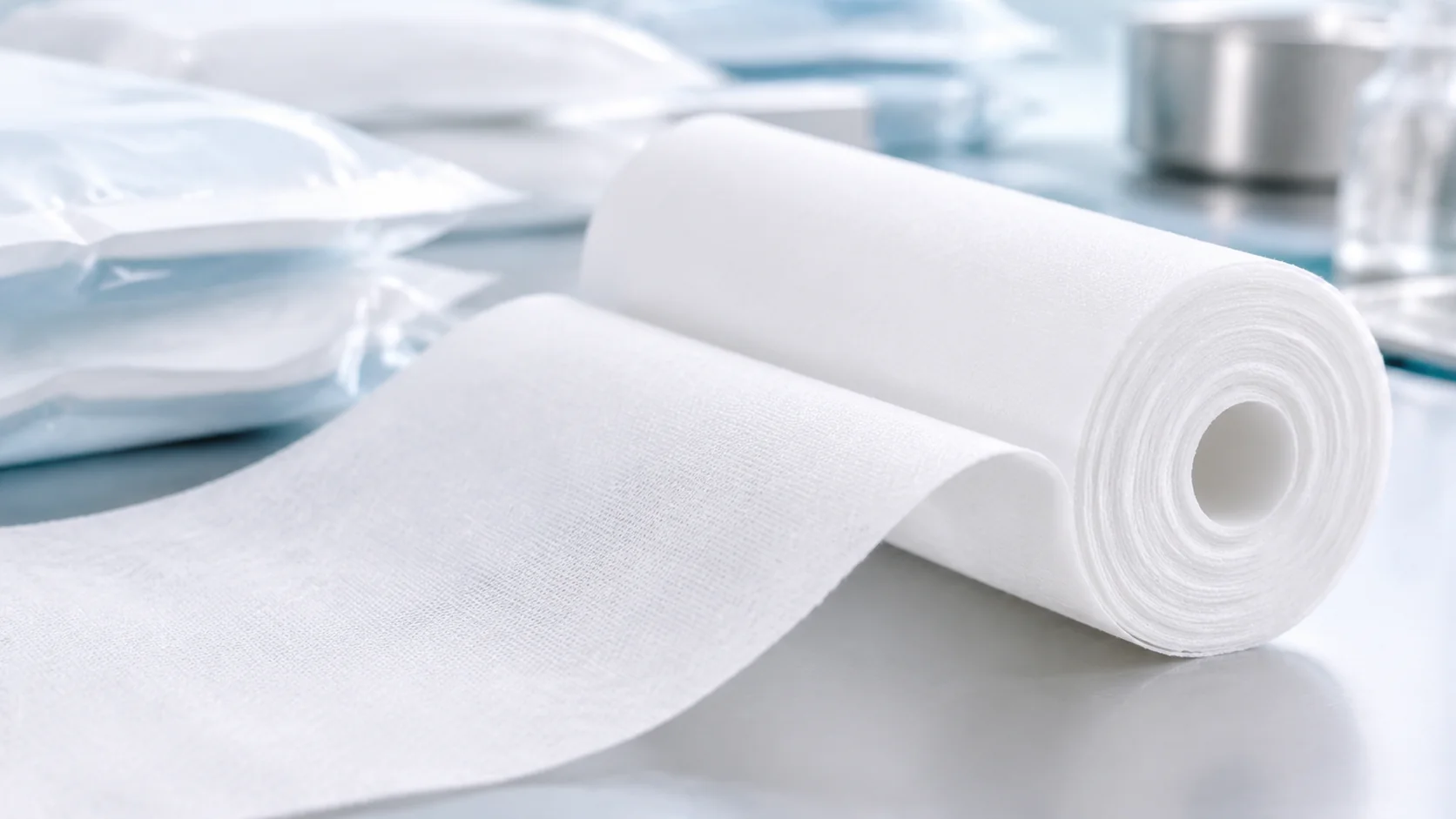
Telfa Dressing Alternative Non-Adherent Wound Care Fabric India — Favourite Fab
Telfa dressing alternative non-adherent wound care fabric from Favourite Fab gives medical device manufacturers and wound care OEMs a verified raw material for non-stick wound contact layers. Favourite Fab is a B2B nonwoven raw material supplier based in Agra, India, supplying perforated nonwoven wound contact fabric to dressing manufacturers across 50+ countries who require a Telfa equivalent for production of non-adherent wound dressings.
What Is a Telfa Alternative Non-Adherent Wound Care Fabric
Telfa is a registered trade name for a non-adherent wound contact dressing layer originally developed by Covidien (now Medtronic). The generic category — non-adherent wound contact layer — describes a perforated or low-adherence fabric placed directly against a wound bed that allows exudate to pass through to an absorbent core while preventing the dressing from bonding to regenerating tissue on removal.
A Telfa alternative wound care fabric replicates the functional performance of the original design using a perforated thermoplastic nonwoven or film-coated nonwoven wound contact layer. The critical performance parameters are low adherence to wound tissue, adequate exudate strike-through, dimensional stability under wound compression, and compatibility with EO or gamma sterilisation for sterile dressing manufacturing.
For wound care dressing manufacturers, sourcing a Telfa equivalent nonwoven from a B2B raw material supplier enables cost-optimised generic dressing production, private-label wound care product development, and supply chain independence from branded component sources. Favourite Fab supplies perforated nonwoven wound contact layer fabric with full material documentation for regulatory submissions.
Specifications and Options
| Parameter | Specification | Detail |
|---|---|---|
| Basis Weight | 18–40 GSM | 25–30 GSM standard for wound contact layer |
| Fibre Type | PP spunbond, PE/PP bicomponent, polyester | PE/PP bicomponent for low-trauma removal |
| Perforation Pattern | Circular, slit, or hexagonal | Aperture size 0.5–3 mm specified at order stage |
| Adherence Level | Low-adherence (non-stick finish) | Silicone-coated or paraffin-free grades available |
| Strike-through Rate | >2 g/min at 0.5 kPa | Per EN 13726-1 or ASTM method on request |
| Sterilisation Compatibility | EO, gamma (25 kGy) | Post-sterilisation performance data available |
| Width | Up to 3200 mm | Slit to dressing-cutting widths on request |
| Certifications | ISO 9001, ISO 10993 biocompatibility | Biocompatibility data available for regulatory files |
Applications in Manufacturing
Non-adherent wound contact layer fabric is used by wound dressing manufacturers producing general-purpose dressings for post-operative wounds, minor lacerations, abrasions, and donor sites. The Telfa-equivalent nonwoven layer forms the wound-facing component of multi-layer dressing assemblies where atraumatic removal is the primary clinical requirement.
Private-label medical device companies sourcing wound care components for NHS, hospital group, and pharmacy chain tenders use non-adherent nonwoven as the wound contact layer in own-brand dressing ranges. The ability to supply with ISO 10993 biocompatibility data and sterilisation validation documentation simplifies CE mark registration under EU MDR 2017/745.
Military and emergency medical kit manufacturers use non-adherent wound contact fabric in field dressing assemblies where the dressing must be removable without secondary trauma in resource-limited environments. Export-grade dressings for humanitarian aid supply chains also use non-adherent nonwoven components from verified B2B suppliers with complete material traceability.
For related medical wound care materials see our nonwoven fabric for wound dressings and EO and gamma sterilisation nonwoven guide. The medical device nonwoven overview is at nonwoven fabric for medical device OEMs.
Why Source From Favourite Fab
- MOQ-friendly — suitable for small and large manufacturers
- Export-ready — ships to 50+ countries
- ISO certified manufacturing facility
- 10+ years supplying hygiene and medical industry
- Custom specifications available on request
- ISO 10993 biocompatibility and sterilisation validation data available
- Custom perforation patterns and aperture sizes on request
Pricing and MOQ
Non-adherent wound contact layer nonwoven is priced based on fibre type, perforation pattern, GSM, and order volume. Favourite Fab offers competitive wholesale pricing for wound care dressing manufacturers and medical device OEMs. Contact sale@favouritehub.com with your fibre preference, perforation requirement, GSM, width, and monthly volume for a quote and sample within 48 hours.
How to Order
- Send your material requirements to sale@favouritehub.com
- Receive a quote and sample within 48 hours
- Confirm order and production begins
Frequently Asked Questions
Q: What makes a nonwoven fabric non-adherent for wound contact use?
A: Non-adherence in a wound contact layer is achieved through perforation (allowing exudate to pass through rather than accumulating at the wound interface), low-surface-energy fibre selection such as PP or PE, and optional silicone or paraffin-free coating treatments that prevent fibre bonding to wound tissue during healing.
Q: Is Favourite Fab’s wound contact nonwoven biocompatible under ISO 10993?
A: Yes. Favourite Fab supplies wound contact layer nonwoven with ISO 10993 biocompatibility data covering cytotoxicity, sensitisation, and irritation evaluations. Full biocompatibility files are available on request to support CE mark and FDA submissions.
Q: Can the perforation pattern be customised for our dressing design?
A: Yes. Favourite Fab offers circular, slit, and hexagonal perforation patterns with aperture sizes from 0.5 mm to 3 mm. Custom perforation layouts are available on enquiry with tooling specifications confirmed at the order stage.
Q: Is the non-adherent nonwoven compatible with gamma sterilisation?
A: Yes. Favourite Fab’s PP and PE/PP bicomponent wound contact nonwoven is compatible with gamma sterilisation at 25 kGy and 50 kGy doses. Post-irradiation mechanical property data is available for sterilisation validation documentation.
Q: Can Favourite Fab supply non-adherent wound contact fabric for EU MDR 2017/745 compliant dressings?
A: Yes. Favourite Fab provides the material documentation package required for EU MDR Class I and Class IIa wound dressing technical files, including ISO 9001 certificate, ISO 10993 biocompatibility data, sterilisation compatibility data, and material specification sheets.
Contact Favourite Fab
Email: sale@favouritehub.com
WhatsApp: +91-8800775462
Send your material specifications today for a same-day quote.

Gaurav Garg
I'm Gaurav Garg, CEO of Favourite Fab, a company on a mission to revolutionize the nonwoven industry with sustainable practices. We work hand-in-hand with manufacturers and suppliers who share our commitment to eco-friendly production. With a deep interest in textile innovation, I'm passionate about educating consumers about sustainable material options and their potential to transform the nonwoven landscape.


