

Tensile Strength MD CD Testing for Nonwoven Fabric: EDANA 110 Method Guide — India
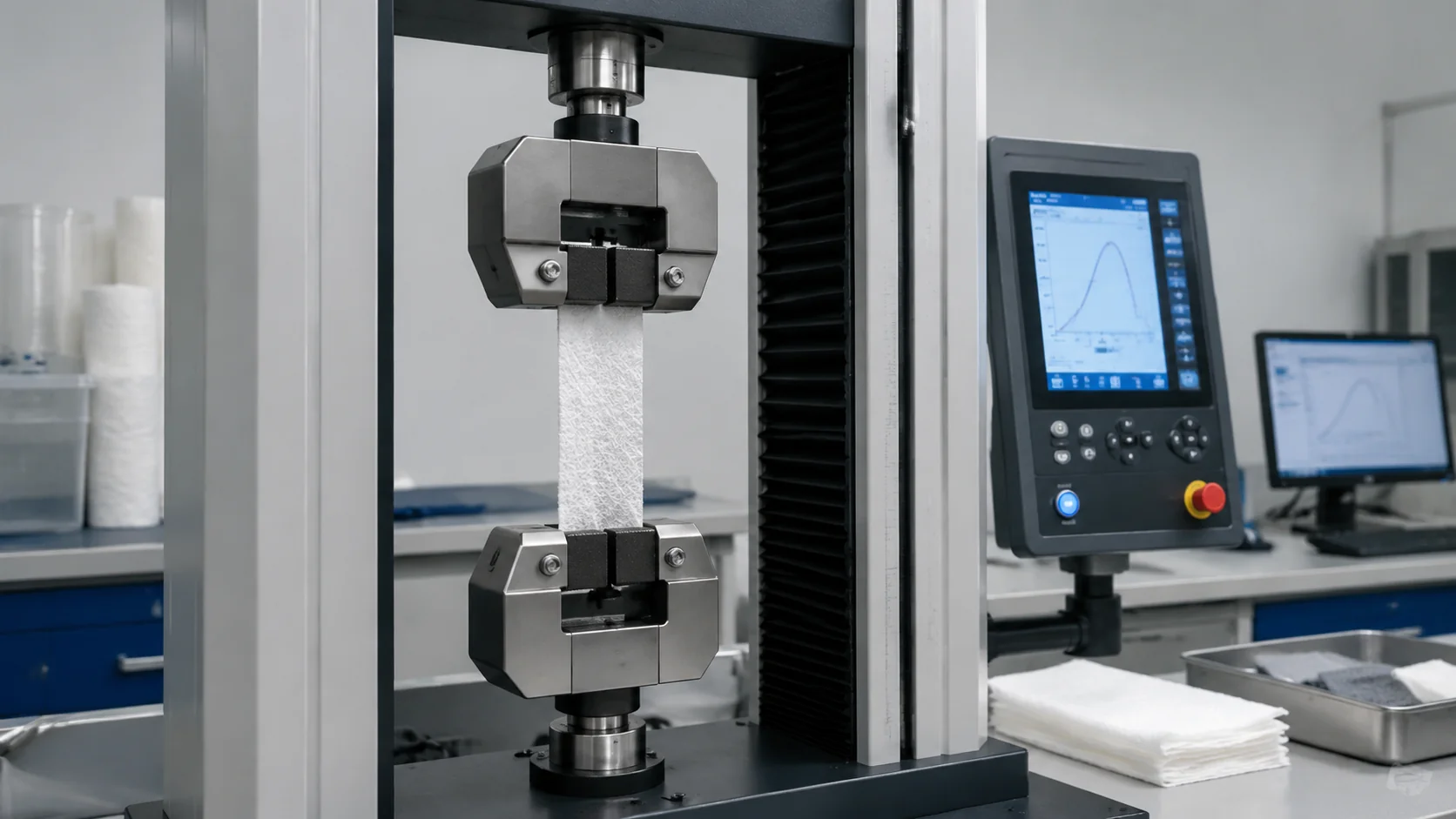
Tensile strength MD (machine direction) and CD (cross direction) testing is the most important mechanical test for nonwoven fabric qualification. Favourite Fab, a B2B nonwoven fabric raw material supplier based in Agra, India, tests tensile strength on every production batch per EDANA ERT 20.2 / WSP 110.4. This guide explains the test setup, MD vs CD difference, force-extension curve interpretation, and typical values for PP spunbond, PET, and spunlace nonwoven grades — helping quality engineers set incoming inspection acceptance criteria.
What Is Tensile Strength Testing for Nonwoven Fabric
Tensile strength testing measures the maximum force a nonwoven fabric strip can withstand before breaking, applied at a controlled rate in a defined direction. Machine direction (MD) refers to the direction the fabric travels through the production line — fibres are more aligned in this direction, giving higher tensile strength. Cross direction (CD) is perpendicular to MD — fibres are less aligned, giving lower tensile strength but often higher elongation. The MD:CD tensile ratio characterises fabric anisotropy and predicts performance on converting equipment.
Key Parameters: Tensile Strength Testing per EDANA ERT 20.2
| Parameter | Specification | Detail |
|---|---|---|
| Test method | EDANA ERT 20.2 / WSP 110.4 | Harmonised EDANA/INDA standard; ISO 9073-3 equivalent |
| Sample width | 50 mm (5 cm) | Results reported per 5 cm width — N/5cm units |
| Gauge length | 200 mm | Distance between grips before test starts |
| Crosshead speed | 100 mm/min | Constant rate of extension (CRE) machine required |
| Conditioning | 23°C ± 2°C, 50% RH ± 5% | Minimum 4 hours conditioning before test |
| Sample count | 5 MD + 5 CD minimum | Report mean ± standard deviation |
| Reported values | Tensile strength (N/5cm) + elongation at break (%) | Both MD and CD reported separately |
| Typical PP 25 GSM MD | ≥ 80–120 N/5cm | Grade and bonding pattern dependent |
Typical Tensile Strength Values by Nonwoven Grade
| Fabric Type | GSM | MD Tensile (N/5cm) | CD Tensile (N/5cm) | MD:CD Ratio |
|---|---|---|---|---|
| PP Spunbond | 15 | 50–80 | 25–45 | ~2:1 |
| PP Spunbond | 25 | 80–130 | 40–70 | ~2:1 |
| PP Spunbond | 40 | 130–200 | 65–110 | ~2:1 |
| SMS (PP) | 20 | 70–110 | 40–65 | ~1.8:1 |
| Spunlace (Viscose/PET) | 40 | 90–150 | 60–100 | ~1.5:1 |
| PET Spunbond | 30 | 120–180 | 70–120 | ~1.7:1 |
Why Tensile Strength Testing Matters for Manufacturers
Tensile strength directly predicts converting performance. Low MD tensile in a topsheet nonwoven causes web breaks on high-speed sanitary pad converting lines — each break means machine stoppage, scrap, and lost production time. Low CD tensile causes tearing during unwinding or cross-cutting. Setting minimum tensile acceptance criteria based on EDANA test data is the single most effective way to prevent converting line failures caused by raw material variation.
The MD:CD ratio also matters — highly anisotropic fabrics (MD:CD > 3:1) perform differently under biaxial stress. For products that experience stress in multiple directions (surgical gowns, filtration media), a more balanced MD:CD ratio is preferred. Favourite Fab can adjust bonding parameters to tune the MD:CD ratio for specific converting applications.
Why Source From Favourite Fab
- MOQ-friendly — tensile test certificates provided at sampling stage
- Export-ready — EDANA/INDA test results with every shipment
- ISO certified — calibrated tensile testing equipment; traceable test results
- 10+ years hygiene and medical nonwoven supply
- Custom specs on request — MD:CD ratio tuned to converting line requirements
- Batch-to-batch consistency monitored via in-house tensile testing on every lot
Pricing and MOQ
Tensile strength test certificates are provided at no charge for all grades. Third-party NABL-accredited tensile testing is available at cost for regulatory submissions. Custom tensile specification development — specific MD/CD minimums, MD:CD ratio targets — is available for volume buyers. Contact sale@favouritehub.com for a quotation with tensile data sheet.
See also: EDANA INDA testing standards guide, absorbency sink time testing, and our spunlace nonwoven for wet wipes product page. Full pillar: nonwoven fabric.
How to Order
- Send requirements to sale@favouritehub.com — specify minimum MD/CD tensile requirements and application
- Receive TDS with tensile data + quotation within 48 hours
- Confirm sample or bulk order — tensile test certificate issued with every batch
Frequently Asked Questions
Q: What is the difference between MD and CD tensile strength in nonwoven fabric?
A: MD (machine direction) tensile is measured parallel to the production direction — fibres are more aligned in this direction, giving higher strength. CD (cross direction) is perpendicular to MD — fibres are less aligned, giving lower tensile but often higher elongation. MD tensile is typically 1.5–3x higher than CD in spunbond fabrics.
Q: Which EDANA test method is used for nonwoven fabric tensile strength?
A: EDANA ERT 20.2 (also published as WSP 110.4 and equivalent to ISO 9073-3) is the standard method. It specifies 50mm wide samples, 200mm gauge length, and 100mm/min crosshead speed on a CRE tensile testing machine. Results are reported in N/5cm for tensile strength and % for elongation at break.
Q: What is the minimum tensile strength for nonwoven topsheet used in sanitary pads?
A: Typical minimum tensile strength for sanitary pad topsheet (15–20 GSM PP spunbond) is 50–80 N/5cm MD and 25–45 N/5cm CD. Higher-speed converting lines may require higher minimums. Favourite Fab can confirm current production values and adjust specification to your converting line requirements.
Q: Does Favourite Fab test tensile strength on every production batch?
A: Yes. Tensile strength (MD and CD) is tested on every production batch as part of outgoing quality control. Results are recorded in the batch quality record and made available to buyers as a test certificate. Batch-level data enables traceability to specific rolls in the event of a quality issue.
Q: Can I specify a custom MD:CD tensile ratio for nonwoven fabric from Favourite Fab?
A: Yes. The MD:CD ratio is influenced by bonding pattern, bonding area, and production parameters. Favourite Fab can adjust production settings to achieve a more balanced or more anisotropic MD:CD ratio for specific applications. Contact sale@favouritehub.com with your target ratio and application for a development discussion.
Contact Favourite Fab
Email: sale@favouritehub.com | WhatsApp: +91-8800775462
Send your tensile strength requirements today for a same-day TDS and quotation.

Gaurav Garg
I'm Gaurav Garg, CEO of Favourite Fab, a company on a mission to revolutionize the nonwoven industry with sustainable practices. We work hand-in-hand with manufacturers and suppliers who share our commitment to eco-friendly production. With a deep interest in textile innovation, I'm passionate about educating consumers about sustainable material options and their potential to transform the nonwoven landscape.


