

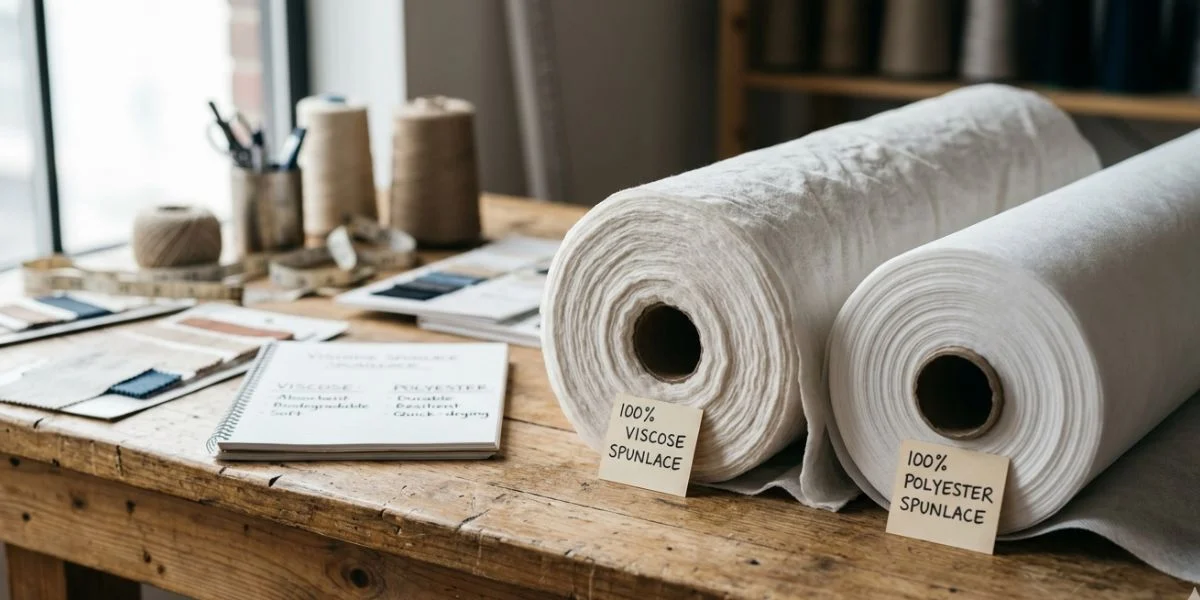
Viscose vs Polyester Spunlace Nonwoven — Which Blend to Choose?
Choosing between viscose and polyester spunlace nonwoven is one of the most common raw material decisions for wipe converters and hygiene OEMs. Both are hydroentangled fabrics but their fibre composition creates significant differences in softness, absorbency, strength, chemical resistance, and cost. This guide compares the two across all key performance parameters.
Browse our full range: View all nonwoven fabric products — spunlace, spunbond, SMS, bico — with GSM, width and certification options. B2B MOQ from 500 kg.
Key Property Comparison
| Property | Viscose Spunlace | Polyester Spunlace |
|---|---|---|
| Softness | Very high (smooth, natural) | Moderate (firmer feel) |
| Absorbency | 1,000–1,400% of weight | 200–400% of weight |
| Wet tensile | Lower | High (60–80% of dry) |
| Chemical resistance | Poor (IPA degrades) | Excellent (IPA, bleach, solvents) |
| Biodegradability | Yes (cellulose base) | No (synthetic) |
| Reusability | 5–10 wash cycles | 25–35 wash cycles |
| Cost (relative) | Higher | Lower |
| Best for | Baby/facial wipes, hygiene | Industrial/cleanroom wipes |
When to Choose Viscose Spunlace
Choose viscose (or viscose-dominant 70/30 blend) for: skin-contact applications (baby wipes, facial wipes, cosmetic pads), single-use hygiene products requiring high absorbency, biodegradable/eco-positioned products, and sanitary pad topsheets. Viscose delivers the softness and natural-fibre appeal consumers associate with premium wipes.
When to Choose Polyester Spunlace
Choose polyester for: IPA and disinfectant wipes (chemical resistance critical), reusable industrial and household wipes (30+ wash cycles), cleanroom wipes (low lint + IPA compatibility), and automotive wipes (oil/solvent resistance). Polyester survives chemical environments that destroy viscose.
The Blend Compromise
Most commercial wipes use viscose/polyester blends — 70/30 for soft wipes (softness priority), 50/50 for balanced household wipes, 30/70 for heavy industrial wipes (durability priority). See our viscose polyester spunlace nonwoven fabric page for full blend specifications.
FAQ
Is viscose spunlace always softer than polyester?
Yes — viscose fibre has a round, smooth cross-section with lower surface friction than polyester. At equivalent GSM, viscose spunlace will always feel softer than polyester. The difference is perceivable by end consumers, which is why premium baby wipes use viscose-dominant blends.
Can polyester spunlace be used for baby wipes?
Technically yes, but not recommended for skin-contact baby wipes. Polyester is firmer and may cause more friction on sensitive baby skin. Polyester spunlace is used for baby wipe applications only where chemical resistance (formulation-specific) is required — which is rare in baby wipe formulations.
Which is more sustainable — viscose or polyester spunlace?
Viscose (cellulose) is biodegradable vs polyester (synthetic, not biodegradable). However, viscose production has environmental impacts (chemical processing of wood pulp). rPET (recycled polyester) spunlace offers a sustainability alternative. Net environmental impact depends on end-of-life scenario — in-landfill viscose biodegrades; polyester remains.
Full range: spunlace nonwoven fabric. Related: viscose polyester spunlace nonwoven fabric.
Technical Specifications — Viscose vs Polyester Spunlace: Head-to-Head Comparison
| Property | Viscose Spunlace | Polyester Spunlace |
|---|---|---|
| Moisture Absorption | ≥ 500% by weight (very high) | ≤ 50% by weight (very low — hydrophobic) |
| Tensile Strength (MD) | ≥ 30 N/5 cm (moderate) | ≥ 60 N/5 cm (high) |
| Softness (hand-feel) | Excellent — silk-like drape | Good — smooth but less natural |
| Biodegradability | Fully biodegradable | Not biodegradable |
| Chemical Resistance | Moderate — sensitive to strong acids/alkalis | Excellent — resistant to most saturants |
| Cost Position | Higher (natural cellulose origin) | Lower (petrochemical origin) |
| Typical GSM Range | 25–80 GSM | 30–120 GSM |
| Certifications | ISO 9001, OEKO-TEX Standard 100 | ISO 9001, OEKO-TEX Standard 100 |
B2B Applications & OEM Use-Cases
- When to Specify Viscose: Premium Hygiene Topsheets & Sheet Masks: OEMs prioritising skin-contact softness and high fluid absorbency specify viscose spunlace for premium feminine hygiene topsheets and serum-carrier sheet masks. The silk-like hand-feel and high moisture uptake are performance attributes that support premium positioning and cannot be replicated by polyester alone at comparable GSM.
- When to Specify Polyester: Industrial Wipes & Chemical-Contact Applications: Where the nonwoven will contact aggressive cleaning chemistries, solvents, or require extended saturation stability, polyester spunlace is the correct specification. Its hydrophobic nature and chemical resistance make it the standard choice for industrial MRO wipes, cleanroom wipes, and any application where the saturant pH exceeds 9 or contains solvent fractions.
- When to Specify a Blend: Most Production-Volume Hygiene & Wipe Applications: Most high-volume OEMs opt for viscose-polyester blended spunlace to balance absorbency (from viscose) against cost, strength, and chemical stability (from polyester). Blend ratios of 70/30 or 50/50 are the most common production configurations, enabling specification optimisation without single-fibre performance compromises.
Sourcing from Favourite Fab — MOQ, Lead Time & Customisation
Favourite Fab supplies both 100% viscose spunlace, 100% polyester spunlace, and all blended ratios from its Agra, India facility, giving B2B buyers a single-source option across the full spunlace fibre spectrum.
- MOQ: 500 kg per specification
- Domestic Lead Time: 7–14 working days
- Export Lead Time: 21–30 working days
- Customisation: 100% viscose, 100% polyester, or any blend ratio; GSM (25–120), width (1.6 m–3.2 m), surface finish
- Certifications: ISO 9001:2015 & OEKO-TEX Standard 100
Contact our B2B sales team with your performance requirements to receive a fibre-selection recommendation and comparative sample set.
Frequently Asked Questions
Which is more cost-effective: viscose or polyester spunlace?
Polyester spunlace is typically 15–25% lower in cost per kg than viscose spunlace at comparable GSM, because PET is a petrochemical-derived commodity fibre with more stable global pricing than viscose (which is impacted by cotton and wood pulp commodity cycles). For cost-sensitive applications where softness and biodegradability are not required, polyester spunlace offers better value. Most volume buyers use blends to balance cost against performance.
Can viscose and polyester spunlace be differentiated by a simple field test?
Yes. The simplest field test is the burn test: viscose burns like paper (cellulosic — leaves ash, smells like burning paper) while polyester melts, forms beads, and smells of burning plastic. For absorbency, a water drop test distinguishes them instantly — viscose absorbs immediately while a water drop beads on polyester for several seconds. Neither test is a substitute for laboratory fibre analysis for formal specification verification.
Is there a sustainability advantage to choosing viscose over polyester spunlace?
Yes, in terms of end-of-life biodegradability. Viscose is a cellulosic fibre derived from wood pulp and is fully biodegradable under composting conditions. Polyester is not biodegradable and persists in the environment. However, viscose production is energy and chemical-intensive, so cradle-to-gate carbon footprint comparisons are more nuanced. Buyers with biodegradability claims or EPR compliance requirements should specify viscose or cotton spunlace; buyers optimising for production performance and cost should evaluate blends or polyester.
📋 Related: Spunlace Nonwoven Fabric — Full Range & Specs | All Nonwoven Products from Favourite Fab

Gaurav Garg
I'm Gaurav Garg, CEO of Favourite Fab, a company on a mission to revolutionize the nonwoven industry with sustainable practices. We work hand-in-hand with manufacturers and suppliers who share our commitment to eco-friendly production. With a deep interest in textile innovation, I'm passionate about educating consumers about sustainable material options and their potential to transform the nonwoven landscape.


