

What Is Carrier Tissue in a Sanitary Napkin? Function & GSM Guide
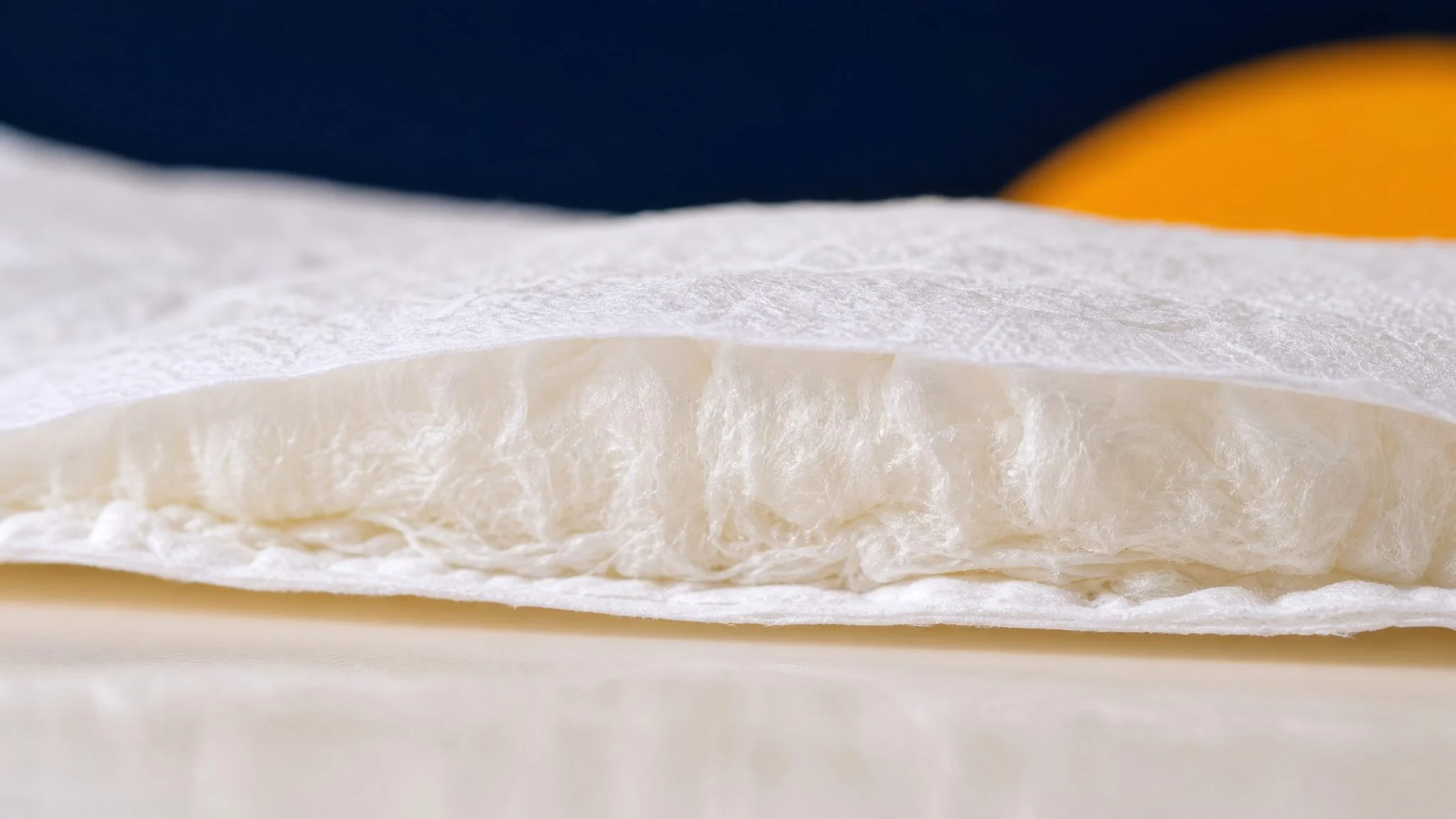
Carrier tissue in a sanitary napkin is a thin, 100% virgin wood pulp tissue layer that wraps the SAP (super absorbent polymer) core. It holds the SAP particles in place during compression, stops pinholing and strike-through, and gives the core enough wet and dry strength to run on high-speed converting lines. Request a carrier tissue sample to check pinhole resistance on your own core-forming line.
perforated nonwoven — skin contact
acquisition & distribution layer
13–15 GSM
SAP + fluff pulp
13–15 GSM
PE film — leak barrier
Carrier tissue wraps the SAP core on both faces — it holds the core together during high-speed converting and blocks SAP granules from pinholing through to the topsheet or backsheet.
What is carrier tissue and why does a sanitary napkin need it?
Every absorbent sanitary napkin core is built from fluff pulp and SAP powder, blended and compressed into a pad-shaped core. Loose SAP granules cannot be compressed directly against a backsheet film or airlaid sheet without leaking through pinholes formed during die-cutting and embossing. Carrier tissue solves this by wrapping the SAP-fluff blend on both sides (or fully enclosing it) before it moves to the next converting stage.
Because carrier tissue is 100% virgin wood pulp, it is highly absorbent in its own right, non-slip against the core, and — critically — strong enough in both dry and wet states to survive line tension, embossing pressure, and folding without tearing. A tissue that fails wet-strength testing lets SAP migrate, which shows up downstream as leakage complaints, not a converting-line fault, which is why buyers scrutinize tissue GSM and strength before locking a supplier.
Where carrier tissue sits inside the pad structure
In a typical sanitary napkin cross-section, layers stack from top to bottom as: topsheet (nonwoven or perforated film) → acquisition/distribution layer (ADL) → absorbent core (fluff pulp + SAP) wrapped in carrier tissue → backsheet film (often with breathable nonwoven backing). The carrier tissue sits directly against the core, between the SAP-fluff mix and the backsheet or ADL. It is the last barrier before the core meets the outer layers, which is why any pinhole or weak spot in the tissue shows up as a strike-through defect on the finished pad rather than an isolated raw-material fault.
On some core designs, carrier tissue also runs on the topside of the core, sandwiching the SAP-fluff blend between two tissue layers before the ADL and topsheet are laminated on. Either configuration relies on the same core function: contain SAP, resist compression, and hold shape through the converting line.
Carrier tissue GSM specification
| Parameter | Specification |
|---|---|
| Material | 100% virgin wood pulp tissue |
| GSM range | 13–15 GSM |
| Strength profile | Wet + dry strength for core-wrap runnability |
| MOQ (Favourite Fab) | 1000 kg |
| Source | Imported |
GSM in this range keeps the tissue thin enough to avoid adding bulk to the finished pad while staying dense enough to resist tearing during high-speed core wrapping. Buyers evaluating a new supplier should ask for GSM test reports on every incoming lot, not just the first sample batch, since pulp-source variation between shipments is a common cause of GSM drift.
Carrier tissue technical data — sanitary pad grade
| Property | Sanitary pad grade | Test method |
|---|---|---|
| Basis weight (GSM) | 13–15 g/m² | EDANA WSP 130.1 / ISO 9073-1 |
| Composition | 100% virgin wood pulp | Furnish declaration |
| Wet-strength treatment | Yes — wet-strength resin for hygiene-core duty | Wet tensile (MD), ISO 12625-5 |
| Tensile strength | MD/CD rated for high-speed unwind | EDANA WSP 110.4 / ISO 9073-3 |
| Function in pad | Core wrap — top & bottom face of SAP/fluff core | — |
| Primary job | Pinhole / strike-through resistance under SAP swell | — |
| Minimum order (MOQ) | 1000 kg | — |
| Sourcing | Imported & quality-verified by Favourite Fab | — |
Test-method references are the recognised EDANA/ISO standards for nonwoven and tissue basis weight, tensile, and wet tensile. Confirm exact per-lot values against your incoming-QC spec sheet — see the full quality checklist.
How basis weight and wet strength are verified on the pad layer stack
Reading the layer stack from skin side down — topsheet, ADL, carrier tissue, SAP core, a second carrier tissue face, then backsheet — makes the wrap’s position clear: it is in direct contact with the swelling SAP on both faces of the core, so it absorbs the mechanical stress the moment the polymer gels and expands. Two lab checks tell buyers whether a lot can survive that duty. Basis weight is confirmed by conditioning and weighing a known area under EDANA WSP 130.1 or ISO 9073-1, which turns a claimed 13–15 GSM into a measured number. Wet tensile strength, measured on a wetted strip under ISO 12625-5, is the property that actually separates carrier tissue from ordinary facial or toilet tissue: untreated tissue loses most of its strength once wet and tears as the SAP swells, whereas wet-strength-treated carrier tissue retains enough tensile to hold the core intact. When that wet tensile is marginal, the wrap ruptures under gel pressure and fluid strikes straight through to the topsheet or backsheet — the strike-through failure buyers design out.
Why carrier tissue GSM and strength affect machine efficiency
Sanitary napkin converting lines run at high speed, and the core-wrap station is one of the more failure-prone zones on the line. If carrier tissue GSM is inconsistent lot-to-lot, or wet strength is marginal, converters see line stoppages from tissue breaks, misaligned wraps, and SAP spillage inside the machine — all of which cost more in downtime than the tissue itself costs per kg. A tissue that holds consistent GSM and strength within spec lets the core-wrap station run continuously without operator intervention, which is the real efficiency metric procurement teams should track, not just per-kg price.
Common buyer mistakes when sourcing carrier tissue
Buyers new to carrier tissue sourcing typically make three mistakes. First, they compare suppliers on GSM number alone without checking wet-strength performance, which is the property that actually prevents SAP leakage under compression. Second, they accept a single sample roll as representative of ongoing supply, when pulp-source shifts between shipments are the more common cause of quality drift. Third, some buyers substitute a low-GSM SMS nonwoven (under roughly 12 GSM) for carrier tissue to cut cost — this can work for certain core designs but changes absorbency and hand-feel characteristics, and should be qualified on your own line before switching, not assumed interchangeable.
If your line runs an SMS-nonwoven wrap and you’re evaluating a switch, see Favourite Fab’s SSS hydrophilic nonwoven spec sheet.
FAQs
Q1: What is carrier tissue made of?
A1: Carrier tissue is made from 100% virgin wood pulp, not recycled fiber, to ensure consistent wet and dry strength for core-wrap applications.
Q2: What GSM is carrier tissue for sanitary napkins?
A2: Favourite Fab’s imported carrier tissue is supplied at 13–15 GSM, the range typically used for SAP core wrapping in sanitary napkins.
Q3: How does carrier tissue prevent SAP leakage?
A3: Carrier tissue wraps the SAP-fluff core tightly and resists tearing under compression and embossing pressure, which stops SAP pinholing and strike-through into the topsheet or backsheet.
Q4: Is carrier tissue the same as airlaid paper?
A4: No. Carrier tissue is a thin virgin wood pulp wrap layer for the SAP core, while airlaid paper is a thicker, bulkier absorbent sheet often used as a standalone core or ADL component. They serve different structural roles in the pad.
Q5: Can SMS nonwoven replace carrier tissue in a sanitary napkin core?
A5: Low-GSM SMS nonwoven (under roughly 12 GSM) is sometimes used as a lower-cost alternative, but it changes absorbency and feel characteristics versus virgin wood pulp tissue. Qualify any substitution on your own converting line before switching suppliers.
Q6: What is the MOQ for carrier tissue paper from Favourite Fab?
A6: Favourite Fab’s MOQ for imported carrier tissue is 1000 kg per order.
For full sourcing guidance, spec comparisons, and supplier vetting criteria, see the complete Carrier Tissue Paper for Sanitary Napkins: Complete B2B Buying Guide.
For diaper-specific core-wrap spec, see Carrier Tissue Paper for Baby Diapers.

Gaurav Garg
I'm Gaurav Garg, CEO of Favourite Fab, a company on a mission to revolutionize the nonwoven industry with sustainable practices. We work hand-in-hand with manufacturers and suppliers who share our commitment to eco-friendly production. With a deep interest in textile innovation, I'm passionate about educating consumers about sustainable material options and their potential to transform the nonwoven landscape.


