

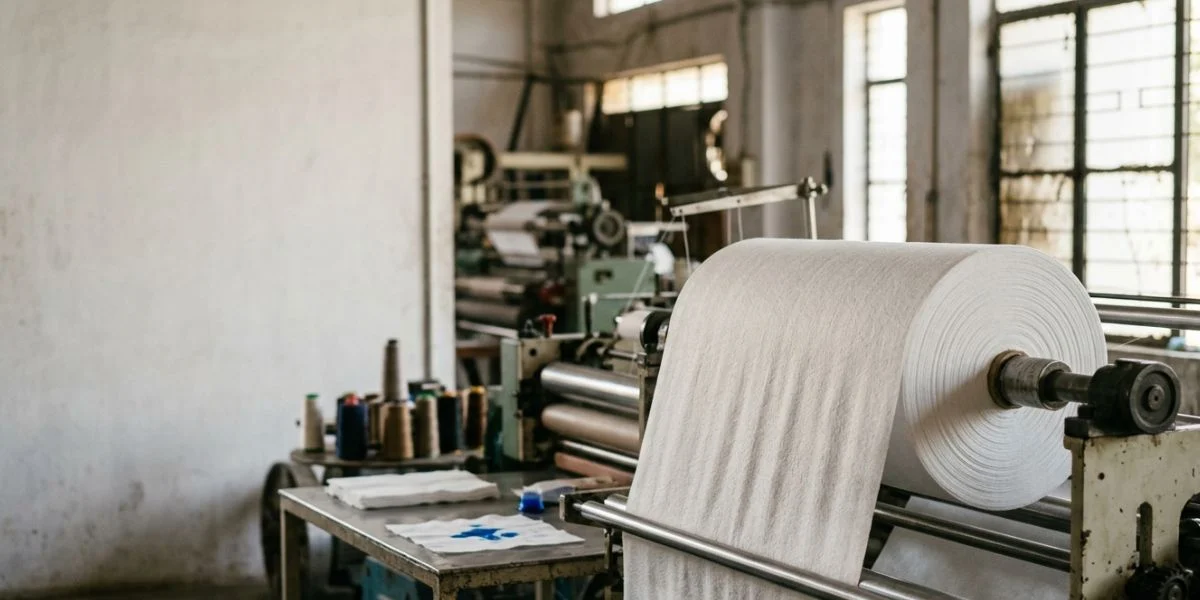
Wood Pulp Polyester Spunlace Nonwoven — High Absorbency Value Grade
Wood pulp polyester spunlace nonwoven combines the ultra-high absorbency and paper-like liquid wicking of wood pulp (fluff pulp) with the structural reinforcement of polyester fibres. The hydroentanglement process bonds these two materials into a coherent fabric that absorbs far more liquid per gram than viscose blends — at a lower raw material cost. Used in high-absorption industrial wipes, oil-absorbent shop towels, foodservice wipes, and cost-sensitive hygiene applications. Favourite Fab supplies wood pulp/polyester spunlace in 70/30 blend at 50–120 GSM.
Key Properties
- Ultra-high absorbency — Wood pulp absorbs liquid faster and in higher volumes than viscose. Total absorption can reach 1,200–1,600% of fabric weight.
- Rapid liquid uptake — Fluff pulp wicks liquid almost instantly — ideal for high-volume spill absorption applications.
- Low cost — Wood pulp (fluff pulp) is significantly less expensive than viscose staple. Value grade for cost-sensitive applications.
- Good dry strength — Polyester reinforcement prevents the fabric from disintegrating when dry — wood pulp alone has very poor dry strength.
- Lower wet strength — Wet tensile lower than viscose/polyester blends. Suitable for single-use applications — not for mechanical scrubbing.
Technical Specifications
| Parameter | Specification |
|---|---|
| GSM range | 50–120 GSM |
| Fibre blend | Wood pulp/polyester 70/30 |
| Width | 160–260 cm |
| Tensile strength (MD) | 80–250 N/5cm (MD, dry) |
| Absorbency | 1,000–1,600% of fabric weight |
| pH | 6.5–7.5 (EDANA 70.2) |
| MOQ | 500 kg per specification |
Applications
Industrial shop towels, kitchen wipes, foodservice wipes, spill absorption cloths, automotive wipes.
Source from Favourite Fab
Direct manufacturer, Agra India. Custom GSM, width, and emboss available. COA per batch. Sample rolls 3–5 days. See full range: spunlace nonwoven fabric. Related: spunlace nonwoven fabric for industrial wipes.
- Factory direct pricing — no distributor margin
- Custom slit widths 3–320 cm, tolerance ±1 cm
- OEKO-TEX certified grades available
- Export to 30+ countries — FOB Nhava Sheva
Frequently Asked Questions
What is wood pulp polyester spunlace used for?
Primarily high-absorption industrial and foodservice wipes — oil absorbent shop cloths, kitchen spill wipes, restaurant table wipes, and cost-sensitive hygiene applications. The combination of ultra-high absorption and low cost makes it competitive against paper towels for high-volume applications.
Is wood pulp spunlace stronger than viscose spunlace?
No — wood pulp has lower wet tensile strength than viscose. Wood pulp/polyester spunlace is suitable for absorb-and-discard single-use applications. For mechanical scrubbing or reusable wipes, viscose/polyester or polyester-only blends are stronger.
What is the price of wood pulp polyester spunlace vs viscose/polyester?
Wood pulp/polyester is typically 15–25% less expensive than 70/30 viscose/polyester at equivalent GSM — making it the value-grade choice for high-volume cost-sensitive applications.
Technical Specifications
| Parameter | Value |
|---|---|
| GSM Range | 40–80 GSM |
| Fiber Blend | Wood Pulp / Polyester (PET) — typical 50/50 to 70/30 |
| Bonding Method | Hydroentanglement (Spunlace) |
| Available Width | 1.6 m – 3.2 m |
| Tensile Strength (MD) | ≥ 42 N/5 cm |
| Moisture Absorption | ≥ 600% of fabric weight |
| Lint Generation | Low — < 0.3 mg/100 cm² |
| Certifications | ISO 9001:2015, OEKO-TEX Standard 100 |
| Key Property | Very high absorbency, low lint, cost-effective natural-synthetic hybrid |
B2B Applications & OEM Use-Cases
- Absorbent Core Wraps for Hygiene Products: Wood pulp-PET spunlace is widely used as a core-wrap substrate in absorbent hygiene products including adult incontinence pads and heavy-flow sanitary products. The high wood pulp absorbency (≥600% by weight) maximises core utilisation, and the PET skeleton holds the wrap intact during production line processing at speeds above 400 m/min.
- Airlaid & Wet-Laid Manufacturing Reinforcement: Airlaid nonwoven producers use wood pulp-PET spunlace as a carrier or reinforcement layer in thermal-bonded airlaid structures. The PET fibre network provides tensile strength that pure pulp sheets lack, enabling higher line speeds and reducing breakage in downstream converting operations.
- Food Service & Catering Wipes: Catering equipment suppliers source wood pulp-PET spunlace for pre-saturated food-service wipes because high absorbency cleans large surface areas with minimal wipe quantity, and low lint generation meets food-contact surface hygiene standards without leaving residue on food preparation equipment.
Sourcing from Favourite Fab — MOQ, Lead Time & Customisation
Favourite Fab supplies wood pulp-polyester spunlace nonwoven from Agra, India, to hygiene OEMs, industrial wipe manufacturers, and specialty converting buyers.
- MOQ: 500 kg per specification
- Domestic Lead Time: 7–14 working days
- Export Lead Time: 21–30 working days
- Customisation: GSM (40–80), width (1.6 m–3.2 m), wood pulp-to-PET ratio, surface pattern, roll weight
- Certifications: ISO 9001:2015 & OEKO-TEX Standard 100
Contact Favourite Fab for absorbency data sheets, lint-generation test reports, and sample rolls for your qualifying program.
Frequently Asked Questions
Why is wood pulp-PET spunlace preferred over pure pulp nonwovens?
Pure wood pulp nonwovens (wet-laid tissue) have very low tensile strength and are prone to wet-tearing under mechanical pressure. The PET fibre fraction in wood pulp-PET spunlace increases wet tensile strength by 3–5x compared to pure pulp at the same GSM, enabling the fabric to survive saturant impregnation, roll-to-roll converting, and end-use mechanical stress while retaining the high absorbency of the pulp fraction.
What is the lint performance of wood pulp-PET spunlace versus cotton spunlace?
Wood pulp-PET spunlace typically generates slightly more lint than cotton spunlace at the same GSM because wood pulp fibres are shorter and less entangled than cotton fibres. Favourite Fab’s optimised hydroentanglement parameters keep lint below 0.3 mg/100 cm², which meets the requirements of most industrial and food-service wipe standards. For cleanroom or surgical applications requiring ultra-low lint, 100% cotton or viscose spunlace is recommended.
Can wood pulp-PET spunlace be used as a core wrap in automated pad production lines?
Yes. Favourite Fab produces wood pulp-PET spunlace with consistent roll tension and width tolerance (±2 mm) to run on automated core-wrapping stations. The PET fraction provides the cross-machine direction strength needed to prevent wrap tearing at typical pad-line speeds of 300–500 m/min. Trial roll dimensions can be specified to match your pad-line mandrel dimensions.
📋 Related: Spunlace Nonwoven Fabric — Full Range & Specs | All Nonwoven Products from Favourite Fab

Gaurav Garg
I'm Gaurav Garg, CEO of Favourite Fab, a company on a mission to revolutionize the nonwoven industry with sustainable practices. We work hand-in-hand with manufacturers and suppliers who share our commitment to eco-friendly production. With a deep interest in textile innovation, I'm passionate about educating consumers about sustainable material options and their potential to transform the nonwoven landscape.


