

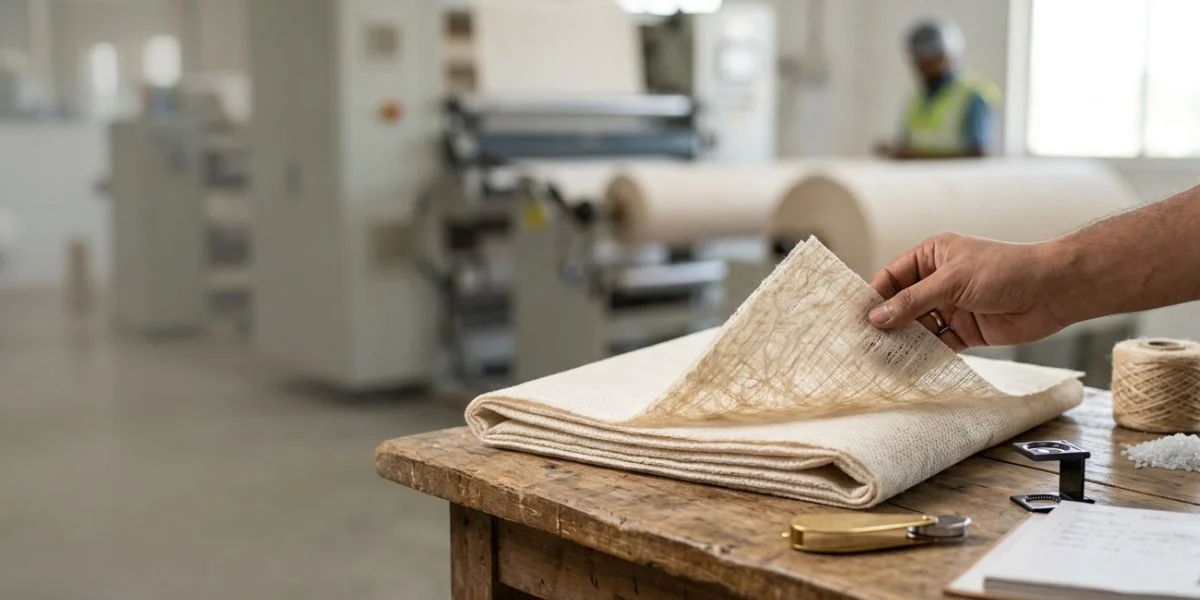
Wood Pulp Polypropylene Spunlace Nonwoven — Absorbent, Chemical-Resistant Grade
Wood pulp polypropylene (PP) spunlace nonwoven combines the ultra-high absorbency of wood pulp with the chemical resistance and low-lint properties of polypropylene fibres. Unlike polyester-reinforced grades, PP provides superior resistance to acids, alkalis, and chlorine-based chemicals — making this blend the preferred choice for chemical-exposure industrial wipes, laboratory wipes, and medical surface disinfection applications. Favourite Fab supplies wood pulp/PP spunlace in 50–100 GSM.
Key Properties
- Chemical resistance — Polypropylene resists concentrated acids, alkalis, bleach, and IPA — far better than polyester or viscose. Suitable for aggressive chemical wipe applications.
- Ultra-high absorbency — Wood pulp component absorbs 1,000–1,500% of fabric weight — rapidly soaks chemical spills or cleaning solutions.
- Low lint — PP fibres generate minimal lint — critical for pharmaceutical, medical, and electronics cleanroom wipe applications.
- Hydrophobic PP + hydrophilic pulp — PP is naturally hydrophobic, wood pulp highly hydrophilic. The blend creates a ‘wicking and holding’ structure: pulp draws and holds liquid while PP maintains structure.
- Cost-effective — Lower cost than viscose/polyester for chemical-resistant applications. Alternative to solvent-resistant synthetic nonwovens.
Technical Specifications
| Parameter | Specification |
|---|---|
| GSM range | 50–100 GSM |
| Fibre blend | Wood pulp/polypropylene 70/30, 60/40 |
| Width | 160–260 cm |
| Tensile strength (MD) | 70–200 N/5cm (MD, dry) |
| Absorbency | 1,000–1,500% of fabric weight |
| pH | 6.5–7.5 (EDANA 70.2) |
| MOQ | 500 kg per specification |
Applications
Chemical-resistant industrial wipes, pharmaceutical cleanroom wipes, laboratory wipes, medical surface disinfection wipes.
Source from Favourite Fab
Direct manufacturer, Agra India. Custom GSM, width, and emboss available. COA per batch. Sample rolls 3–5 days. See full range: spunlace nonwoven fabric. Related: spunlace nonwoven fabric for industrial wipes.
- Factory direct pricing — no distributor margin
- Custom slit widths 3–320 cm, tolerance ±1 cm
- OEKO-TEX certified grades available
- Export to 30+ countries — FOB Nhava Sheva
Frequently Asked Questions
Why use PP instead of polyester as the reinforcement in wood pulp spunlace?
Polypropylene is chemically inert — resistant to concentrated acids, alkalis, bleach, and solvents that degrade polyester over time. For wipes used with aggressive chemicals (pharmaceutical cleaning, laboratory disinfection), PP reinforcement significantly extends wipe integrity during use.
Is wood pulp PP spunlace suitable for pharmaceutical cleanroom wipes?
Yes. At 70–80 GSM with <0.05 mg/cm² lint (INDA IST 160.1), wood pulp/PP spunlace meets ISO Class 5–7 cleanroom wipe requirements. Used with IPA, quat, and H₂O₂ disinfectants in pharmaceutical manufacturing environments.
What is the difference between wood pulp/PP and wood pulp/polyester spunlace?
Chemical resistance is the key difference. PP provides far better resistance to acids, bases, and bleach. Polyester is cheaper and has higher wet tensile strength. For chemical wipe applications: choose PP. For cost-sensitive high-absorption wipes: choose polyester.
Technical Specifications
| Parameter | Value |
|---|---|
| GSM Range | 40–80 GSM |
| Fiber Blend | Wood Pulp / Polypropylene (PP) — typical 50/50 to 70/30 |
| Bonding Method | Hydroentanglement (Spunlace) |
| Available Width | 1.6 m – 3.2 m |
| Tensile Strength (MD) | ≥ 38 N/5 cm |
| Moisture Absorption | ≥ 550% of fabric weight (pulp fraction) |
| Thermal Stability | Up to 130°C (PP fraction) |
| Ash Content | Low — < 0.5% |
| Certifications | ISO 9001:2015, OEKO-TEX Standard 100 |
| Key Property | Heat-stable, low ash, high absorbency — suitable for thermal-bonded converting lines |
B2B Applications & OEM Use-Cases
- Thermal-Bonded Hygiene Layer Components: Wood pulp-PP spunlace is processed through thermal-bonding converting lines that would melt PET-containing substrates. The PP fraction’s higher melting point resistance (relative to PET in some thermal-bonding configurations) allows the fabric to survive hot-roller lamination steps in adult incontinence and feminine hygiene pad manufacturing without substrate deformation.
- Low-Ash Filter Media Base Fabric: Filtration OEMs use wood pulp-PP spunlace as a base fabric for liquid and air filter cartridges. Low ash content (<0.5%) is critical for filter media applications where combustion residue from the substrate would contaminate filter efficiency test results and violate end-product specifications.
- Disposable Surgical Drapes & Gowns (Component): Medical device manufacturers incorporate wood pulp-PP spunlace as the liquid-absorptive inner layer of composite disposable surgical drapes. The PP outer skeleton provides the dimensional stability needed for lamination with SMS (spunbond-meltblown-spunbond) outer barrier layers, while the pulp interior handles surgical fluid absorption.
Sourcing from Favourite Fab — MOQ, Lead Time & Customisation
Favourite Fab manufactures wood pulp-polypropylene spunlace nonwoven from its Agra, India production facility for hygiene, filtration, and medical B2B buyers.
- MOQ: 500 kg per specification
- Domestic Lead Time: 7–14 working days
- Export Lead Time: 21–30 working days
- Customisation: GSM (40–80), width (1.6 m–3.2 m), pulp-to-PP ratio, ash content specification, roll format
- Certifications: ISO 9001:2015 & OEKO-TEX Standard 100
Contact Favourite Fab for thermal-stability data, ash-content test reports, and customisation options for your production process.
Frequently Asked Questions
What is the thermal stability difference between wood pulp-PP and wood pulp-PET spunlace?
PP has a melting point of approximately 160–170°C versus PET’s 250–260°C, so for high-temperature processing PP is actually the lower-stability option. However, wood pulp-PP spunlace is preferred over wood pulp-PET in thermal-calender bonding lines operating at 120–140°C, where controlled PP softening is used to bond layered composites without adhesive. The PP fraction bonds at these temperatures while the wood pulp structure is preserved.
Why is low ash content important for wood pulp-PP spunlace in filtration applications?
Ash content measures the inorganic mineral residue remaining after combustion of the fabric. In filter media, high ash content introduces inorganic particles that can migrate into filtered fluids (critical in pharmaceutical or food-grade filtration) and skew filter efficiency test results based on gravimetric measurement. Keeping ash below 0.5% ensures the substrate does not interfere with downstream product specifications or regulatory compliance testing.
Can wood pulp-PP spunlace be heat-sealed?
Yes. The PP fraction makes wood pulp-PP spunlace heat-sealable at temperatures between 130°C and 150°C, depending on sealing dwell time and pressure. This is used in hygiene pad component assembly and in medical packaging where a heat-seal bond between the nonwoven and a PP film layer is required. Optimum sealing parameters vary by PP content ratio — contact our technical team for application-specific guidance.
📋 Related: Spunlace Nonwoven Fabric — Full Range & Specs | All Nonwoven Products from Favourite Fab

Gaurav Garg
I'm Gaurav Garg, CEO of Favourite Fab, a company on a mission to revolutionize the nonwoven industry with sustainable practices. We work hand-in-hand with manufacturers and suppliers who share our commitment to eco-friendly production. With a deep interest in textile innovation, I'm passionate about educating consumers about sustainable material options and their potential to transform the nonwoven landscape.


