

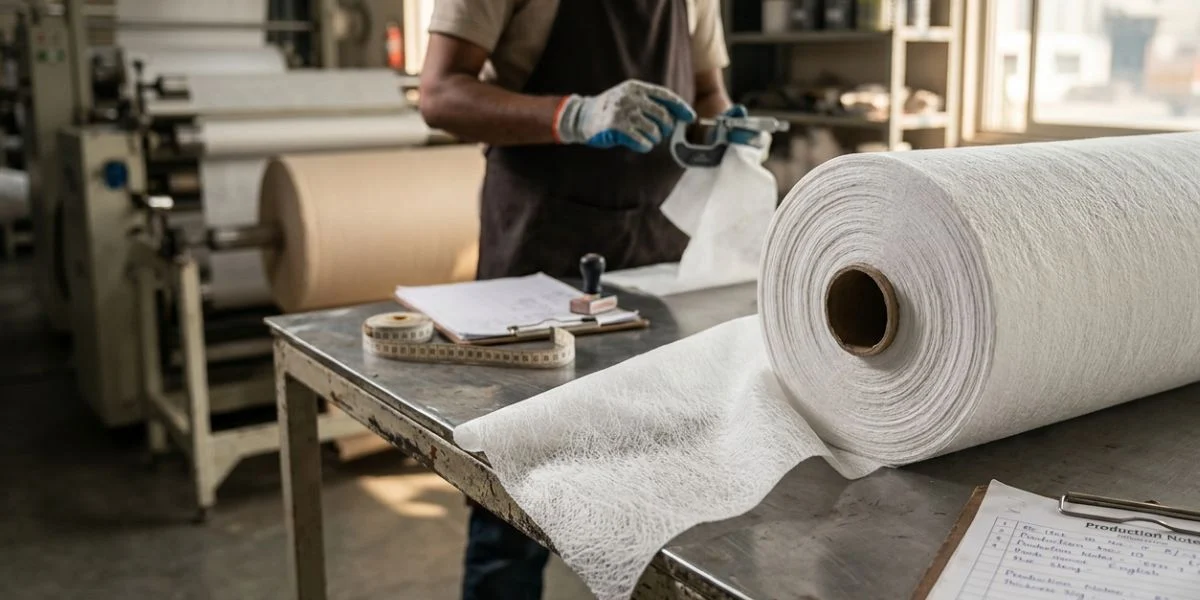
70 GSM Spunlace Nonwoven Fabric — Heavy Wipe & Industrial Grade India
70 GSM spunlace nonwoven fabric bridges the gap between premium personal care wipes and household/industrial wipe grades. At this weight, the fabric has excellent wet tensile strength, high liquid retention, and a substantial cloth-like feel — suitable for reusable household wipes, heavy-duty personal care wipes, industrial surface wipes, and medical applications requiring higher absorbency. Favourite Fab supplies 70 GSM spunlace in viscose/polyester and polyester-dominant blends.
Technical Specifications
| Parameter | Specification |
|---|---|
| GSM | 70 GSM ±5% |
| Fibre blend | Viscose/polyester 70/30, 50/50, 100% polyester |
| Width | 160–320 cm |
| Tensile MD | 180–280 N/5cm |
| Absorbency | 700–1,000% of fabric weight |
| MOQ | 500 kg |
Applications
Heavy household wipes, reusable cleaning cloths, medical swabs, industrial surface wipes, wound dressings.
Why Source from Favourite Fab
Direct manufacturer in Agra, India. No middleman. Custom slit widths 3–320 cm ±1 cm tolerance. COA per batch (GSM, tensile, absorbency). Sample rolls dispatched 3–5 working days. Export to 30+ countries FOB Nhava Sheva.
Full range: spunlace nonwoven fabric. Related: spunlace nonwoven for household wipes.
Frequently Asked Questions
What applications use 70 GSM spunlace?
Heavy-duty household wipes, reusable cleaning cloths (washable up to 20 cycles), medical swabs, thick cosmetic pads, and light industrial wipes. At 70 GSM the fabric has a cloth-like feel that positions well for ‘reusable’ product claims.
Can 70 GSM spunlace be washed and reused?
Yes — 70 GSM viscose/polyester 50/50 blend survives 15–20 machine wash cycles at 60°C. 70 GSM 100% polyester handles 25–30 cycles. Viscose-dominant blends (70/30) are softer but degrade faster with repeated washing.
Is 70 GSM spunlace suitable for wound dressings?
Yes. 70 GSM 100% viscose spunlace is used as primary absorbent wound dressings and secondary dressings. Absorbency 900–1,100% of fabric weight. EO sterilisation compatible. See our wound dressing spunlace range for full specifications.
B2B Applications & End-Uses
The 70 GSM spunlace nonwoven fabric represents the upper boundary of the standard wipe grade range and the entry point to heavy-duty converting applications. At 68–72 GSM with a PET-dominant or full PET composition, this weight class delivers machine-direction tensile values of ≥80 N/5 cm — a threshold that separates it sharply from lighter grades in performance terms and defines its suitability for applications where mechanical durability under load is the primary selection criterion, not softness or absorbency.
Industrial wipe converters manufacturing maintenance, engineering, and MRO cleaning wipes source 70 GSM PET-dominant spunlace as their preferred substrate for pre-saturated and dry wiping formats used in automotive assembly, aerospace maintenance, and precision manufacturing environments. In these settings, the wipe must withstand aggressive manual scrubbing against metal, composite, and glass surfaces without tearing, linting, or shedding fibres that could contaminate machined surfaces or optical assemblies. The low-lint characteristic of the high-PET 70 GSM grade — measured per EDANA ERT 80.3 — is a specification requirement rather than a marketing claim for industrial OEM buyers in these sectors.
Household heavy-duty wipe manufacturers producing floor cleaning wipes, bathroom scrubbing wipes, and kitchen degreaser wipes use 70 GSM spunlace as a differentiated offering relative to standard 40 GSM household wipes. The additional basis weight communicates product quality to end consumers while delivering functional durability that allows the product to be used repeatedly during a single cleaning task without disintegrating. Converters selling into mass-market retail chains under private-label programmes frequently position the 70 GSM SKU as the “heavy-duty” or “power” variant within a tiered wipe range, using the higher basis weight as the primary product differentiation lever.
Technical textile converters producing reusable and single-use protective apparel components, filtration substrates, and surface protection materials also source 70 GSM spunlace. The V/PET blend at this weight provides a balance between fabric conformability — necessary for draping over complex surface geometries — and the dimensional stability required for die-cutting and ultrasonic seaming at high converting line speeds. OEM buyers in the technical textile sector typically specify 70 GSM spunlace alongside a detailed converting process description so that Favourite Fab’s technical team can recommend the optimal blend ratio and surface finish for the specific application and machinery configuration.
Certifications & Quality Assurance
Quality assurance for 70 GSM spunlace at Favourite Fab is structured around the dual performance requirements of this weight class: mechanical durability and low lint generation. Tensile testing per EDANA ERT 20.2 is conducted on every production lot, with machine-direction wet tensile required to meet ≥80 N/5 cm and cross-direction tensile reported as part of the batch COA. For PET 100% grades, the tensile specification is calibrated to the higher stiffness of the all-synthetic web, and buyers should review the MD/CD tensile ratio data when specifying grades for converting lines with known directional tension sensitivity.
Lint evaluation per EDANA ERT 80.3 (Taber abrasion lint test) is a mandatory quality check for all 70 GSM grades intended for industrial and cleanroom-adjacent applications. Acceptable lint levels are agreed at the time of product qualification and are stated as maximum values in the product specification sheet. For industrial applications where lint limits are determined by the buyer’s internal contamination control standard rather than an industry specification, Favourite Fab’s quality team will work with the buyer to establish the acceptance criterion and validate it against the production process. ISO 9001:2015 certification covers the full quality management system governing these processes.
OEKO-TEX Standard 100 certification is available for 70 GSM grades used in consumer household wipe applications where a compliance document is required for retail supply chain audits. Industrial grades not requiring OEKO-TEX are supplied with a standard batch COA citing fibre composition, basis weight (measured per EDANA ERT 40.3), tensile, elongation, and lint values. For export orders, additional documentation including material safety data, country of origin declaration, and HS code 5603.14 classification documentation can be provided to support customs clearance and buyer compliance requirements.
More Questions Answered
What blend ratio — PET 100% or V/PET — should I specify for industrial wipes requiring low lint and high wet tensile?
For industrial wipe applications where lint minimisation is the primary constraint — such as precision electronics cleaning, aerospace maintenance, and optical surface wiping — PET 100% at 70 GSM is the recommended specification. Pure PET spunlace generates significantly lower Taber abrasion lint values than V/PET blends because the synthetic fibre does not fibrillate under mechanical stress the way cellulosic viscose fibres do. Wet tensile performance is also higher in PET 100% grades at equivalent basis weight. The trade-off is reduced absorbent capacity relative to V/PET blends — in dry or solvent-wiping applications this is typically not a constraint, but in pre-saturated aqueous lotion wipes where lotion uptake is critical, a V/PET blend may be preferable. Favourite Fab’s technical team can supply comparative lint and tensile data for both compositions at 70 GSM to support the specification decision.
Can 70 GSM spunlace be supplied in perforated roll format for converting into interfolded or pop-up wipe formats?
Yes. Favourite Fab can supply 70 GSM spunlace in pre-perforated roll formats with perforation pitch customised to the buyer’s desired wipe dimensions, subject to minimum order quantities that make perforation tooling economically viable. Perforation is applied in-line during the winding process using rotary perforation equipment, and the perforation tear force can be calibrated to ensure clean separation in manual dispensing without premature tearing during roll handling. For interfolded format production, flat roll goods without perforation are typically preferred, with the interfolder applying the fold pattern in-line. Buyers should specify their dispensing format — pop-up canister, interfolded flat-pack, or wet wipe roll — when requesting quotation so that the appropriate supply format can be recommended.
📋 Related: Spunlace Nonwoven Fabric — Full Range & Specs | All Nonwoven Products from Favourite Fab

Gaurav Garg
I'm Gaurav Garg, CEO of Favourite Fab, a company on a mission to revolutionize the nonwoven industry with sustainable practices. We work hand-in-hand with manufacturers and suppliers who share our commitment to eco-friendly production. With a deep interest in textile innovation, I'm passionate about educating consumers about sustainable material options and their potential to transform the nonwoven landscape.


