

Hot Air Through Bonded Nonwoven — ADL Raw Material Supplier India 2026
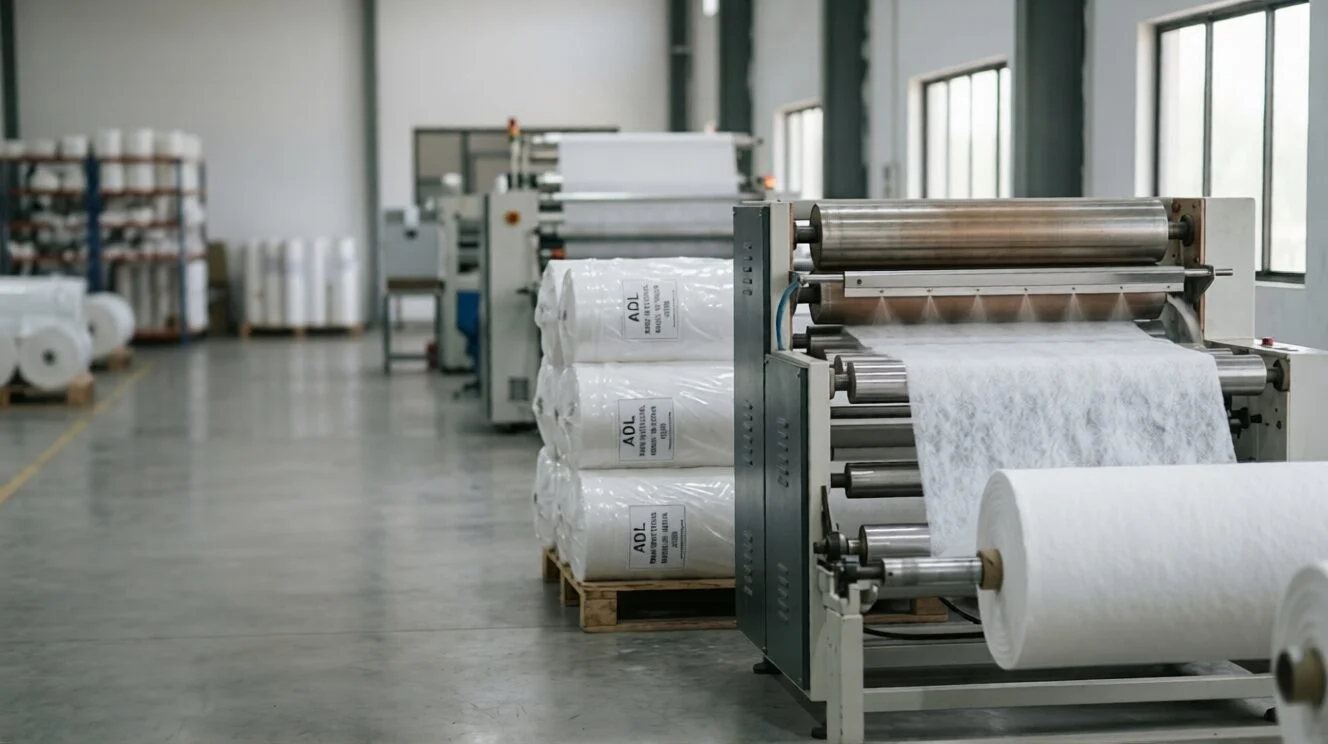
Hot Air Through Bonded (HATB, also called Through-Air Bonded or TAB) nonwoven is a high-loft, bulky fabric produced by passing hot air through a fibre web to thermally fuse the fibres at their crossover points. The result is a 3D, springy, low-density nonwoven that can hold large volumes of fluid in its open structure — exactly the property needed for the Acquisition & Distribution Layer (ADL) in modern diapers, sanitary pads, and adult incontinence products.
This guide covers HATB nonwoven specifications, fibre options, applications beyond hygiene, and supply from Favourite Fab.
How HATB Differs from Other Nonwovens
| Bonding Method | Process | Fabric Density | Best Use |
|---|---|---|---|
| Calender bonded (spunbond) | Heated rollers compress fibres | High density, flat | Topsheet, backsheet |
| Hot Air Through Bonded | Hot air thermally fuses crossover points | Low density, lofty | ADL, insulation |
| Spunlace | Water jets entangle fibres | Medium density | Wipes, cosmetic |
| Needle punch | Mechanical needles entangle | Variable | Heavy industrial |
HATB’s defining property is loft. The fabric is 3–5× thicker than equivalent-GSM spunbond — providing void volume that holds liquid temporarily before it transfers to the absorbent core.
Fibre Composition
HATB is almost always made from bicomponent (bico) staple fibres:
- PE/PP bico: Polyethylene sheath / polypropylene core. Bonds at lower temperature (130°C). Most common for hygiene ADL
- PE/PET bico: Polyethylene sheath / polyester core. Higher tensile strength, better wet performance. Premium ADL
- PLA/PLA bico: Polylactic acid sheath and core (different melt points). Compostable option for biodegradable hygiene products — see biodegradable sanitary pad raw materials
The sheath melts during hot-air processing and bonds to adjacent fibres at crossover points. The core remains intact, preserving fibre length and giving the fabric strength.
HATB Specifications for ADL Applications
| Property | Baby Diaper ADL | Adult Diaper ADL | Sanitary Pad ADL |
|---|---|---|---|
| GSM | 25–35 | 30–50 | 30–40 |
| Loft (mm) | 0.8–1.2 | 1.0–1.5 | 0.8–1.2 |
| Strike-through (1st insult) | <1 sec | <2 sec | <1 sec |
| Re-wet (after 3 insults) | <0.5 g | <1.0 g | <0.3 g |
| Fibre type | PE/PP bico | PE/PET bico | PE/PP or PE/PET |
For full diaper architecture context: Absorbent core for diapers.
Beyond Hygiene — Other HATB Applications
While ADL is the largest single use, HATB also serves:
- Thermal insulation: Loft traps air — used in jacket linings, sleeping bag fillers
- Acoustic insulation: Sound absorption in automotive headliners and HVAC ducting
- Medical wadding: Soft absorbent pads, splint padding
- Filter pre-stage: Light dust capture in coarse filters
- Cosmetic puffs: Soft application pads for makeup and skincare
Performance Optimisation — How Bonding Affects Performance
HATB performance is tuned via three process parameters:
- Air temperature: Higher temperature = more bonding points = stiffer fabric (less loft)
- Air dwell time: Longer dwell = more bonding = denser fabric
- Fibre cross-section: Round vs hollow vs trilobal — affects loft and fluid handling
For diaper ADL, the goal is light bonding — just enough to hold the fabric together while preserving maximum loft. For acoustic insulation, deeper bonding is acceptable since loft matters less than coverage.
Pricing & MOQ
| Grade | GSM | Price (₹/kg) | MOQ |
|---|---|---|---|
| Standard PE/PP bico HATB | 25–40 GSM | ₹220–290/kg | 500 kg |
| Premium PE/PET bico HATB | 30–50 GSM | ₹260–340/kg | 500 kg |
| PLA bico HATB (compostable) | 25–40 GSM | ₹420–560/kg | 1,000 kg |
HATB is priced higher than spunbond per kg because of the bicomponent fibre cost and the slower production line speed.
Why Source HATB from Favourite Fab
- Bicomponent fibre options: PE/PP and PE/PET available
- Custom GSM and loft: Tunable from 25 to 50 GSM
- Pre-slit rolls: Match diaper ADL infeed specs (typically 100–150 mm)
- Test data: Strike-through, rewet, basis weight test reports issued with each batch
- ±5% GSM tolerance across rolls (HATB is harder to control than calendered fabrics)
- ISO 9001:2015 certified
Connected products: Diaper raw material supplier India | Nonwoven raw material for baby diapers
Frequently Asked Questions
What is the difference between HATB and resin-bonded ADL?
HATB uses thermal bonding via hot air — clean, no chemical residue. Resin-bonded ADL uses an acrylic or styrene-acrylic binder sprayed onto the web. Resin-bonded ADL is cheaper (₹160–220/kg) but has slightly stiffer hand and may carry residual binder. Premium hygiene products favour HATB.
Why is HATB more expensive than spunbond?
Three reasons: bicomponent fibre is 30–50% more expensive than monocomponent PP, hot-air thermal bonding line speeds are slower (15–25 m/min vs 200+ m/min for spunbond), and the loft requirement means more fibre volume per square metre.
Can HATB replace ADL entirely?
HATB IS the ADL in most modern diaper designs. The question is which type of ADL — HATB, resin-bonded, or carded thermal-bonded. HATB is the premium choice; resin-bonded is the economy choice.
Is HATB the same as “air-laid” nonwoven?
Different. Air-laid uses short cellulose fibres (wood pulp) deposited on a screen via airflow, then bonded with resin or thermal. HATB uses long staple synthetic fibres carded into a web, then thermally bonded by hot air. Air-laid is cellulose-based; HATB is synthetic.
Does HATB work in pull-up diapers?
Yes — pull-up diapers use HATB ADL identical to tape diapers. The challenge in pull-ups is faster fluid acquisition because pull-up cores are typically thinner.
What’s the typical loft thickness?
For 30 GSM HATB: 0.8–1.2 mm bulk thickness. Higher GSM (40–50) reaches 1.5–2.0 mm. The loft directly relates to void volume and fluid acquisition speed.
Get HATB Samples
Share your application (baby/adult diaper, sanitary pad, insulation) and target GSM. Receive 1–5 metre sample rolls within 5 days.
- 📞 +91 95288 11566 / +91 88007 75462
- ✉️ sale@favouritehub.com
- 🌐 Send specifications
Related Hydrophilic Cluster Resources
- Master Pillar: Hydrophilic Non Woven Fabric Manufacturer India — production, grades (SS / SSS / SMS / HATB / spunlace), GSM matrix, B2B ordering.
- Application Pillar: Hydrophilic Top Sheet for Diapers and Hygiene Products — topsheet selection logic for baby diaper, sanitary napkin, adult incontinence, underpad.
- Process Pillar: Hydrophilic Hot Air Through Nonwoven Fabric — HATB / TAB lofty topsheet + ADL grades, bicomponent fibers, premium hygiene applications.

Gaurav Garg
I'm Gaurav Garg, CEO of Favourite Fab, a company on a mission to revolutionize the nonwoven industry with sustainable practices. We work hand-in-hand with manufacturers and suppliers who share our commitment to eco-friendly production. With a deep interest in textile innovation, I'm passionate about educating consumers about sustainable material options and their potential to transform the nonwoven landscape.


