

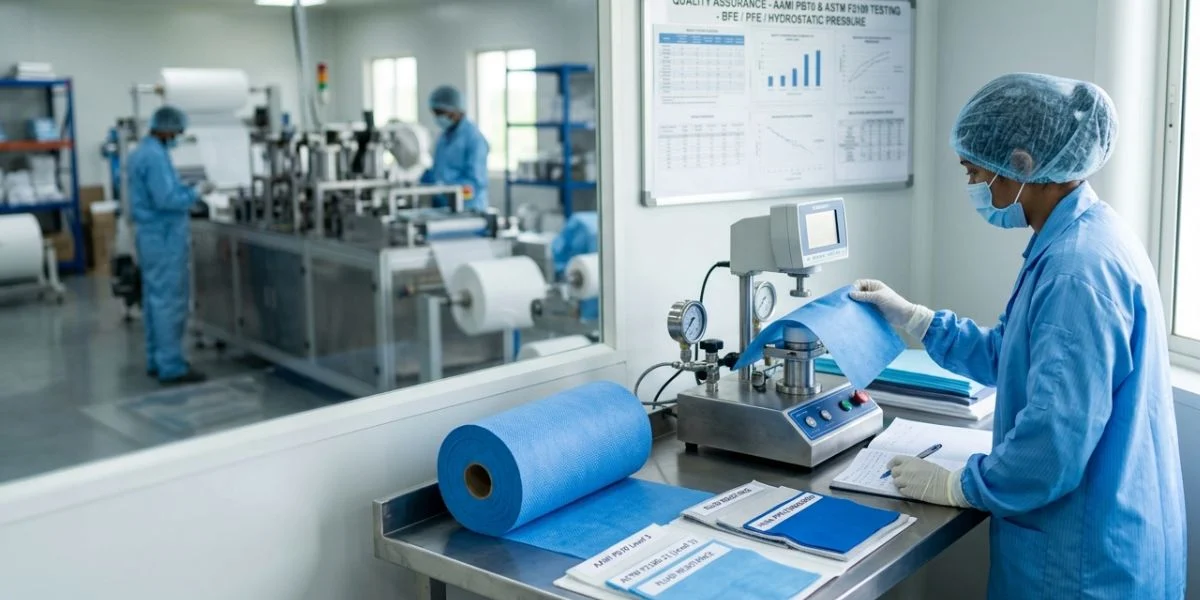
AAMI PB70 & ASTM F2100 Nonwoven Fabric — Medical PPE Barrier Standards Guide India
AAMI PB70 and ASTM F2100 are the two most important US/international standards governing nonwoven barrier performance in surgical PPE. Understanding these standards is essential for nonwoven buyers sourcing for surgical gown, mask, and drape manufacturing — they determine which SMS or SSMMS grade is required for your product classification. Favourite Fab supplies SMS and SSMMS nonwoven tested and documented against both standards.
Browse our full range: View all nonwoven fabric products — spunlace, spunbond, SMS, bico — with GSM, width and certification options. B2B MOQ from 500 kg.
AAMI PB70 — Surgical Gown Barrier Levels
| Level | Protection | Test Method | Hydrostatic Head | Nonwoven Grade |
|---|---|---|---|---|
| Level 1 | Minimal — low splash risk | AATCC 42 | ≥20 cmH₂O | SMS 20–30 GSM |
| Level 2 | Low — limited exposure | AATCC 42 + 127 | ≥20 cmH₂O | SMS 30–40 GSM |
| Level 3 | Moderate — wet environment | AATCC 42 + 127 | ≥50 cmH₂O | SSMMS 45–55 GSM |
| Level 4 | High — high fluid exposure | ASTM F1671 | Bloodborne pathogen barrier | SSMMS 60–70 GSM |
ASTM F2100 — Surgical Mask Material Levels
| Level | BFE (%) | PFE (%) | Pressure Drop | Nonwoven Grade |
|---|---|---|---|---|
| Level 1 | ≥95 | ≥95 | <5 mmH₂O/cm² | SMS 20 GSM |
| Level 2 | ≥98 | ≥98 | <6 mmH₂O/cm² | SMS 25–30 GSM |
| Level 3 | ≥98 | ≥98 | <5 mmH₂O/cm² | SMS/SSMMS 30–40 GSM |
FAQ
How do I know which AAMI level my surgical gown requires?
AAMI level is determined by surgical procedure type and expected fluid exposure: outpatient/low-risk procedures (Level 1–2), standard surgical procedures (Level 2–3), cardiac/orthopaedic/trauma surgery (Level 3–4). Product labelling must state the AAMI level. Consult AAMI TIR11 for procedure-to-level mapping guidance.
Does Favourite Fab provide AAMI PB70 test reports with SMS shipments?
Yes. AAMI PB70 test reports (hydrostatic head per AATCC 127, BFE per ASTM F2101, tensile per ASTM D5034) available from NABL-accredited third-party labs. Specify required AAMI level and test package at time of order. Reports included with first shipment; subsequent shipments with COA referencing initial approval.
Is SSMMS always required for AAMI Level 3?
Not always — high-performance SMS at 50–60 GSM with optimised meltblown ratio can meet Level 3 hydrostatic head (≥50 cmH₂O). However, SSMMS more reliably and consistently achieves Level 3–4 without marginal compliance risk. For Level 4 (ASTM F1671 bloodborne pathogen barrier), SSMMS is effectively required.
Full range: medical nonwoven fabric. Related: SMS nonwoven fabric manufacturer India.
B2B Applications & End-Uses
Medical PPE manufacturers, surgical drape fabricators, and isolation gown producers procuring SMS nonwoven fabric require documented compliance with AAMI PB70 liquid barrier levels and ASTM F2100 face mask material performance tiers before any production qualification can begin. Favourite Fab supplies SMS and SSMMS nonwoven to medical PPE converters with full barrier test documentation \u2014 hydrostatic head values, BFE, PFE, and differential pressure \u2014 provided in the COA to support your device technical file or 510(k) submission.
Surgical gown manufacturers producing Level 1 and Level 2 garments per AAMI PB70 specify SMS nonwoven for the outer shell and reinforcement panels. Level 1 requires resistance to water penetration at 20 cm H\u2082O per AAMI PB70 Impact Penetration test \u2014 standard 40\u201350 GSM SMS satisfies this. Level 2 requires 20 cm H\u2082O per hydrostatic pressure test in addition to Impact Penetration \u2014 50\u201360 GSM SMS with tighter meltblown specification is the standard construction. Level 3 and Level 4 applications requiring resistance to synthetic blood and viral penetration respectively specify SSMMS constructions with validated hydrostatic head above 50 cm H\u2082O and ASTM F1671 viral penetration test data.
Face mask outer shell and filter layer procurement teams sourcing to ASTM F2100 Level 1 (BFE \u226595%, PFE \u226595% at 0.1 \u03bcm, \u0394P \u22644.0 mmH\u2082O/cm\u00b2) or Level 2 (BFE \u226598%, PFE \u226598%, \u0394P \u22645.0 mmH\u2082O/cm\u00b2) specifications can request grade-specific test reports from our technical sales team.
Certifications & Quality Assurance
Favourite Fab produces SMS and SSMMS nonwoven for medical applications under documented clean-production protocols with particulate controls during winding and packaging. Meltblown layer charge uniformity and electret performance for filtration grades are verified during production and confirmed in the COA. Hydrostatic head testing follows AAMI PB70 test method protocols, and bacterial filtration efficiency testing is performed per ASTM F2101 by accredited third-party laboratories.
Each production lot of medical-grade SMS generates a full COA covering: GSM (nominal and measured), hydrostatic head (cm H\u2082O), BFE (%), differential pressure (mmH\u2082O/cm\u00b2), and width tolerance. Lot traceability links the COA to specific production parameters and raw material batches \u2014 providing the audit trail required for ISO 13485 quality system compliance at the converter level. Material safety data sheets and biocompatibility declarations (ISO 10993 alignment) are available for grades intended for skin-contact or wound-adjacent applications.
More Questions Answered
What is the difference between AAMI PB70 Level 2 and Level 3 in terms of SMS nonwoven specification?
AAMI PB70 Level 2 requires the fabric to resist liquid penetration under hydrostatic pressure at 20 cm H\u2082O and pass the Impact Penetration test \u2014 standard 50\u201360 GSM SMS with a well-formed meltblown core achieves this reliably. Level 3 adds a Spray Impact Penetration test at 50 cm H\u2082O hydrostatic pressure, requiring a heavier or more tightly constructed meltblown layer, typically achieved with SSMMS laminate at 60\u201380 GSM. Level 4 adds ASTM F1671 viral penetration resistance \u2014 the highest barrier classification \u2014 and requires specific construction validation beyond GSM and hydrostatic head alone. Buyers should confirm which AAMI PB70 level their finished garment must meet before specifying fabric GSM and construction.
Does Favourite Fab supply test reports that can be used directly in a medical device technical file for surgical gowns?
Yes. Our COA for medical-grade SMS nonwoven includes the test parameters and values required for inclusion in a surgical gown technical file: hydrostatic head per AAMI PB70 test method, GSM, width, and lot identification. BFE test data generated by accredited third-party laboratories is provided as a supplementary document where required. Buyers preparing EU MDR technical files or FDA 510(k) submissions should review their notified body or FDA requirements for fabric-level documentation and engage our technical team early in the qualification process so that any additional test reports or declarations can be arranged before your submission deadline.

Gaurav Garg
I'm Gaurav Garg, CEO of Favourite Fab, a company on a mission to revolutionize the nonwoven industry with sustainable practices. We work hand-in-hand with manufacturers and suppliers who share our commitment to eco-friendly production. With a deep interest in textile innovation, I'm passionate about educating consumers about sustainable material options and their potential to transform the nonwoven landscape.


