

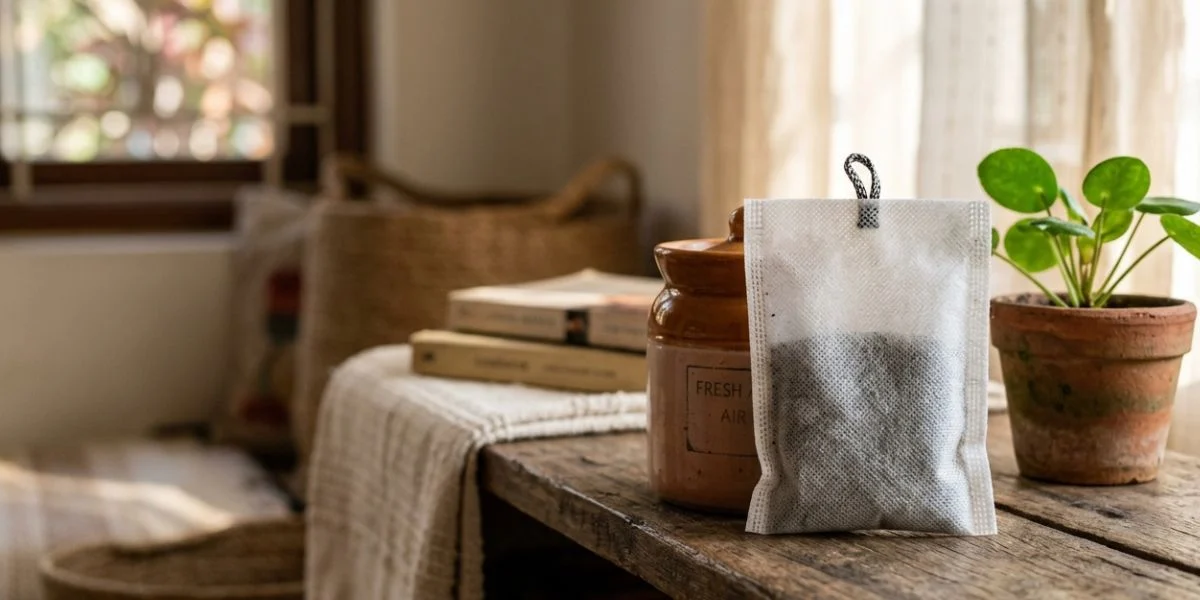
Activated Carbon Pouch Nonwoven Fabric — Odour & Gas Adsorption Sachets India
Activated carbon pouch nonwoven fabric serves as the containment material for activated carbon sachets and bags used in odour absorption, VOC removal, refrigerator fresheners, shoe deodorisers, and air purification pouches. The nonwoven must allow maximum gas-phase contact between the activated carbon granules and the surrounding atmosphere while fully containing the carbon particles. Low lint and dark-colour tolerance are additional requirements for this application. Favourite Fab supplies activated carbon pouch nonwoven in black and grey coloured PP spunbond.
Browse our full range: View all nonwoven fabric products — spunlace, spunbond, SMS, bico — with GSM, width and certification options. B2B MOQ from 500 kg.
Technical Specifications
| Parameter | Specification |
|---|---|
| GSM | 40–80 GSM |
| Fibre | PP spunbond, black/grey masterbatch available |
| Air permeability | 500–2,000 mm/s (ISO 9237) |
| Lint | <0.05 mg/cm² |
| Heat seal | 140–160°C |
| Width | 10–260 cm |
| MOQ | 500 kg |
Applications
Refrigerator odour absorbers, shoe deodorant sachets, VOC removal air purification pouches, automotive cabin odour control, industrial activated carbon filters.
Why Source from Favourite Fab
Direct manufacturer, Agra India. Full range: desiccant nonwoven fabric. Related: breathable nonwoven fabric for sachets.
- Factory direct — no distributor margin
- Custom slit widths 10 mm–260 cm, ±1 mm tolerance
- COA per batch — MVTR, tensile, heat seal, GSM
- Sample rolls dispatched 3–5 working days
- Export ready — FOB Nhava Sheva / ICD Tughlakabad
Frequently Asked Questions
Why is dark-coloured nonwoven preferred for activated carbon pouches?
Activated carbon is black — dark-coloured (black or dark grey) nonwoven prevents the carbon colour from showing through the pouch fabric, maintaining a clean appearance. Standard white PP spunbond allows carbon to show through visually, which consumers associate with contamination.
What air permeability is needed for activated carbon sachets?
Higher air permeability = faster gas exchange = more effective odour absorption. Activated carbon sachets typically use 800–2,000 mm/s air permeability (ISO 9237). Desiccant sachets can use lower permeability. For activated carbon, maximise air flow while maintaining carbon containment.
Can the same nonwoven be used for both silica gel and activated carbon sachets?
Yes — 40–60 GSM PP spunbond at 500–1,500 mm/s air permeability works for both. The key difference is colour preference: white/natural for silica gel sachets, black/grey for activated carbon pouches. Favourite Fab supplies both colour options.
B2B Applications & End-Uses
Activated carbon pouch nonwoven fabric is the critical containment substrate in any sachet or cartridge application where adsorption of volatile organic compounds (VOCs), odour molecules, or gaseous contaminants must occur through the fabric wall while activated carbon powder or granules are fully retained within the pouch. Refrigerator deodoriser manufacturers — supplying private-label products for appliance OEMs and household goods brands — use 40–60 GSM PP or bicomponent spunbond to construct flat-pack or moulded carbon sachets placed in refrigerator drawers and freezer compartments, targeting hydrogen sulphide, mercaptans, and ammonia compounds.
Footwear manufacturers and shoe-insert OEMs integrate activated carbon pouches into moulded insole constructions and hang-tag sachets for packaged footwear, where isovaleric acid, butyric acid, and ammonia from perspiration must be adsorbed over a 6–12 month product shelf life. Industrial odour-control applications include placement of carbon sachets in toolboxes, vehicle cabin interiors, gym bag accessories, and pet product packaging — all requiring high adsorption capacity per unit area without carbon dust bleed-through compromising enclosed product surfaces.
VOC adsorption applications in electronics packaging use activated carbon pouches alongside desiccant sachets to suppress off-gassing from adhesives, foams, and PCB coatings inside sealed equipment housings. Air purification module manufacturers embed activated carbon nonwoven fabric as a pre-filter layer in HVAC filter stacks and portable air purifier cassettes, where the fabric must provide a pressure drop below 10 Pa at standard airflow while retaining fine carbon particles. Favourite Fab’s low-dust containment grades are also specified for industrial gas mask canister pre-filter assemblies where carbon dust inhalation risk makes dust-through performance a safety-critical specification.
Certifications & Quality Assurance
Activated carbon pouch nonwoven from Favourite Fab is tested for carbon dust containment per ISO 9073-10 particulate filtration method, with pass criteria of <0.05% particle bleed-through by mass — a tighter specification than standard desiccant pouch grades, reflecting the contamination risk of black carbon powder on enclosed products and surfaces. Basis weight uniformity is controlled to ±5% across roll width (EDANA ERT 10.4-99), and pore size distribution is characterised by bubble-point testing to confirm consistent aperture size prevents carbon fines migration while allowing gas-phase VOC passage.
For food-proximity applications (refrigerator deodourisers, food storage container sachets), carbon pouch fabric is produced from food-contact compliant PP resin grades with extractables testing per EU Regulation No. 10/2011. OEKO-TEX Standard 100 Class I certification is available for grades used in proximity to food or skin-contacting accessories. Tensile and elongation properties are tested per ASTM D882 in both machine and cross directions to validate integrity on rotary sachet filling machines at production line speeds.
ISO 9001:2015 production controls govern incoming carbon material acceptance (iodine number, CTC activity, mesh size) and finished pouch substrate properties. Certificate of conformance, material safety data sheets, and full test data packs are issued per production lot. Custom grades optimised for specific activated carbon particle mesh sizes (100–325 mesh) are available — contact our technical sales team with your carbon specification and sachet machine parameters.
More Questions Answered
What fabric construction best prevents activated carbon dust bleed-through without excessively restricting adsorption vapour flow?
Bicomponent (bico) spunbond in the 40–50 GSM range delivers the best balance: the sheath-core fibre structure creates a tighter, more uniform pore network than standard PP spunbond at equivalent GSM, suppressing fine carbon particle migration while maintaining gas-phase permeability. For very fine carbon powders (200–325 mesh), a thermally bonded bico grade with calendar-bonded surface is preferred over mechanically bonded grades — the smoother surface reduces interfibre gaps that allow ultrafine particles to pass under vibration during transport. Favourite Fab can run dust-bleed validation trials on your specific carbon grade before committing to production volumes.
Can activated carbon pouch nonwoven be supplied in roll format compatible with standard tea-bag sachet machines?
Yes. Favourite Fab supplies activated carbon pouch nonwoven in slit-roll widths from 80mm to 1,200mm, with core diameters of 76mm or 152mm to match standard rotary and vertical form-fill-seal sachet machines. Roll tension and surface treatment are optimised to prevent static charge build-up — a common issue with carbon-filled pouches on high-speed sachet lines — which causes carbon clumping and fill-weight variation. Minimum order quantities and lead times vary by GSM and certification grade; contact our B2B team with your machine model and fill-weight specification for a compatibility assessment.
B2B Applications & End-Uses
Activated carbon pouch nonwoven fabric is the critical containment substrate in any sachet or cartridge application where adsorption of volatile organic compounds (VOCs), odour molecules, or gaseous contaminants must occur through the fabric wall while activated carbon powder or granules are fully retained within the pouch. Refrigerator deodoriser manufacturers — supplying private-label products for appliance OEMs and household goods brands — use 40–60 GSM PP or bicomponent spunbond to construct flat-pack or moulded carbon sachets placed in refrigerator drawers and freezer compartments, targeting hydrogen sulphide, mercaptans, and ammonia compounds.
Footwear manufacturers and shoe-insert OEMs integrate activated carbon pouches into moulded insole constructions and hang-tag sachets for packaged footwear, where isovaleric acid, butyric acid, and ammonia from perspiration must be adsorbed over a 6–12 month product shelf life. Industrial odour-control applications include placement of carbon sachets in toolboxes, vehicle cabin interiors, gym bag accessories, and pet product packaging — all requiring high adsorption capacity per unit area without carbon dust bleed-through compromising enclosed product surfaces.
VOC adsorption applications in electronics packaging use activated carbon pouches alongside desiccant sachets to suppress off-gassing from adhesives, foams, and PCB coatings inside sealed equipment housings. Air purification module manufacturers embed activated carbon nonwoven fabric as a pre-filter layer in HVAC filter stacks and portable air purifier cassettes, where the fabric must provide a pressure drop below 10 Pa at standard airflow while retaining fine carbon particles. Favourite Fab’s low-dust containment grades are also specified for industrial gas mask canister pre-filter assemblies where carbon dust inhalation risk makes dust-through performance a safety-critical specification.
Certifications & Quality Assurance
Activated carbon pouch nonwoven from Favourite Fab is tested for carbon dust containment per ISO 9073-10 particulate filtration method, with pass criteria of <0.05% particle bleed-through by mass — a tighter specification than standard desiccant pouch grades, reflecting the contamination risk of black carbon powder on enclosed products and surfaces. Basis weight uniformity is controlled to ±5% across roll width (EDANA ERT 10.4-99), and pore size distribution is characterised by bubble-point testing to confirm consistent aperture size prevents carbon fines migration while allowing gas-phase VOC passage.
For food-proximity applications (refrigerator deodourisers, food storage container sachets), carbon pouch fabric is produced from food-contact compliant PP resin grades with extractables testing per EU Regulation No. 10/2011. OEKO-TEX Standard 100 Class I certification is available for grades used in proximity to food or skin-contacting accessories. Tensile and elongation properties are tested per ASTM D882 in both machine and cross directions to validate integrity on rotary sachet filling machines at production line speeds.
ISO 9001:2015 production controls govern incoming carbon material acceptance (iodine number, CTC activity, mesh size) and finished pouch substrate properties. Certificate of conformance, material safety data sheets, and full test data packs are issued per production lot. Custom grades optimised for specific activated carbon particle mesh sizes (100–325 mesh) are available — contact our technical sales team with your carbon specification and sachet machine parameters.
More Questions Answered
What fabric construction best prevents activated carbon dust bleed-through without excessively restricting adsorption vapour flow?
Bicomponent (bico) spunbond in the 40–50 GSM range delivers the best balance: the sheath-core fibre structure creates a tighter, more uniform pore network than standard PP spunbond at equivalent GSM, suppressing fine carbon particle migration while maintaining gas-phase permeability. For very fine carbon powders (200–325 mesh), a thermally bonded bico grade with calendar-bonded surface is preferred over mechanically bonded grades — the smoother surface reduces interfibre gaps that allow ultrafine particles to pass under vibration during transport. Favourite Fab can run dust-bleed validation trials on your specific carbon grade before committing to production volumes.
Can activated carbon pouch nonwoven be supplied in roll format compatible with standard tea-bag sachet machines?
Yes. Favourite Fab supplies activated carbon pouch nonwoven in slit-roll widths from 80mm to 1,200mm, with core diameters of 76mm or 152mm to match standard rotary and vertical form-fill-seal sachet machines. Roll tension and surface treatment are optimised to prevent static charge build-up — a common issue with carbon-filled pouches on high-speed sachet lines — which causes carbon clumping and fill-weight variation. Minimum order quantities and lead times vary by GSM and certification grade; contact our B2B team with your machine model and fill-weight specification for a compatibility assessment.

Gaurav Garg
I'm Gaurav Garg, CEO of Favourite Fab, a company on a mission to revolutionize the nonwoven industry with sustainable practices. We work hand-in-hand with manufacturers and suppliers who share our commitment to eco-friendly production. With a deep interest in textile innovation, I'm passionate about educating consumers about sustainable material options and their potential to transform the nonwoven landscape.


