

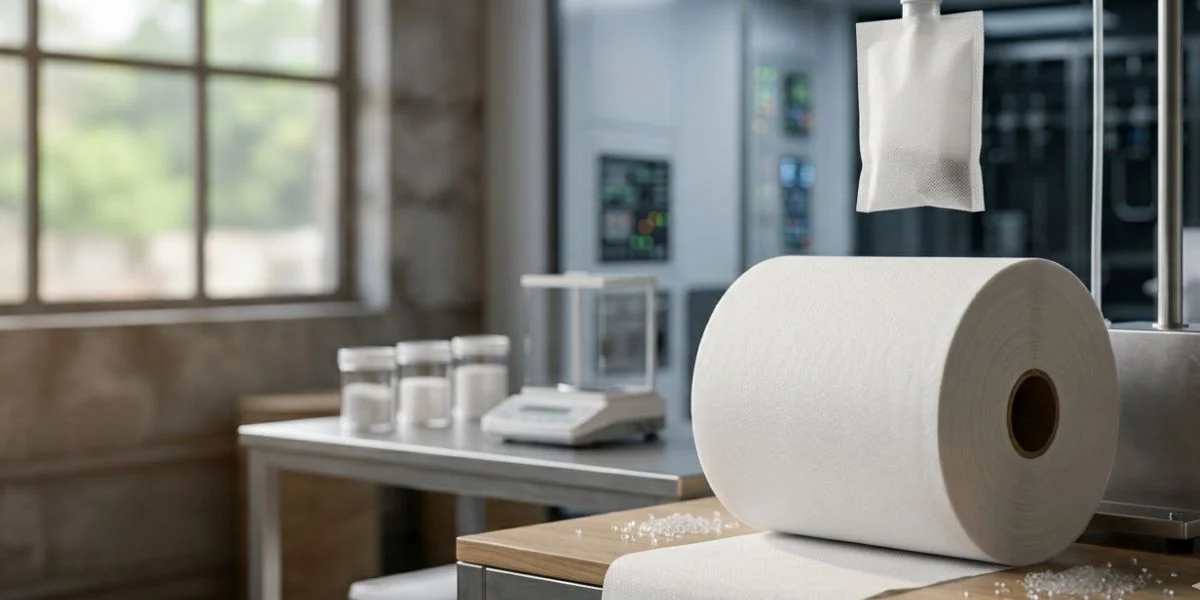
Breathable Nonwoven Fabric for Sachets — Desiccant Pouch Raw Material India
Breathable nonwoven fabric for sachets must allow moisture vapour to pass through freely to reach the desiccant inside, while keeping the desiccant granules contained and the sachet intact. PP spunbond and bicomponent (bico) PE/PP spunbond are the standard materials — they are heat-sealable, moisture-permeable, low-lint, and food/pharmaceutical safe. Favourite Fab supplies sachet-grade nonwoven in 30–80 GSM with consistent MVTR (moisture vapour transmission rate) and heat-seal integrity.
Browse our full range: View all nonwoven fabric products — spunlace, spunbond, SMS, bico — with GSM, width and certification options. B2B MOQ from 500 kg.
Technical Specifications
| Parameter | Specification |
|---|---|
| GSM | 30–80 GSM |
| Fibre | PP spunbond, bico PE/PP spunbond |
| MVTR | 500–3,000 g/m²/day (ASTM E96) |
| Heat seal strength | ≥10 N/25mm at 140–160°C |
| Width | 10–260 cm |
| Porosity | ISO 9237 air permeability 100–2,000 mm/s |
| MOQ | 500 kg |
Applications
Silica gel sachets, molecular sieve pouches, activated carbon bags, clay desiccant sachets, pharmaceutical desiccant canisters.
Why Source from Favourite Fab
Direct manufacturer, Agra India. Full range: desiccant nonwoven fabric. Related: nonwoven fabric hygiene products India.
- Factory direct — no distributor margin
- Custom slit widths 10 mm–260 cm, ±1 mm tolerance
- COA per batch — MVTR, tensile, heat seal, GSM
- Sample rolls dispatched 3–5 working days
- Export ready — FOB Nhava Sheva / ICD Tughlakabad
Frequently Asked Questions
What GSM nonwoven is standard for desiccant sachets?
40–60 GSM PP spunbond is the industry standard for most desiccant sachets (1–5g silica gel, 1–10g molecular sieve). Lighter 30 GSM used for mini sachets in small electronics packaging. Heavier 60–80 GSM used for industrial desiccant bags requiring higher burst resistance.
What heat seal temperature does sachet nonwoven require?
PP spunbond seals at 140–160°C on standard sachet sealing machines. Bico PE/PP seals at 120–140°C (lower temperature = faster line speed + less fabric shrinkage at seal). Heat seal strength minimum 10 N/25mm for intact sachet integrity during handling and shipping.
Can Favourite Fab supply sachet nonwoven in narrow widths for small sachet machines?
Yes. We slit sachet nonwoven from 10 mm to 260 cm. Common sachet widths: 30 mm, 50 mm, 70 mm, 100 mm. All slit widths ±1 mm tolerance. Core: 3-inch ID standard for sachet machine compatibility.
B2B Applications & End-Uses
Breathable nonwoven fabric for sachet and pouch applications must simultaneously contain the particulate contents u2014 silica gel, activated carbon, molecular sieve, potpourri, dried herbs u2014 while transmitting moisture vapour through the fabric wall at a rate sufficient to activate the fill material or enable product function. Favourite Fab supplies heat-sealable and non-sealable breathable nonwoven grades to desiccant sachet manufacturers, air freshener pouch converters, pharmaceutical desiccant insert producers, and specialty packaging fabricators across India and for export.
Desiccant sachet manufacturers require bicomponent (PE/PP) heat-sealable spunbond or spunlace grades that can be sealed on rotary or flat-bed heat-seal equipment at standard dwell-time and temperature settings. The PE sheath in bico fibres melts and forms a hermetic seal perimeter while the PP core maintains fabric integrity u2014 no adhesive laminate or separate seal strip is required. This seal construction holds against the fill weight and handling loads experienced during sachet production, packaging, and shipment.
Air freshener and potpourri pouch producers specify lightweight breathable nonwoven u2014 typically 30u201350 GSM u2014 where fragrance diffusion rate is a product design parameter. Tea and herb sachet manufacturers in the food segment require food-grade polypropylene or polyester grades with migration test data. Pharmaceutical companies producing desiccant inserts for drug bottle packaging specify minimum MVTR values and lot traceability documentation consistent with their drug master file requirements.
Certifications & Quality Assurance
Breathable nonwoven grades from Favourite Fab are tested for MVTR per ASTM E96 Method B, with results reported on the COA. Heat-sealable bico grades undergo seal strength testing to confirm that seals formed at standard converting parameters meet minimum peel-force requirements for the target fill weight and sachet size. GSM is measured per production roll with tolerance held within u00b15% of nominal, as GSM variation directly affects both breathability and seal quality.
Polypropylene and polyester grades used in food-contact-adjacent sachet applications are produced from materials with food-contact compliance declarations available upon request. Lot-level traceability links each roll to the raw fibre batch, enabling buyers to complete their own incoming material qualification records. Roll dimensions u2014 width, linear metres, and core diameter u2014 are confirmed against order specifications and labelled on each roll for converting line setup accuracy.
More Questions Answered
What is the difference between heat-sealable and non-sealable breathable nonwoven for sachet production?
Heat-sealable breathable nonwoven u2014 typically bicomponent PE/PP spunbond u2014 bonds to itself or to compatible substrates when heat and pressure are applied, forming a sealed pouch perimeter without adhesive. The PE sheath component melts at lower temperature than the PP core, creating the seal while the fabric retains structural integrity. Non-sealable breathable nonwoven such as standard PP spunbond or polyester spunlace cannot be heat-sealed to itself and requires ultrasonic bonding, adhesive application, or mechanical closure methods. Choosing the correct type depends on your converting equipment and the seal integrity requirements for the fill material and end-use conditions.
What minimum MVTR is required for desiccant sachet nonwoven to function effectively?
For most industrial desiccant sachet applications using silica gel or molecular sieve fill, a minimum MVTR of 2,000 g/mu00b2/day measured per ASTM E96 Method B is considered functionally adequate, though many specification standards set the threshold at 3,000 g/mu00b2/day or above for pharmaceutical-grade desiccant inserts. The MVTR required for your application depends on the desiccant’s target equilibrium moisture content, the container headspace volume, and the allowable time-to-equilibrium. Favourite Fab supplies COA MVTR data for all desiccant-grade nonwoven so that you can verify compliance with your sachet system design parameters before purchase commitment.
Related: SMS non woven fabric for desiccant bags and non woven rolls for automatic desiccant pouch packing machine.

Gaurav Garg
I'm Gaurav Garg, CEO of Favourite Fab, a company on a mission to revolutionize the nonwoven industry with sustainable practices. We work hand-in-hand with manufacturers and suppliers who share our commitment to eco-friendly production. With a deep interest in textile innovation, I'm passionate about educating consumers about sustainable material options and their potential to transform the nonwoven landscape.


