

Adult Diaper Making Machine — Manufacturer Sourcing Guide India | Favourite Fab
Choosing an adult diaper making machine is the single largest capex decision in a hygiene plant. Output speed, servo architecture, pad-size flexibility, and changeover time directly govern unit economics for the next 8–12 years. This sourcing guide is written for plant procurement heads, factory owners, and entrepreneurs setting up an adult diaper line in India — covering machine types, specifications, supplier evaluation, line layout, raw-material match, and ROI levers. Request machine quote or book a plant-setup consultation with our Agra team.
ISO 9001 raw-material partner | Agra, India | Pan-India machinery sourcing network
What is an adult diaper making machine?
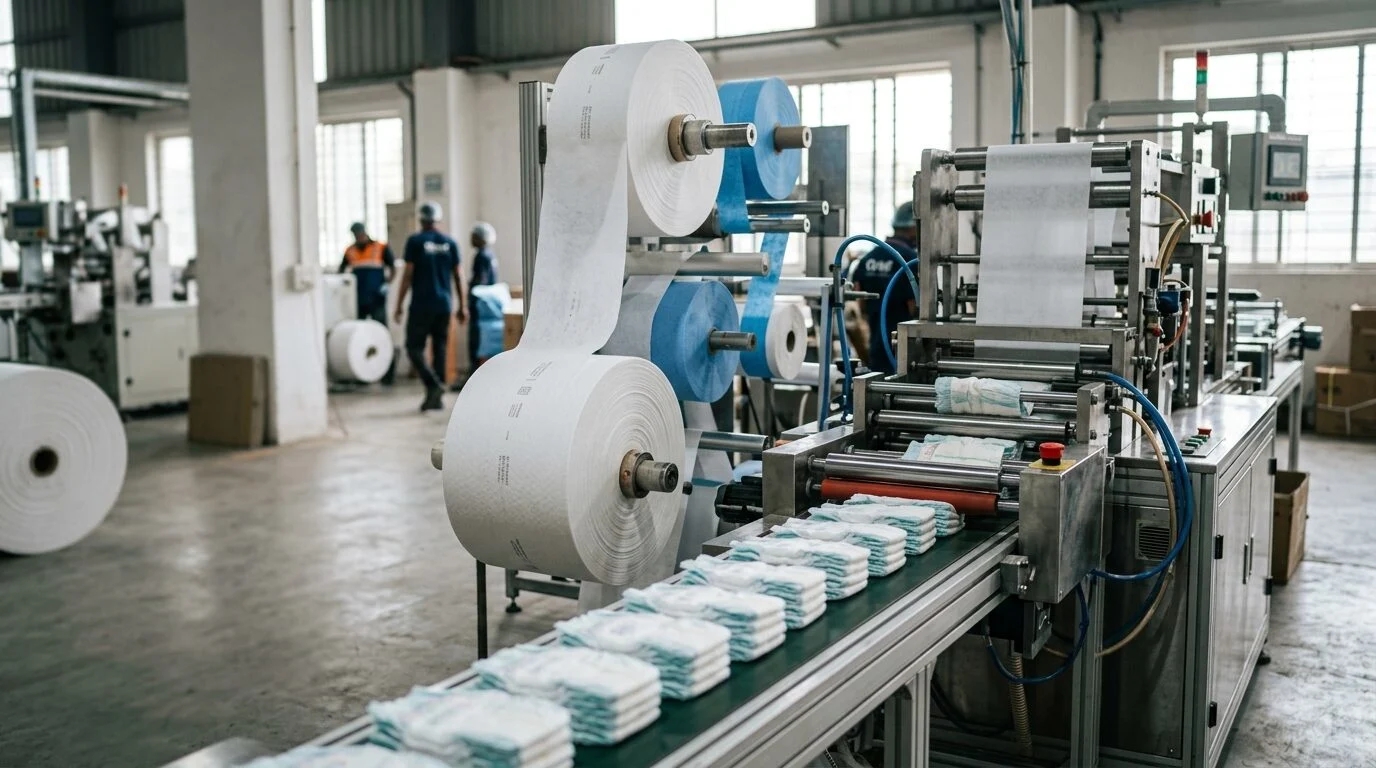
An adult diaper making machine is an inline converting system that unwinds multiple roll-form raw materials — non-woven topsheet, SAP-fluff core, PE backsheet, elastic strands, frontal tape — and bonds, cuts, folds and stacks them into finished adult incontinence pads or briefs at speeds of 80 to 600 pieces per minute. It is not one machine but a coordinated train of stations linked by servo-controlled drives and vision systems.
Global demand for adult incontinence products is growing at 7–9% CAGR, driven by ageing populations in Japan, the EU, and increasingly India. Domestic adult diaper consumption in India has tripled since 2020, pulling new converting capacity into Tier-2 cities like Agra, Indore, Coimbatore, and Ahmedabad. Most new entrants begin with a single semi-automatic or full-automatic line and scale to multi-line plants once distribution is locked in.
An adult diaper line is mechanically more demanding than a sanitary-napkin or baby-diaper line because the pad is larger (typically 600–900 mm unfolded), heavier (15–35 g SAP load), and requires elasticated leg cuffs plus waistband closure — features absent in feminine hygiene converting.
How an adult diaper is made on the line
A modern adult diaper line executes the following stations in sequence. Each station must run in servo-synchronised pitch or the pad fails final inspection.
- Backsheet unwind — PE breathable film or laminated nonwoven is unwound, edge-guided, and tension-controlled.
- Leg-cuff forming — hydrophobic spunbond strips are folded and elastic strands inserted with hot-melt adhesive.
- SAP and fluff pulp core forming — defibrated wood pulp is mixed with super-absorbent polymer in a drum former and profiled to the pad shape.
- ADL and acquisition layer placement — an acquisition-distribution layer is bonded above the core for quick liquid intake.
- Topsheet lamination — soft hydrophilic spunbond or perforated film is bonded over the core via hot-melt or ultrasonic.
- Waist elastic and frontal tape application — elastics and landing-zone tapes are placed for brief-style products.
- Embossing and cutting — anvil and pattern rolls cut individual pads at pitch.
- Folding — bi-fold or tri-fold module collapses the pad for packaging.
- Stacking and counting — servo stacker delivers count-accurate bundles to bagger.
- Bagging or pouching — finished pads are sealed into retail pouches, then case-packed.
End-to-end vision inspection rejects pads with missing components, off-pitch cuts, or core-weight deviations beyond ±5%. Reject rate on a tuned line stays under 1.5%.
Machine types — manual, semi-auto, full-auto, full-servo
Buyers typically evaluate four broad classes of adult diaper converting line. The right class depends on target output, available capex, labour cost, and product mix.
| Machine class | Output (pads/min) | Capex tier | Footprint | Operators | Best for |
|---|---|---|---|---|---|
| Manual / table-top | 5–15 | Entry | 30–60 m² | 6–10 | Pilot batches, MSME entrants |
| Semi-automatic | 60–120 | Mid-entry | 120–180 m² | 3–5 | Regional brands, contract makers |
| Full-automatic (mechanical cam) | 150–280 | Mid | 200–280 m² | 2–3 | Pan-India brands, mid-volume |
| Full-servo | 300–600 | Premium | 300–450 m² | 2 | Exporters, large OEM contracts |
Manual and table-top units
Stand-alone forming and sealing units operated by hand. Used only for small batches, sampling, or institutional supply. Quality variance is high and labour intensity makes scaling impractical beyond 50,000 pads per month.
Semi-automatic lines
Most stations are mechanised but core forming, packaging, or folding may still require operator intervention. Suited to entrepreneurs starting under 200,000 pads per month with phased scale-up plans.
Full-automatic mechanical lines
Cam-driven, mechanically synchronised. Lower capex than full-servo and forgiving on Indian power-quality conditions. Changeover between adult sizes (M, L, XL) takes 45–90 minutes.
Full-servo lines
Each station is independently servo-driven and recipe-managed by a central PLC and HMI. Size changeover drops to 15–25 minutes via stored recipes. Highest output and lowest reject rate, but requires clean three-phase power, a trained electrical team, and OEM spares on contract.
Semi-servo vs full-servo
Semi-servo hybrids retain mechanical timing on the core former and stacker but use servos on the cutter, folder, and applicator. They land at 75–85% of full-servo output for 60–70% of the capex, making them the sweet spot for first-time investors targeting 200–350 pads per minute.
Specifications that actually matter
Brochure speed is the most misquoted number in the industry. Evaluate every adult diaper making machine on the following spec set, not on theoretical maximum alone.
| Specification | Typical range | Why it matters |
|---|---|---|
| Mechanical speed | 200–600 pads/min | Brochure number; rarely sustained in production |
| Sustained production speed | 70–85% of mechanical | Real OEE basis for ROI calculation |
| Pad-size range | M / L / XL / XXL, 600–900 mm | Determines SKU flexibility |
| Changeover time | 15 min (servo) – 90 min (mech) | Drives multi-SKU profitability |
| SAP dosing accuracy | ±3% to ±5% | Direct cost — SAP is the most expensive input |
| Installed power | 60–150 kW | Sizes transformer, DG backup, energy bill |
| Compressed air | 1.5–3.5 m³/min @ 7 bar | Sizes compressor capex |
| Reject rate (steady state) | under 1.5% | Yield and material waste |
| Vision inspection | Yes / No, channels | Quality auditability for exports |
| OEE target (12-month) | 65–78% | True payback driver |
Insist on a Factory Acceptance Test that runs the machine at quoted speed on your own raw-material samples for a minimum of four continuous hours before shipment.
Production line components and layout
An adult diaper plant is not just the converting machine. Plan the following ancillary footprint when modelling capex and factory layout.
- Raw material warehouse — minimum 21 days of nonwoven, SAP, fluff pulp, PE film, hot melt and elastic.
- Air compressor room — oil-free screw compressor sized 25–40% above peak demand.
- Hot-melt adhesive station — tank, hose and nozzle network feeding cuff, core, and frontal applicators.
- Dust extraction — fluff pulp shedding requires cyclone plus HEPA, especially for ISO 13485 medical-grade lines.
- Bagger and case packer — pouching machine plus carton sealer, typically 30% of converter footprint.
- QC lab — absorbency tester, rewet, basis-weight scale, tensile, and SAP free-swell rig.
- Finished goods warehouse — bulky pads need 2.5× the footprint per unit of sanitary napkins.
A balanced 300-pad/min line typically needs 900–1,400 m² of total covered factory area including warehousing.
Raw materials the machine consumes
Machine selection is meaningless if raw materials do not match its design tolerances. The most common cause of underperformance against brochure speed is raw-material variance, not machine fault.
- Topsheet — soft hydrophilic spunbond, 15–20 gsm. See our PP spunbond nonwoven price guide for current ranges.
- Leg cuffs — hydrophobic SS or SMS spunbond, 12–15 gsm. Source from a consistent SMS non-woven fabric supplier to avoid cuff leak failures.
- Core wrap — tissue or SMS at 12–17 gsm.
- SAP — sodium polyacrylate, 28–35 g/g free swell, dosing per pad 8–25 g depending on absorbency rating.
- Fluff pulp — softwood Kraft, mat or roll form, 4–10 g per pad.
- Backsheet — PE breathable film or laminated nonwoven, 18–25 gsm.
- Elastics — spandex strands 470–940 dtex for cuffs and waistband.
- Hot-melt — construction grade for component bonding, elastic grade for strand attachment.
- Frontal tape and landing zone — for brief-style adult diapers.
For a consolidated raw-material supply contract across nonwoven, SAP, and tapes, review our hygiene raw-material supply program.
How to choose the right machine supplier
Indian buyers face three supplier pools — domestic OEMs (Gujarat, Tamil Nadu, NCR), Chinese OEMs (Quanzhou, Guangzhou cluster), and European OEMs (Italy, Germany). Use the following eight-point checklist before issuing a purchase order for an adult diaper line.
- Reference list with site visit rights — minimum three running customers in similar geography.
- FAT and SAT protocol in writing — quoted speed sustained on buyer raw materials for four hours minimum.
- Spare parts catalogue and stock map — local stocking of wear parts within India is non-negotiable.
- Engineer response SLA — under 72 hours on-site for critical breakdowns.
- Servo and PLC brand — Siemens, Allen-Bradley, Mitsubishi, Yaskawa preferred over generic.
- Training plan — minimum two weeks operator and one week maintenance training included.
- Warranty terms — 12 months minimum on mechanical, separate electrical warranty.
- Upgrade path — confirmation that the machine accepts brief-style and pant-style retrofits without full rebuild.
Never sign on quoted speed alone. Demand OEE projections with documented raw-material assumptions.
Capex tiers, cost factors and ROI
Investment ranges vary widely by class, origin, and automation. We reference competitive capex tiers rather than specific figures because OEM quotes shift with steel, freight, and INR-USD parity. Request a structured quote for current pricing.
| Class | Capex tier | Working capital | Plant area | Typical payback |
|---|---|---|---|---|
| Manual + sealing | Entry | Low | 30–60 m² | 18–30 months |
| Semi-automatic | Mid-entry | Moderate | 120–180 m² | 24–36 months |
| Full-auto mechanical | Mid | High | 200–280 m² | 30–48 months |
| Full-servo | Premium | High | 300–450 m² | 36–60 months |
Payback is governed less by machine price and more by these levers — OEE, SAP dosing accuracy, raw-material reject rate, and distribution velocity. A semi-servo line at 75% OEE typically out-earns a full-servo line at 55% OEE during the first two years.
Key cost factors beyond machine price
- Civil and electrical works — 8–14% of machine cost.
- Compressors, dust extraction, hot-melt tanks — 6–10% of machine cost.
- Spares kit for first 12 months — 4–6% of machine cost.
- Operator and maintenance training — typically OEM-included but verify.
- Freight, customs, GST — 15–22% for imported machines.
- Working capital for 60 days of raw material — frequently underestimated.
Baby diaper vs adult diaper machine — key differences
Buyers entering hygiene converting often ask whether a baby diaper line can produce adult products. The short answer is no — the machines share a process family but differ in pitch, core capacity, and elastic architecture.
| Parameter | Baby diaper line | Adult diaper line |
|---|---|---|
| Pad pitch length | 320–460 mm | 600–900 mm |
| SAP load per pad | 4–12 g | 15–35 g |
| Core former drum diameter | Smaller | Larger, higher torque |
| Elastic waistband | Standard | Wider, higher tension |
| Frontal tape | Optional | Mandatory for brief style |
| Output (full-servo) | 500–1,000 ppm | 300–600 ppm |
Some OEMs offer convertible platforms with size-kit changeover between baby and adult, but conversion takes 6–10 hours and is not practical for daily SKU rotation. Run dedicated lines if your business plan covers both segments.
Maintenance, spares and troubleshooting
Adult diaper lines are continuous-process assets. Unplanned downtime above 8% per month destroys ROI faster than any other variable. Build the following maintenance discipline from day one.
Daily checks
- Hot-melt nozzle inspection and purge.
- Knife and anvil-roll edge inspection.
- SAP feeder calibration against gravimetric scale.
- Vision-system illumination check.
- Compressed air dew point and oil filter.
Weekly
- Servo motor cooling fan and encoder cleanliness.
- Hot-melt hose temperature profile audit.
- Cuff elastic tension dynamometer test.
- Dust extraction filter back-pressure.
Common failure modes
- Off-pitch cut — usually encoder slip, web tension drift, or worn anvil bearing.
- Core weight drift — SAP feeder auger wear or fluff pulp moisture variance.
- Cuff leak — elastic tension loss or hot-melt nozzle clog at cuff applicator.
- Frontal tape misalignment — applicator vacuum loss or servo phase error.
- Folder jams — pad stiffness variance from SAP overdose or low fluff.
Keep a 90-day rolling spares kit for wear parts — knives, nozzles, vacuum cups, servo belts, elastic guides, and edge-guide sensors. Imported spares lead-time of 6–10 weeks is the single biggest hidden cost in machine ownership.
Why source through Favourite Fab
Favourite Fab is a hygiene raw-material manufacturer and machinery sourcing partner based in Agra, India. We are not a machine OEM — we are an independent advisor, raw-material supplier, and post-installation support partner for plants commissioning an adult diaper making machine.
- Independent OEM shortlisting across Indian, Chinese, and European suppliers, matched to your capex and output targets.
- Raw-material match testing — we run your shortlisted machine’s published tolerances against our spunbond, SMS, and SAP lots before you sign the PO.
- Pan-India supply network for spunbond, SMS, SAP, fluff pulp, hot-melt, and elastics under one consolidated contract.
- Plant-setup consultation covering layout, utilities sizing, manpower planning, and statutory clearances.
- Distribution introductions to adult diaper brand owners through our adult diaper manufacturers India network.
- ISO 9001 certified raw-material operations with documented batch traceability.
Frequently asked questions
What is the typical output of an adult diaper making machine?
Output ranges from 5–15 pads per minute on manual units to 300–600 pads per minute on full-servo lines. Most Indian first-time investors choose semi-automatic or semi-servo machines in the 150–300 pads per minute band as the best balance of capex and ROI.
Can a baby diaper machine make adult diapers?
Not practically. Pad pitch, core drum size, and waistband architecture differ. Some OEMs offer size-kit conversion, but the changeover takes 6–10 hours and is unsuitable for daily production. Run dedicated lines for each product segment.
What is the difference between semi-servo and full-servo adult diaper machines?
Semi-servo machines retain mechanical timing on the core former and stacker while using servos on cutter, folder, and applicator stations. Full-servo machines drive every station with independent servos under recipe control. Semi-servo costs 60–70% of full-servo while delivering 75–85% of the output.
How much factory area do I need for an adult diaper line?
A balanced 300-pad-per-minute line needs 900–1,400 m² of total covered area including raw-material warehouse, converting line, compressor room, dust extraction, QC lab, and finished-goods storage. Plan a clear-height of 5.5 metres minimum.
What raw materials does an adult diaper making machine consume?
Hydrophilic spunbond topsheet, hydrophobic SMS or SS leg cuffs, SAP, fluff pulp, PE breathable backsheet, elastic strands, hot-melt adhesive, frontal tape, and landing-zone material. Consolidating supply through one partner reduces working capital and quality variance.
What changeover time should I expect between adult diaper sizes?
Mechanical full-auto lines need 45–90 minutes. Servo lines drop to 15–25 minutes via stored recipes. If you plan to run more than three SKUs per shift, prioritise servo architecture or you will lose 8–12% of available production hours to changeover.
How long is the payback period on an adult diaper line in India?
Typical payback ranges from 24–36 months for semi-automatic lines to 36–60 months for full-servo lines, assuming 65–78% OEE and stable distribution. Payback is more sensitive to OEE and SAP dosing accuracy than to machine class.
What certifications should a machine supplier hold?
Look for CE marking on European-supplied machines, ISO 9001 on the OEM, and documented compliance with Indian electrical and safety codes. For medical-grade adult incontinence products, the converting environment must support ISO 13485 traceability even if the machine itself does not.
Can I start with a semi-automatic machine and upgrade later?
Yes — many Indian entrants begin with semi-automatic 80–120 ppm lines and add a full-servo line in year two or three after distribution is established. Plan factory layout, utilities, and warehousing for the full-servo footprint from day one to avoid expensive civil rework.
What is the most common cause of underperformance against quoted speed?
Raw-material variance — basis-weight drift on nonwoven, SAP particle-size variation, fluff pulp moisture, and elastic dtex tolerance. Machine OEMs quote speed against tightly specified raw materials. Sourcing through a consolidated raw-material partner with batch traceability is the highest-leverage decision a plant owner can make.
Does Favourite Fab sell adult diaper making machines directly?
No. We are an independent raw-material manufacturer and sourcing advisor. We help you shortlist Indian, Chinese, and European OEMs, run raw-material match testing against shortlisted machines, and supply spunbond, SMS, SAP, and elastics post-commissioning. This independence keeps our advice unbiased.
What is the GST rate on adult diaper making machinery in India?
As of 2026-05, capital machinery for hygiene converting attracts 18% GST under HSN 8441/8479 depending on configuration. Always confirm the HSN classification with your tax advisor before issuing a PO, since incorrect classification can trigger reassessment and input-credit disputes.
📋 Related: Diaper Raw Materials | All Products from Favourite Fab

Gaurav Garg
I'm Gaurav Garg, CEO of Favourite Fab, a company on a mission to revolutionize the nonwoven industry with sustainable practices. We work hand-in-hand with manufacturers and suppliers who share our commitment to eco-friendly production. With a deep interest in textile innovation, I'm passionate about educating consumers about sustainable material options and their potential to transform the nonwoven landscape.


