

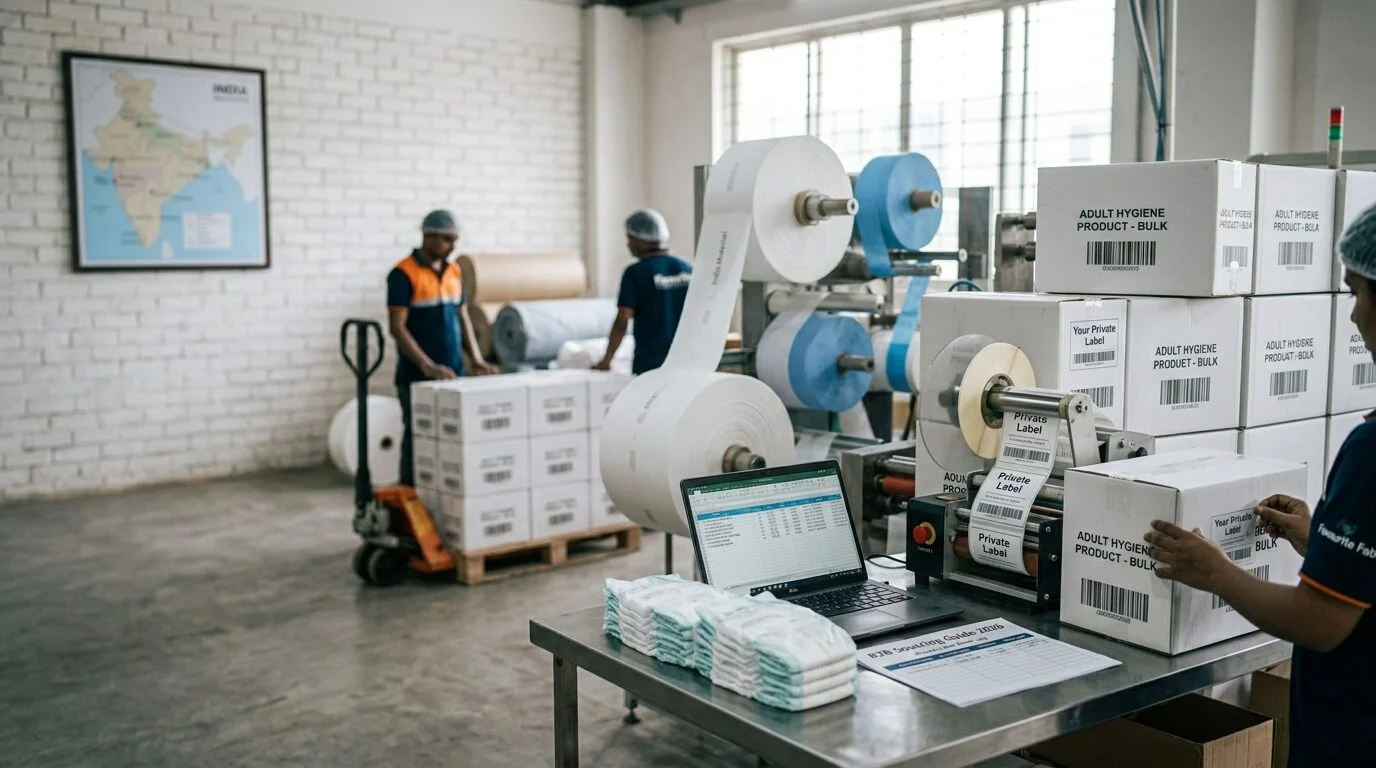
Adult Diaper Manufacturers India — B2B Sourcing, Private Label & Bulk Supply Guide (2026)
Sourcing from adult diaper manufacturers India has become the most cost-effective route for OEM brand owners, hospital procurement teams, distributors and private-label buyers across the Middle East, Africa, South-East Asia and the domestic Indian market. India now produces over 1.8 billion adult incontinence units per year across 140+ registered factories, with export-grade lines matching Chinese and South-Korean quality at 18–28% lower landed cost. This pillar consolidates everything a procurement head needs — comparison of leading manufacturers, city-wise sourcing hubs, raw material specifications, MOQ & lead time benchmarks, certification checklists, and private-label workflows — written for B2B decision-makers, not consumers.
Request B2B Quote Request Sample Kit
ISO 9001:2015 · ISO 13485 (medical-grade lines) · BIS / CDSCO compliant raw materials · REACH & OEKO-TEX · 15+ years export experience
India’s adult diaper market — 2026 snapshot
India’s adult incontinence category is the fastest-growing hygiene sub-sector in Asia after Japan. Driven by an ageing population (160 million Indians aged 60+ by 2030), rising urbanisation, hospital expansion under Ayushman Bharat, and post-surgical home-care demand, the segment is compounding at 16–19% CAGR and is projected to cross USD 850 million by 2028.
The structural shift matters for B2B buyers: a market that was 90% imports from China and Indonesia in 2015 is now 62% locally manufactured. Capacity build-out across Gujarat, Tamil Nadu, Maharashtra and the NCR belt has compressed lead times from 60–75 days (CIF China) to 18–25 days ex-works India. For private-label buyers and distributors, this means smaller working-capital cycles, faster artwork iteration, and easier compliance with CDSCO and state FDA registrations.
Two demand pockets dominate B2B order books — (1) institutional supply to hospitals, nursing homes, palliative-care chains and government tenders, and (2) private-label exports to GCC, East Africa, Sri Lanka, Nepal, Bangladesh and Francophone Africa. Both verticals favour Indian manufacturers because of English-language documentation, halal-friendly factory protocols, and acceptance of mixed-SKU container loads.
Top adult diaper manufacturers in India — comparison table
The table below maps the principal Indian manufacturers active in B2B and private-label supply. Capacity figures reflect 2026 declared line-output; certification status is from public registry filings. Use this as a shortlist, then verify samples and audit reports before commitment.
| Manufacturer | HQ / Plant | Daily capacity (pcs) | MOQ (cartons) | Private label | Key certifications | Export focus |
|---|---|---|---|---|---|---|
| Nobel Hygiene (Friends) | Palghar, Maharashtra | 2,500,000 | 500 | Selective | ISO 9001, ISO 13485, CE | GCC, SEA |
| Kimberly-Clark India | Sanand, Gujarat | 1,800,000 | 1,000 | No (own brand) | ISO 9001, FDA | Domestic + export |
| Procter & Gamble (Old Harbour) | Hyderabad, Telangana | 1,500,000 | 2,000 | No | ISO 9001, ISO 14001 | Domestic |
| Romsons Scientific | Agra, Uttar Pradesh | 700,000 | 300 | Yes | ISO 13485, CDSCO, CE | 30+ countries |
| Mediplus India | Faridabad, Haryana | 650,000 | 250 | Yes | ISO 9001, CDSCO | Africa, GCC |
| Polycare Tradex | Surat, Gujarat | 900,000 | 200 | Yes | ISO 9001, OEKO-TEX | Africa, SAARC |
| Niine Hygiene | Ahmedabad, Gujarat | 500,000 | 500 | Limited | ISO 9001 | Domestic-led |
| Inhouse / Wellbe | Rajkot, Gujarat | 450,000 | 150 | Yes | ISO 9001, CE | Africa, GCC |
| SCA Asia (Tena licensee) | Pune, Maharashtra | 800,000 | 1,000 | No | ISO 13485, CE, FDA | Hospital channel |
| Favourite Fab (raw-material + converter partners) | Agra, Uttar Pradesh | Raw-material 25 T/day + converter network | 1 carton (raw); 200 cartons (finished) | Yes — full white-label | ISO 9001, OEKO-TEX, REACH | India + 18 export markets |
Three notes for procurement. First, declared capacity is not the same as available capacity — Tier-1 brand-owner factories typically book 80–90% of output to their own SKUs, so realistic private-label allocation is small. Second, MOQ on paper is always negotiable upward; downward flexibility exists only with converters that share a raw-material base across multiple buyers (which is why integrated raw-material houses like Favourite Fab can support smaller B2B trial orders). Third, certification depth varies — a generic ISO 9001 does not equal medical-device readiness; for hospital tenders insist on ISO 13485 and CDSCO Form MD-15 (importer) or MD-5 (manufacturer).
City-wise sourcing hubs for adult diaper manufacturers India
Geography matters because raw material clusters, port access, labour rates and state-level incentives create real cost differences. The five clusters below cover roughly 92% of national output.
Gujarat — Ahmedabad, Surat, Rajkot
The largest converter belt in India. Strong because spunbond nonwoven, SAP imports and Mundra/Pipavav ports sit within 250 km. Surat and Rajkot host the highest density of small and mid-size private-label converters; Ahmedabad has the brand-owner factories. Best fit for export-focused private label, mixed-SKU containers, and trial MOQs of 200–500 cartons. Sourcing from adult diaper manufacturers in Gujarat typically gives the lowest CIF landed cost to Africa and GCC.
Maharashtra — Palghar, Pune, Aurangabad
Highest concentration of Tier-1 capacity and ISO 13485 lines. Best fit for hospital-grade SKUs, institutional supply contracts, and brand owners who need scale (1M+ pieces / month). JNPT port proximity supports Europe and Americas shipping. Expect higher MOQ floors (1,000+ cartons).
Tamil Nadu — Coimbatore, Chennai, Tiruppur
Emerging hub. Strong nonwoven spinning base (carded thermal-bond, spunlace), and Chennai port. Adult diaper manufacturers in Coimbatore are competitive on bonded-fibre topsheet and 3D-embossed ADL layers; Chennai converters handle SAARC and East-Africa containers efficiently.
NCR — Delhi, Faridabad, Noida, Greater Noida
Dominant in domestic-channel distribution and government / CGHS tenders. Faridabad has the highest density of CDSCO-licensed medical-device manufacturers. Logistics radius covers north and east India in 48 hours.
South India — Hyderabad, Bangalore
P&G’s Old Harbour plant anchors Hyderabad; Bangalore hosts several mid-size converters serving Karnataka and Kerala hospital chains. Adult diapers wholesale in Hyderabad typically clears through this cluster.
Uttar Pradesh — Agra, Noida, Kanpur
Agra is the historical raw-material capital — PP spunbond, SMS, hot-air-through (ADL), and PE backsheet film converters have been operating here since the early 2000s. Favourite Fab’s plant sits in Agra and supplies raw materials to converters across all five clusters above, which is why we are able to offer integrated private-label routes at lower MOQ than pure converter houses.
Raw materials & GSM specifications for adult diapers
A finished adult diaper is a six-to-nine-layer composite. The table below shows the standard B2B specification grid used by Indian export-grade factories. These are the materials Favourite Fab supplies daily to converter partners.
| Layer | Material | Typical GSM | Function | Common polymer |
|---|---|---|---|---|
| Topsheet | Hydrophilic PP spunbond or bicomponent spunbond | 15–22 gsm | Skin-contact, fast strike-through | PP / PP-PE bico |
| ADL (acquisition / distribution) | Hot-air-through nonwoven, 3D embossed | 30–50 gsm | Pulls fluid down, prevents rewet | PE-PET bico |
| Absorbent core | Fluff pulp + SAP (sodium polyacrylate) | 250–600 gsm composite | Locks fluid as gel | Pulp + SAP |
| Tissue wrap | SAP-stabilising tissue | 14–17 gsm | Holds core integrity | Cellulose |
| Backsheet | Breathable PE film laminated to PP spunbond (clothlike) | 15 + 17 gsm | Leak-proof, breathable | PE / PP |
| Leg cuffs / barrier leg | SMS hydrophobic nonwoven | 13–18 gsm | Side-leak prevention | PP |
| Frontal tape / landing zone | PP spunbond loop or film loop | 50–80 gsm | Hook-and-loop closure | PP |
| Elastic waistband | Spandex strands + spunbond laminate | — | Pant-style fit | Lycra / PP |
| Hot-melt adhesives | Construction + elastic + core PSA | 3–8 g per piece | Bonds layers | SBC / APAO |
Material decisions drive the three KPIs procurement teams care about — absorbency (rewet < 0.5 g), breathability (MVTR > 3000 g/m²/24h), and skin-friendliness (pH 5.5–7.0, no formaldehyde). The wrong topsheet GSM or a cheap SAP grade will be visible in customer complaints within 60 days, so we always recommend buyers approve a sealed master sample before any container ships. Deep-dive specifications are linked from our hygiene raw material pillar and the PP spunbond nonwoven price guide; for barrier layers see SMS nonwoven specifications.
How adult diapers are manufactured
A modern Indian factory uses a single in-line servo-driven machine that integrates 14 stations. The high-level flow:
- Raw material unwind — backsheet film, topsheet, SMS, ADL, tissue and elastic strands are loaded onto independent unwinders with edge-position controllers.
- Core forming — defibrated fluff pulp is mixed with SAP in a drum former; profiled to “I” or “T” shape with mass-per-zone control.
- Core wrapping — tissue applied above and below the core, ultrasonic-sealed.
- Hot-melt application — construction adhesive sprayed at 145–160 °C for layer bonding; elastic adhesive applied to standing leg cuffs.
- Cuff formation — SMS barrier folded into a C-cuff with spandex strands stretched 280–350%.
- Front waist & back ear assembly — for tape-style products, ears are die-cut and bonded; for pant-style, side panels are ultrasonic-welded.
- Frontal tape / landing zone — PP loop laminate die-cut and applied to the waist of tape-style SKUs.
- Wetness indicator stripe — pH-reactive ink applied to backsheet.
- Cut & transfer — single-piece cut by anvil knife, transferred via vacuum drum at line speeds of 350–500 pcs/min.
- QC vision & metal detection — every piece passes a vision camera and metal detector; rejects auto-ejected.
- Folding & primary pack — bi-fold or tri-fold, then 8/10/30-piece poly bagging.
- Cartoning, case-coding & palletising — cartons batch-coded with line, date and shift; palletised for export.
Line OEE on a well-run Indian plant runs 78–85%; export-grade audit (ISO 13485) additionally requires lot-traceability of every raw-material batch to finished carton. The sister pillar on adult diaper making machines covers OEM machine choices and capex ranges for buyers planning their own line.
Private-label & contract manufacturing
Private label is the dominant B2B route for new entrants, importers, and regional brand-owners who don’t want to invest in a USD 1.8–3.5 million machine. A typical engagement runs through eight stages:
- Brand brief — SKU mix, target market, price tier, claims (overnight, plus-size, breathable, etc.).
- Specification freeze — GSM grid, absorbency target, fragrance, colour of frontal tape.
- Artwork & dieline — poly bag and carton artwork in CMYK + spot colours, regulatory text (importer name, MDR/CDSCO licence, batch field).
- Pilot run — 2,000–5,000 pieces for laboratory testing (rewet, MVTR, tensile, pH).
- Pre-shipment sample approval — sealed master sample exchanged.
- Production run — first 5% of production held for visual + lab QC.
- Pre-shipment inspection — buyer or third-party (SGS, Intertek, Bureau Veritas).
- FCA / FOB / CIF shipment — paperwork includes COO, COA, MSDS for SAP, and CE / CDSCO certificates where applicable.
Indian converters generally support white-label MOQs from 200 cartons (≈ 19,200 pieces of size L) for tape style and 300 cartons for pant style. Brand-owner factories require 1,000+ cartons. Lead time after artwork approval is 18–25 days for stock specifications and 35–45 days for fully custom GSM grids.
Bulk & wholesale supply — MOQ, lead time, distribution
Wholesale and distributor enquiries cover three sub-buyer profiles:
- State-level distributors — typically pull 1–3 truckloads (1 truck ≈ 600 cartons) of a mid-tier domestic brand; require credit terms of 30–45 days and exclusive territory.
- Modern-trade aggregators — supply Big Basket, JioMart, Amazon-pantry-grade clients; require GS1 barcodes, e-commerce-ready outer cartons, and FSSAI-style batch traceability.
- Export wholesalers — buy 1×20′ or 1×40’HC FCL containers; FOB Mundra / Nhava Sheva pricing; mixed SKU permitted at 6+ cartons per SKU.
Because pricing fluctuates with pulp, SAP and polypropylene indices on a weekly basis, we publish only indicative band statements and route every enquiry to the sales team for a written PI. Buyers seeking adult diapers wholesale price commitments longer than 30 days should negotiate quarterly contracts indexed to ICIS pulp / Platts polymer benchmarks.
Hospital, nursing home & institutional supply
Institutional buyers — hospital procurement teams, multi-specialty chains, palliative care providers, GeM tender bidders — have a different requirement profile from retail. The non-negotiables are:
- ISO 13485 manufacturing site with valid CDSCO Manufacturing Licence (Form MD-5) for medical-device classification.
- Lot-traceable production with COA (Certificate of Analysis) for every batch.
- Tested absorbency (≥ 1500 ml for overnight grade) per ISO 11948 Rothwell method.
- Latex-free, fragrance-free, hypoallergenic confirmation on COA.
- Larger sizes (XL, XXL, 3XL) and bariatric grades in MOQ-friendly volumes.
- Bulk packing — 80 or 100 pieces per case, no retail artwork.
For institutional buyers we recommend pairing adult diapers with disposable underpads for aged care as a bundled SKU — most hospital tenders ask for both lines together and a single supplier reduces vendor management overhead. Tender pricing should reference IRR (Indian Rupee) with an FX / raw-material escalation clause if delivery extends beyond 90 days.
India vs China — sourcing comparison
Adult diaper manufacturer in China remains a high-volume source — Fujian (Quanzhou, Jinjiang) and Guangdong clusters dominate global supply. India has closed the quality gap on most B2B specifications and now competes openly on cost, lead time, and compliance flexibility. The comparison table summarises the practical trade-offs.
| Criterion | India | China |
|---|---|---|
| Cost (FOB, L-size, mid-tier) | Lower 15–22% on private label | Benchmark |
| MOQ flexibility | 200–500 cartons typical | 1,000–2,000 cartons typical |
| Lead time (after PO) | 18–25 days | 28–45 days (factory) + 25–35 days ocean |
| Documentation (English-language, CE, FDA) | Strong | Strong (top tier) |
| Halal-friendly factory protocols | Common | Limited |
| Customs duty into India | Domestic | 10–20% BCD + IGST |
| Best for buyers in | Africa, GCC, SAARC, domestic India | EU, USA, Latin America at scale |
Certifications & quality compliance checklist
Before issuing a PO, verify the following — each line item should be documented, not verbal:
- ISO 9001:2015 — quality-management baseline.
- ISO 13485 — medical-device QMS, required for hospital and CDSCO classified SKUs.
- CDSCO Manufacturing Licence Form MD-5 — for India sale of medical-device-classified adult diapers.
- CE Mark — for EU and EU-influenced markets.
- FDA 510(k) — for USA institutional sale.
- OEKO-TEX Standard 100 Class I — skin-contact textile safety.
- REACH SVHC declaration — for EU import.
- Halal certificate — for GCC, Indonesia, Malaysia distribution.
- Third-party lab test reports — rewet, MVTR, tensile, pH, fluorescent agents.
How to choose the right adult diaper manufacturer — buyer checklist
- Define SKU economics first. Decide tape-style vs pant-style, size mix, target retail price, gross-margin target.
- Map certification depth to channel. Hospital channel needs ISO 13485 + CDSCO; e-commerce needs ISO 9001 + OEKO-TEX.
- Audit raw-material backward integration. Converters that buy spot polypropylene or fluff have volatile costs; integrated houses lock pricing for 30–60 days.
- Insist on a sealed master sample before signing a PO. Photograph it from six angles, store one copy with each party.
- Request third-party lab reports issued within the last 6 months — not historical files.
- Verify factory ownership of the line — many “manufacturers” are trader-resellers. Ask for the GST registration of the manufacturing premises.
- Run a 2,000-piece pilot before committing to FCL volumes.
- Lock packaging artwork in vector format with regulatory disclaimers approved by your importer-of-record.
- Build a 6-week safety stock on the import side — Red Sea / Suez disruptions added 18 days to GCC routes in 2024.
- Diversify across two suppliers for any SKU contributing more than 15% of revenue.
Why source from Favourite Fab
Favourite Fab is a 15-year hygiene raw-material manufacturer based in Agra, Uttar Pradesh — the historical heartland of India’s PP spunbond, SMS, and ADL nonwoven industry. We do not sell our own consumer-branded adult diaper. Instead, we operate in two B2B lanes that matter to procurement teams:
- Raw material supply — hydrophilic spunbond topsheet (15–25 gsm), SMS barrier (13–18 gsm), hot-air-through ADL (30–50 gsm), PE breathable backsheet film, SAP-stabilising tissue, and frontal-tape loop laminate. Delivered to converter partners across India and 18 export markets.
- Converter-network private label — through a curated panel of CDSCO-licensed and ISO 13485 converters, we manage end-to-end private-label projects from artwork to FOB Mundra/Nhava Sheva, at MOQs as low as 200 cartons.
Our credentials include ISO 9001:2015, OEKO-TEX Standard 100, REACH SVHC clearance on the raw material side; our converter partners hold ISO 13485 and CDSCO Form MD-5. We publish weekly indicative price bands tied to ICIS PP and pulp benchmarks so buyers can defend their costing to internal finance teams. Combined plant + partner output supports 22 million adult diaper pieces per month, with FCL despatch within 21 days of artwork freeze.
Frequently asked questions about adult diaper manufacturers India
1. Who are the largest adult diaper manufacturers in India?
Nobel Hygiene (Friends brand), Kimberly-Clark India, P&G Old Harbour, Romsons Scientific and SCA Asia (Tena licensee) are the largest by output. For private label, Romsons, Polycare Tradex, Mediplus and Favourite Fab’s converter network are the most accessible.
2. What is the typical MOQ for private-label adult diapers from India?
200–500 cartons (19,200–48,000 pieces, size L) for converter houses; 1,000+ cartons for Tier-1 brand-owner factories. Trial runs of 2,000–5,000 pieces are usually possible for lab testing.
3. How does sourcing from India compare to China?
India offers 15–22% lower FOB cost on private label, smaller MOQs, 18–25-day lead time, and English-language CDSCO/CE documentation. China remains stronger for ultra-large EU/US programmes that need 50+ container annual volumes.
4. What certifications should I demand from an adult diaper manufacturer?
ISO 9001 (mandatory), ISO 13485 (for hospital channel), CDSCO Form MD-5 (for India medical-device sale), CE Mark (EU), OEKO-TEX Standard 100, and recent third-party lab reports for rewet, MVTR, and pH.
5. Which Indian city has the most adult diaper manufacturers?
Gujarat (Ahmedabad, Surat, Rajkot) hosts the highest density of converters and the lowest CIF cost for African and GCC exports. Maharashtra (Palghar, Pune) leads on Tier-1 capacity and ISO 13485 lines.
6. What raw materials go into an adult diaper?
PP spunbond topsheet, hot-air-through ADL, fluff pulp + SAP core, tissue wrap, breathable PE backsheet laminated to clothlike PP spunbond, SMS leg cuffs, hot-melt adhesives, spandex elastics, and a frontal tape / landing zone. Full GSM grid is in the specifications table above.
7. What is the lead time for bulk adult diaper orders?
18–25 days for stock specifications; 35–45 days for fully custom GSM and artwork. Ocean transit adds 8–14 days to GCC, 18–25 days to East Africa, 25–35 days to West Africa.
8. Can Indian manufacturers supply hospital-grade adult diapers?
Yes — ISO 13485 + CDSCO MD-5 licensed converters in Maharashtra, Faridabad and Gujarat supply major hospital chains and GeM tenders. Insist on COA per batch and Rothwell-method absorbency testing (ISO 11948).
9. Do Indian manufacturers offer plus-size and bariatric adult diapers?
Yes, XL through 3XL are produced. Bariatric (waist 56–70 inch) grades are made by select converters in Gujarat and Maharashtra; MOQ is typically 300+ cartons because of die-change cost.
10. How do I verify a manufacturer is not a trader?
Ask for the GST registration of the manufacturing premises, the CDSCO licence linked to that address, a virtual or physical factory audit, and electricity bills as proof of operating machinery. A trader-reseller cannot produce these.
11. What is the export HSN code for adult diapers?
HSN 96190010 (sanitary towels, napkins and similar articles, of any material). GST applicable as of 2026-05 is 12%. Always verify the current rate with your CHA before shipment.
12. Can I get a sample kit before placing an order?
Yes — Favourite Fab dispatches a B2B sample kit containing topsheet, ADL, SMS, backsheet and frontal-tape swatches plus 2 finished diapers in size L, free of cost against a verifiable company GST and shipping account.
About the author & Favourite Fab
Favourite Fab — Plot 21, Industrial Area, Foundry Nagar, Agra, Uttar Pradesh 282006, India. Hygiene raw-material manufacturer since 2010, supplying 140+ converter partners across India and 18 export markets. ISO 9001:2015 and OEKO-TEX Standard 100 certified plant. Founder-led B2B sales team available in English, Hindi and Arabic. Editorial team for this page includes our QA Head (15 years in nonwoven hygiene) and Export Manager (12 years GCC and Africa channel). Last updated 2026-05-15.
Related B2B Resources
- BIS Certificate Baby Diaper — Manufacturer Compliance
- How to Apply for BIS Certificate For Underpad
- Integrating Packaging with Adult Incontinence Pad Lines
- Quality Control & Certifications — Indian Diaper Manufacturing
- Loop Frontal Tape Manufacturing — Raw Materials Guide
- PP Side Tape Manufacturing — Quality Control
- Quality Control for Magic Frontal Tape Fastening
- Sustainable Breathable Frontal Tape — Eco Options
📋 Related: Diaper Raw Materials | All Products from Favourite Fab

Gaurav Garg
I'm Gaurav Garg, CEO of Favourite Fab, a company on a mission to revolutionize the nonwoven industry with sustainable practices. We work hand-in-hand with manufacturers and suppliers who share our commitment to eco-friendly production. With a deep interest in textile innovation, I'm passionate about educating consumers about sustainable material options and their potential to transform the nonwoven landscape.


