

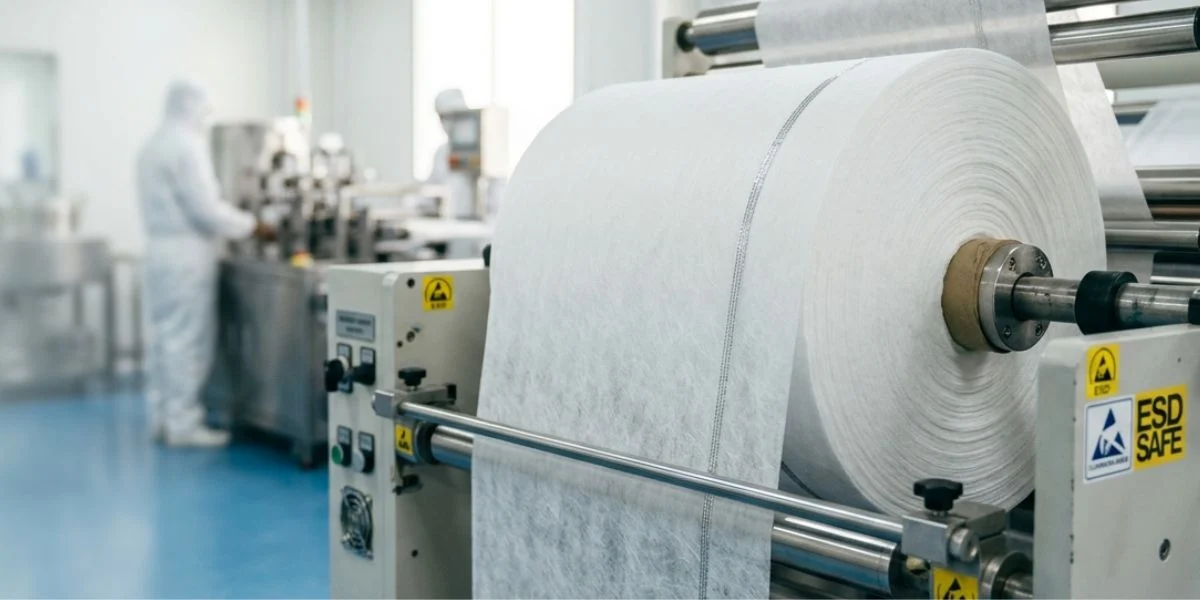
Anti-Static Spunlace Nonwoven Fabric — ESD Safe Wipes & Cleanroom Grade India
Anti-static spunlace nonwoven fabric incorporates conductive fibres or permanent anti-static treatment to dissipate electrostatic charge — preventing ESD (electrostatic discharge) damage to sensitive electronics, semiconductors, and precision components. Used in cleanroom wipes, electronics assembly wipes, PCB cleaning cloths, and semiconductor handling materials, anti-static spunlace meets ANSI/ESD S20.20 requirements for electrostatic discharge control. Favourite Fab supplies anti-static spunlace with surface resistivity <10⁹ Ω.
Browse our full range: View all nonwoven fabric products — spunlace, spunbond, SMS, bico — with GSM, width and certification options. B2B MOQ from 500 kg.
Technical Specifications
| Parameter | Specification |
|---|---|
| GSM | 50–100 GSM |
| Fibre | Polyester + conductive carbon fibre, or anti-stat treated PET |
| Surface resistivity | <10⁹ Ω (ANSI/ESD S11.11) |
| Width | 160–260 cm |
| Lint | <0.05 mg/cm² |
| IPA compatibility | Yes — polyester base |
| MOQ | 1,000 kg |
Applications
Electronics assembly cleanroom wipes, semiconductor handling cloths, PCB cleaning, hard drive manufacturing environments, ESD-sensitive component packaging.
Why Source from Favourite Fab
Direct manufacturer, Agra India. Full range: medical nonwoven fabric. Related: spunlace nonwoven for industrial wipes.
- Factory direct — no distributor margin
- Custom slit widths 10 mm–260 cm, ±1 mm tolerance
- COA per batch — MVTR, tensile, heat seal, GSM
- Sample rolls dispatched 3–5 working days
- Export ready — FOB Nhava Sheva / ICD Tughlakabad
Frequently Asked Questions
What surface resistivity is required for ESD-safe wipes?
ANSI/ESD S20.20 requires surface resistivity <10¹¹ Ω for ESD-controlled area materials. For direct contact with ESD-sensitive devices (Class 0 CDM), surface resistivity <10⁹ Ω is preferred. Our anti-static spunlace achieves <10⁸–10⁹ Ω consistently.
How is anti-static treatment applied to spunlace?
Two methods: (1) Conductive carbon or metal-coated fibre blended into the web (permanent — survives IPA and repeated use). (2) Topical anti-static finish applied post-hydroentanglement (temporary — may wash off). We use conductive fibre blending for permanent ESD performance.
Is anti-static spunlace suitable for ISO Class 5 cleanrooms?
Yes. Our anti-static polyester spunlace with <0.03 mg/cm² lint and <10⁹ Ω surface resistivity is qualified for ISO Class 5–7 cleanroom use. Supplied in double-bag cleanroom packaging available on request.
B2B Applications & End-Uses
Anti-static spunlace nonwoven fabric is a purpose-engineered substrate for electrostatic discharge (ESD) sensitive environments where conventional cleaning and wiping materials create unacceptable charge accumulation. Electronics assembly facilities operating PCB soldering and component placement lines specify ESD-safe wipes to prevent electrostatic discharge events that can destroy or degrade integrated circuits, capacitors, and MOSFET devices without producing any visible physical damage — silent failures that only emerge during downstream functional testing or in field returns.
Semiconductor fabrication plants operating at ISO Class 5 to ISO Class 7 cleanroom classification require wipe substrates that simultaneously meet particle count limits, ionic contamination limits, and surface resistivity specifications. A single wipe that fails any one of these three parameters represents a process risk that can contaminate an entire wafer lot. Anti-static spunlace with a surface resistivity between 10^5 and 10^9 Ω (per EN 1149-5 or ANSI/ESD STM11.11) dissipates charge without generating a spark, the critical requirement for fuel system maintenance wipes and solvent-cleaning operations in aerospace MRO facilities.
Hard disk drive assembly lines and LCD flat-panel manufacturing operations specify anti-static wipes for cleaning read-write heads, glass substrates, and polariser films where both particle contamination and ESD damage are simultaneous threats. Pharmaceutical cleanroom operators in Grade C and Grade D environments use anti-static wipes for equipment surface decontamination where static attraction of airborne particles to cleaned surfaces would compromise the cleaning validation outcome.
Certifications & Quality Assurance
Favourite Fab’s anti-static spunlace nonwoven is tested for surface resistivity per ANSI/ESD STM11.11 and EN 1149-5 at the production stage and again on finished rolls, with results documented on the certificate of conformance supplied with every shipment. Surface resistivity values are reported at standard conditions (23°C, 12% relative humidity) and, on request, at low-humidity conditions (23°C, 25% relative humidity) relevant to climate-controlled electronics factories.
Particle count is measured per IEST-RP-CC004 using a liquid particle counter, with results reported as particles per cm² at size thresholds of 0.3 μm, 0.5 μm, and 5 μm. Ionic contamination — specifically sodium, potassium, chloride, and sulphate — is quantified by ion chromatography per SEMI C79 methodology, with sodium plus potassium combined reported below 5 ppb for cleanroom-grade grades. Low extractables validation per ISO 10993-12 is available for pharmaceutical cleanroom customers requiring biocompatibility documentation.
Each production lot is assigned a unique identifier linked to the antistatic fibre blend ratio, hydroentanglement process parameters, and finishing bath chemistry, enabling full traceability from roll label back to raw material certificates. Quality hold and release procedures are ISO 9001:2015 compliant.
More Questions Answered
What is the difference between anti-static and conductive nonwoven wipes for electronics applications?
Anti-static wipes have a surface resistivity in the dissipative range — typically 10^5 to 10^9 Ω per ANSI/ESD STM11.11 — which means they bleed off electrostatic charge slowly and in a controlled manner without generating a discharge event. Conductive wipes have a surface resistivity below 10^5 Ω, which dissipates charge very rapidly; this is appropriate for grounding applications but can itself cause a discharge if the wipe contacts a charged component at high potential difference. For most PCB assembly wiping, LCD cleaning, and general electronics MRO applications, the dissipative (anti-static) range is the correct specification. Conductive grades are specified for specific ground-strap verification or charge-neutralisation procedures where rapid dissipation is intentionally required. Favourite Fab’s standard anti-static spunlace targets the dissipative range; conductive grades with carbon fibre content above 2% can be produced on request with a development lead time of 15–20 working days.
How should anti-static spunlace nonwoven be packaged and stored to maintain its ESD performance?
Anti-static performance can degrade if the wipes are stored in environments that allow moisture absorption or if the antistatic fibre surface is contaminated by packaging materials that leach ionic species. Favourite Fab supplies anti-static spunlace rolls in sealed polyethylene bags with desiccant packets, packed inside a rigid cardboard box to prevent compression damage to the antistatic fibre network. Rolls should be stored in a controlled environment between 18°C and 25°C with relative humidity below 50%. Before use in a cleanroom environment, individual wipe packs should be wiped down or passed through a cleanroom air shower to remove outer packaging surface contamination. Do not store anti-static rolls adjacent to strong oxidising chemicals or in direct sunlight, as UV exposure and chemical vapour absorption can alter the surface resistivity of the antistatic fibre treatment. Storage life from the date of manufacture is 24 months when stored per the above conditions.
B2B Applications & End-Uses
Anti-static spunlace nonwoven fabric is a purpose-engineered substrate for electrostatic discharge (ESD) sensitive environments where conventional cleaning and wiping materials create unacceptable charge accumulation. Electronics assembly facilities operating PCB soldering and component placement lines specify ESD-safe wipes to prevent electrostatic discharge events that can destroy or degrade integrated circuits, capacitors, and MOSFET devices without producing any visible physical damage — silent failures that only emerge during downstream functional testing or in field returns.
Semiconductor fabrication plants operating at ISO Class 5 to ISO Class 7 cleanroom classification require wipe substrates that simultaneously meet particle count limits, ionic contamination limits, and surface resistivity specifications. A single wipe that fails any one of these three parameters represents a process risk that can contaminate an entire wafer lot. Anti-static spunlace with a surface resistivity between 10^5 and 10^9 Ω (per EN 1149-5 or ANSI/ESD STM11.11) dissipates charge without generating a spark, the critical requirement for fuel system maintenance wipes and solvent-cleaning operations in aerospace MRO facilities.
Hard disk drive assembly lines and LCD flat-panel manufacturing operations specify anti-static wipes for cleaning read-write heads, glass substrates, and polariser films where both particle contamination and ESD damage are simultaneous threats. Pharmaceutical cleanroom operators in Grade C and Grade D environments use anti-static wipes for equipment surface decontamination where static attraction of airborne particles to cleaned surfaces would compromise the cleaning validation outcome.
Certifications & Quality Assurance
Favourite Fab’s anti-static spunlace nonwoven is tested for surface resistivity per ANSI/ESD STM11.11 and EN 1149-5 at the production stage and again on finished rolls, with results documented on the certificate of conformance supplied with every shipment. Surface resistivity values are reported at standard conditions (23°C, 12% relative humidity) and, on request, at low-humidity conditions (23°C, 25% relative humidity) relevant to climate-controlled electronics factories.
Particle count is measured per IEST-RP-CC004 using a liquid particle counter, with results reported as particles per cm² at size thresholds of 0.3 μm, 0.5 μm, and 5 μm. Ionic contamination — specifically sodium, potassium, chloride, and sulphate — is quantified by ion chromatography per SEMI C79 methodology, with sodium plus potassium combined reported below 5 ppb for cleanroom-grade grades. Low extractables validation per ISO 10993-12 is available for pharmaceutical cleanroom customers requiring biocompatibility documentation.
Each production lot is assigned a unique identifier linked to the antistatic fibre blend ratio, hydroentanglement process parameters, and finishing bath chemistry, enabling full traceability from roll label back to raw material certificates. Quality hold and release procedures are ISO 9001:2015 compliant.
More Questions Answered
What is the difference between anti-static and conductive nonwoven wipes for electronics applications?
Anti-static wipes have a surface resistivity in the dissipative range — typically 10^5 to 10^9 Ω per ANSI/ESD STM11.11 — which means they bleed off electrostatic charge slowly and in a controlled manner without generating a discharge event. Conductive wipes have a surface resistivity below 10^5 Ω, which dissipates charge very rapidly; this is appropriate for grounding applications but can itself cause a discharge if the wipe contacts a charged component at high potential difference. For most PCB assembly wiping, LCD cleaning, and general electronics MRO applications, the dissipative (anti-static) range is the correct specification. Conductive grades are specified for specific ground-strap verification or charge-neutralisation procedures where rapid dissipation is intentionally required. Favourite Fab’s standard anti-static spunlace targets the dissipative range; conductive grades with carbon fibre content above 2% can be produced on request with a development lead time of 15–20 working days.
How should anti-static spunlace nonwoven be packaged and stored to maintain its ESD performance?
Anti-static performance can degrade if the wipes are stored in environments that allow moisture absorption or if the antistatic fibre surface is contaminated by packaging materials that leach ionic species. Favourite Fab supplies anti-static spunlace rolls in sealed polyethylene bags with desiccant packets, packed inside a rigid cardboard box to prevent compression damage to the antistatic fibre network. Rolls should be stored in a controlled environment between 18°C and 25°C with relative humidity below 50%. Before use in a cleanroom environment, individual wipe packs should be wiped down or passed through a cleanroom air shower to remove outer packaging surface contamination. Do not store anti-static rolls adjacent to strong oxidising chemicals or in direct sunlight, as UV exposure and chemical vapour absorption can alter the surface resistivity of the antistatic fibre treatment. Storage life from the date of manufacture is 24 months when stored per the above conditions.
📋 Related: Spunlace Nonwoven Fabric — Full Range & Specs | All Nonwoven Products from Favourite Fab

Gaurav Garg
I'm Gaurav Garg, CEO of Favourite Fab, a company on a mission to revolutionize the nonwoven industry with sustainable practices. We work hand-in-hand with manufacturers and suppliers who share our commitment to eco-friendly production. With a deep interest in textile innovation, I'm passionate about educating consumers about sustainable material options and their potential to transform the nonwoven landscape.


