

Battery Separator Nonwoven Fabric — EV & Energy Storage Manufacturer India
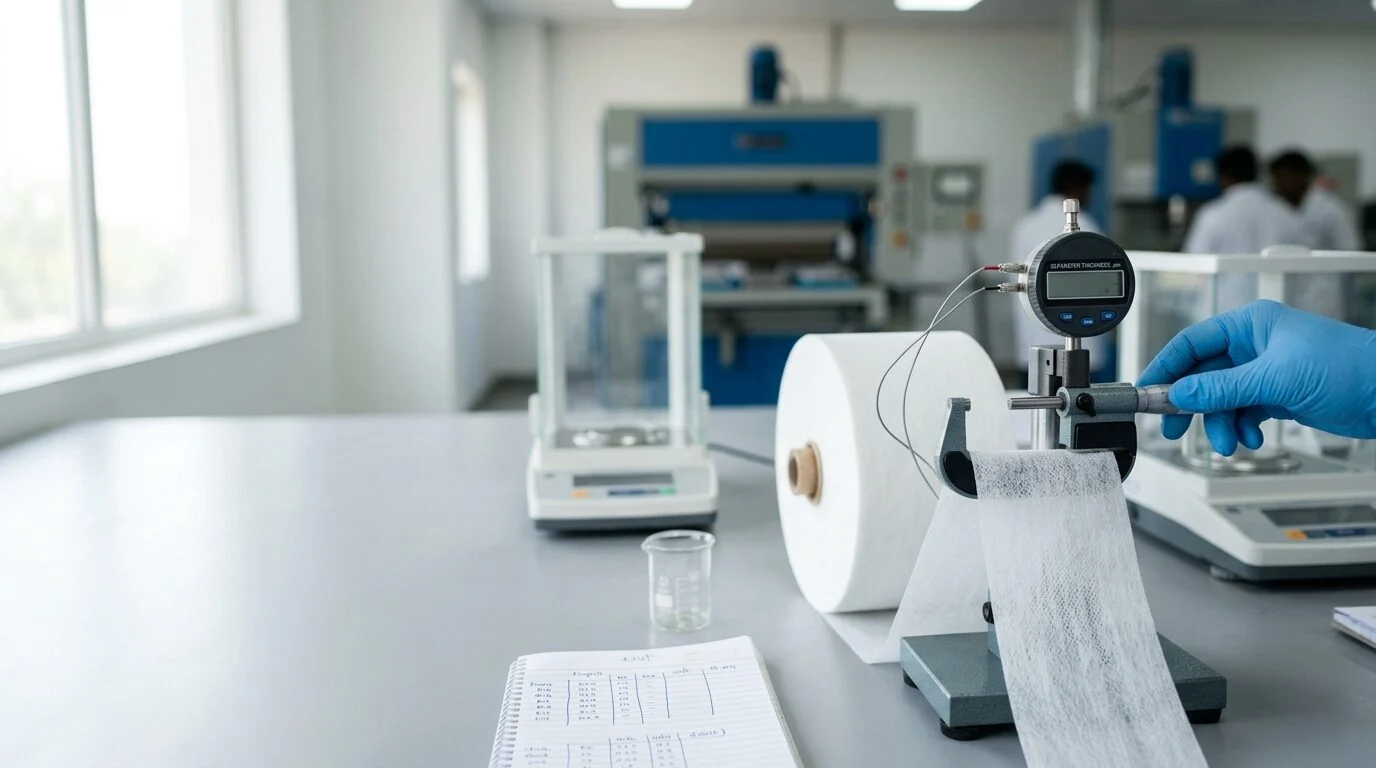
Battery separator nonwoven fabric is a critical component in lithium-ion batteries, lead-acid batteries, and supercapacitors — physically separating positive and negative electrodes while allowing ion transport through electrolyte-saturated pores. As India’s EV manufacturing scales rapidly, domestic supply of battery separator nonwoven is gaining strategic importance. Favourite Fab supplies wetlaid polyester and glass fibre nonwoven for battery separator applications — serving battery manufacturers, EV component suppliers, and energy storage system integrators.
Browse our full range: View all nonwoven fabric products — spunlace, spunbond, SMS, bico — with GSM, width and certification options. B2B MOQ from 500 kg.
Specifications
| Property | Specification |
|---|---|
| Fibre | Wetlaid PET, glass fibre, PET/cellulose |
| GSM | 20–80 GSM |
| Thickness | 0.1–0.5 mm |
| Porosity | 60–80% |
| Temperature resistance | Up to 180°C (PET), 500°C (glass fibre) |
| Electrolyte absorption | >300% of fabric weight |
| MOQ | 500 kg |
FAQ
What nonwoven is used as battery separator in lead-acid batteries?
Absorbed Glass Mat (AGM) batteries use glass fibre nonwoven 1–2 mm thick as the electrolyte-saturated separator. Glass fibre provides high chemical resistance to sulfuric acid and temperature stability. Wetlaid glass fibre nonwoven 100–200 GSM is standard for AGM VRLA batteries.
Can nonwoven replace polymer film separators in lithium-ion batteries?
Nonwoven separators (wetlaid PET or cellulose) are used in some lithium-ion chemistries — particularly with ceramic coating to improve thermal stability. They offer higher porosity and better electrolyte wettability vs polyolefin film. Adoption is growing for solid-state and next-generation batteries.
Full range: spunbond nonwoven fabric manufacturer India. Related: PET nonwoven fabric manufacturer India.
B2B Applications & End-Uses
Nonwoven fabrics in the battery and energy storage sector serve multiple distinct functional roles, each demanding different material properties and performance thresholds. As India’s EV sector accelerates under the Production Linked Incentive (PLI) scheme — with OEM cell manufacturers, battery pack assemblers, and electric two-wheeler and four-wheeler manufacturers scaling domestic production — the demand for technically qualified nonwoven substrates in battery construction and packaging is growing at a rate that outpaces current domestic supply capability.
The three principal applications for nonwoven fabric within battery systems are structurally and chemically distinct:
- Nickel-Metal Hydride (NiMH) Battery Separator: Wet-laid PET or nylon nonwoven serves as the separator membrane in NiMH cells, providing the electrolyte retention, ionic conductivity, and oxidation resistance required in alkaline electrolyte environments. Applications include hybrid electric vehicle battery packs, power tool batteries, and stationary backup power systems. GSM range 30–80 with precisely controlled pore structure.
- Lithium-Ion Battery Wrapping and Packaging Nonwoven: Dry-process thermally bonded nonwoven is used as cell wrapping, module insulation, and pack-level protective layer in Li-ion battery assemblies. The nonwoven must maintain dimensional stability at temperatures exceeding 120°C — a requirement driven by normal operating thermal gradients and the thermal management system design envelope. GSM range 80–200.
- Thermal Runaway Insulation Layer: A specialised application where high-loft or ceramic-filled nonwoven is positioned between battery modules to slow thermal propagation in the event of cell failure. Material performance is evaluated against both temperature resistance (sustained exposure at 200°C+) and compressibility under pack assembly clamping forces.
Additional applications include battery tab insulation sleeves, electrolyte wicking layers in solid-state battery development prototypes, and acoustic damping nonwoven within EV battery enclosures to reduce road noise transmission through the floor-mounted pack structure.
Certifications & Quality Assurance
Battery application nonwoven fabrics require quality documentation that extends beyond standard textile nonwoven COA requirements. Favourite Fab’s battery-grade nonwoven supply framework addresses:
- Chemical Resistance Validation: Material compatibility with alkaline electrolytes (KOH, for NiMH applications) and organic carbonate solvents (LiPF₆-based electrolytes for Li-ion adjacent applications) is verified by immersion testing and post-immersion tensile retention measurement. Results are documented per material grade.
- Dimensional Stability at Elevated Temperature: Thermal shrinkage at 120°C and 150°C is measured and documented. Acceptable shrinkage limits (typically <2% in MD and CD) are agreed with the customer at product qualification stage and verified per production lot for qualified accounts.
- Ionic Contamination Control: Low ionic contamination is critical for battery separator and cell-adjacent applications where metallic or ionic contaminants can cause micro-short circuits or accelerate electrolyte degradation. Extractable ion content (Na⁺, K⁺, Ca²⁺, Cl⁻, SO₄²⁻) is measured and reported for battery-grade lots.
- IEC 60086 / UL 1973 Reference Compliance: Battery separator materials supplied for NiMH applications are documented with reference to IEC 60086 series (primary and secondary batteries) construction requirements. UL 1973 documentation support is available for customers targeting North American EV market certification.
- Basis Weight and Thickness Uniformity: GSM per ISO 9073-1 and caliper per ISO 9073-2 are measured at defined intervals across roll width. Within-roll variation directly affects separator performance uniformity across the electrode stack in a multi-cell module.
More Questions Answered
What nonwoven material properties are most critical for NiMH battery separator applications?
NiMH battery separator nonwoven must simultaneously deliver high electrolyte retention (to maintain ionic conductivity), oxidation resistance in concentrated KOH alkaline electrolyte (typically 6–9 mol/L), controlled pore size and distribution (to prevent internal short-circuit via electrode particle migration), and sufficient tensile strength to survive winding and stacking assembly without tearing. Wet-laid PET nonwoven is the industry-standard substrate for NiMH separators because of its superior oxidation resistance versus nylon in alkaline environments and its ability to be produced with consistent pore structure in the 5–30 micron range. Favourite Fab’s wet-laid PET grades for NiMH applications are produced with controlled fibre diameter and binder content specifically to address these requirements. Contact our technical team with your cell chemistry specifications for a targeted grade recommendation.
How does India’s PLI scheme for advanced chemistry cells affect nonwoven battery material procurement for domestic manufacturers?
India’s PLI scheme for Advanced Chemistry Cell (ACC) battery manufacturing incentivises domestic production of battery cells and packs, with significant capacity targets under awarded manufacturers including Ola Electric, Reliance New Energy, and others. A key PLI compliance consideration is local value addition — procuring qualifying raw materials and components from domestic suppliers contributes to the local content calculations that affect PLI incentive eligibility. Sourcing battery-grade nonwoven from a domestic manufacturer such as Favourite Fab rather than importing from Japan, South Korea, or China directly supports PLI local content thresholds. Beyond compliance, domestic sourcing eliminates lead time uncertainty and foreign exchange exposure that imported specialty battery materials carry. We recommend early engagement with our technical team to align material qualification timelines with your PLI project commissioning schedule.

Gaurav Garg
I'm Gaurav Garg, CEO of Favourite Fab, a company on a mission to revolutionize the nonwoven industry with sustainable practices. We work hand-in-hand with manufacturers and suppliers who share our commitment to eco-friendly production. With a deep interest in textile innovation, I'm passionate about educating consumers about sustainable material options and their potential to transform the nonwoven landscape.


