

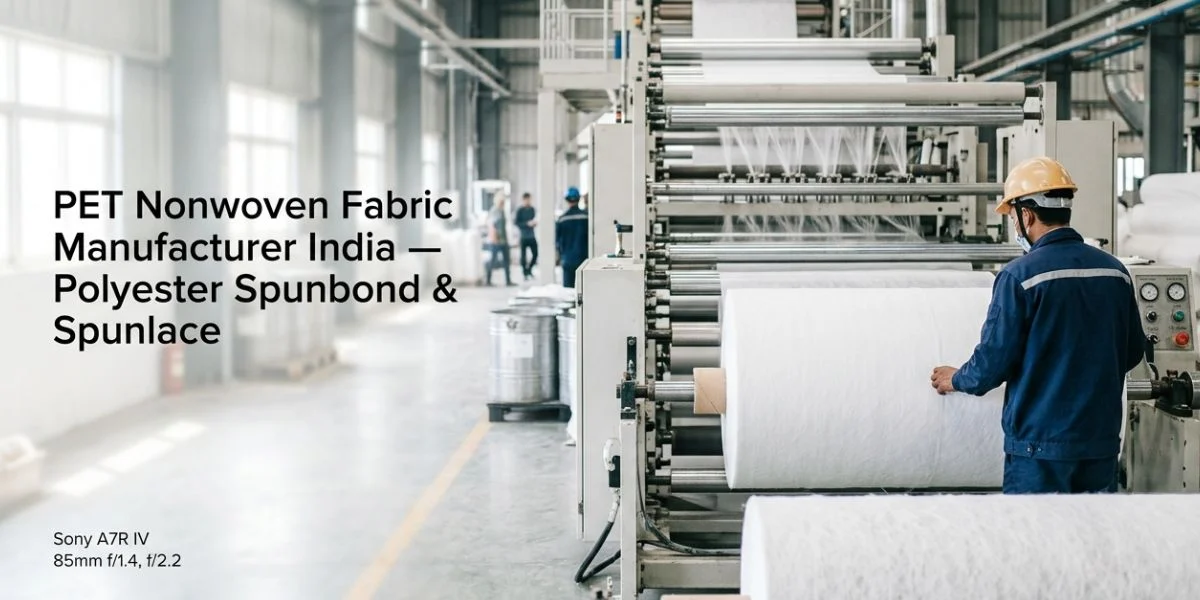
PET non woven fabric manufacturer India — Favourite Fab supplies polyester spunbond, PET spunlace, needle-punched PET, and GRS-certified rPET nonwoven in 30–300 GSM. PET nonwoven fabric and PET non woven fabric are the same material: PET is polyethylene terephthalate, the polyester polymer, and only the spelling differs by region. PET (polyethylene terephthalate) nonwoven outperforms PP-based alternatives in high-temperature environments, chemical-exposure applications, and ESG-driven procurement. B2B manufacturers in geotextile, automotive, filtration, and medical sectors choose Favourite Fab for consistent quality, custom GSM, and export-ready supply.
What Is PET Nonwoven Fabric
PET nonwoven fabric is made from polyethylene terephthalate (polyester) fibres or continuous filaments bonded by thermal, chemical, or mechanical means — producing a fabric without weaving or knitting. The three primary PET nonwoven processes are spunbond (continuous filament, thermally bonded), spunlace (hydroentangled short fibres), and needle punch (mechanically interlocked fibres for heavy industrial grades).
PET outperforms polypropylene (PP) on three critical industrial properties: temperature resistance (PET is continuously stable to 200°C and softens near 220°C, vs PP which melts at 130–165°C), tensile modulus (PET is stiffer and more dimensionally stable under load), and UV resistance (PET inherently resists UV degradation; PP requires UV stabiliser additives). These properties make PET nonwoven the preferred raw material for geotextile, automotive, and high-temperature filtration applications.
Recycled PET (rPET) nonwoven, manufactured from post-consumer PET bottles, carries GRS (Global Recycled Standard) certification. rPET nonwoven delivers identical mechanical performance to virgin PET at equivalent GSM while reducing CO₂ footprint by 30–50%. Corporate ESG procurement teams and sustainability-driven OEMs increasingly mandate GRS-certified rPET for packaging, filtration, and industrial textile applications.
PET Nonwoven Fabric — Technical Specifications
| Parameter | PET Spunbond | PET Spunlace | PET Needle Punch |
|---|---|---|---|
| GSM range | 30–200 GSM | 40–120 GSM | 80–300 GSM |
| Fibre | 100% PET continuous filament | 100% polyester staple | 100% PET staple |
| Temperature resistance | Continuous to 200°C | Continuous to 150°C | Continuous to 200°C |
| Tensile strength (MD) | 100–800 N/5cm | 80–400 N/5cm | 200–1,200 N/5cm |
| Width | 160–260 cm | 160–320 cm | 200–320 cm |
| Chemical resistance | Acids, alkalis, most solvents | IPA, bleach, solvents | Acids, alkalis |
| UV resistance | Inherent — no additives | Inherent | Inherent |
| MOQ | 500 kg | 500 kg | 500 kg |
PET vs PP Nonwoven — Which to Choose
Procurement engineers frequently compare PET and PP nonwoven before placing orders. The choice depends on end-use temperature, mechanical load, and sustainability requirements.
| Property | PET Nonwoven | PP Nonwoven |
|---|---|---|
| Melting point | 255°C (softens at 220°C) | 160°C (softens at 130°C) |
| Continuous use temperature | Up to 200°C | Up to 120°C |
| Tensile modulus | Higher — stiffer, dimensionally stable | Lower — more flexible |
| UV resistance | Inherent | Requires UV stabiliser additives |
| Chemical resistance | Excellent — acids, alkalis, solvents | Good — limited solvent resistance |
| rPET / sustainability | GRS-certified rPET available | rPP available but less common |
| Cost | Higher per kg | Lower per kg |
| Best for | Geotextile, automotive, filtration, high-temp industrial | Hygiene, medical, packaging, agriculture |
For geotextile road construction, automotive trunk liners, and liquid filtration at elevated temperatures — PET nonwoven is the correct choice. For hygiene top sheets, surgical drapes, and agricultural crop covers — PP or SMS nonwoven is more economical.
Applications by Industry
PET nonwoven fabric serves demanding applications across four major B2B sectors:
- Geotextile and construction: 80–300 GSM needle-punched PET for road separation layers, drainage filtration, slope erosion control, and roofing underlayment. Conforms to IS 14324 geosynthetics specifications. Tensile strength up to 1,200 N/5cm meets international road-building standards.
- Automotive: 100–200 GSM PET spunbond and needle punch for trunk liners, bonnet insulation, door panel backing, and acoustic dampening. PET heat resistance handles underbonnet temperatures that deform PP-based materials.
- Industrial filtration: 50–150 GSM PET spunbond as filter media or support layers in liquid filtration systems, air filtration cassettes, and HEPA pre-filters. Chemical resistance allows use with aggressive process fluids.
- Medical and cleanroom: 60–80 GSM PET spunlace for cleanroom wipes (ISO Class 5–7), wound contact layers, and reusable sterilisation wraps. PET survives 30+ autoclave cycles and IPA, quat, and H₂O₂ disinfectant exposure.
Recycled PET (rPET) — GRS Certified Supply
Favourite Fab supplies GRS-certified recycled PET nonwoven for ESG-driven procurement. rPET nonwoven is produced from post-consumer PET bottles, traceable through the supply chain, and certified to Global Recycled Standard (GRS). Available in spunbond and needle-punch grades from 80–200 GSM.
rPET delivers the same mechanical performance as virgin PET at equivalent GSM. CO₂ reduction: 30–50% vs virgin PET production. GRS certificate provided per batch for audit and compliance reporting.
Why Source From Favourite Fab
- Direct manufacturer — no middlemen, competitive wholesale pricing
- Custom GSM, width, and finish on request (production lead: 10–15 days)
- GRS-certified rPET grades available for ESG compliance
- COA per batch — GSM, tensile, elongation, weight uniformity
- Export-ready supply to 50+ countries — complete shipping documentation
- Sample dispatch in 3–5 working days
- ISO-certified manufacturing facility, Agra, India
Pricing and MOQ
PET nonwoven fabric pricing varies by grade (spunbond, spunlace, needle punch), GSM, and order volume. Favourite Fab offers competitive wholesale pricing for B2B manufacturers. MOQ is 500 kg per grade and GSM. Container-load pricing available for 40ft HC orders (typically 8–15 MT depending on GSM and roll dimensions). Contact sales for a volume price schedule.
Email: sale@favouritehub.com | WhatsApp: +91-8800775462
How to Order
- Send material requirements — grade, GSM, width, quantity — to sale@favouritehub.com
- Receive quote and sample availability within 48 hours
- Approve sample, confirm order — production begins with 10–15 day lead time
- Receive shipment with COA and GRS certificate (rPET grade)
Frequently Asked Questions
What is the maximum temperature PET nonwoven can withstand?
PET nonwoven maintains structural integrity up to 200°C in continuous use. It begins to soften at approximately 220°C. PP nonwoven softens at 130°C — PET is the correct material for geotextile, automotive underbonnet, and high-temperature filtration applications. For temperatures above 200°C, consider PTFE or glass fibre nonwoven alternatives.
Can Favourite Fab supply GRS-certified rPET nonwoven?
Yes. GRS-certified recycled PET nonwoven is available in spunbond and needle-punch grades from 80–200 GSM. GRS certificate is provided per batch for audit and compliance documentation. rPET reduces CO₂ footprint by 30–50% vs virgin PET at equivalent mechanical performance.
What GSM PET nonwoven is used for road construction geotextile?
Road separation and drainage filtration use 100–150 GSM needle-punched PET. Slope erosion control and heavy-duty separation layers use 150–300 GSM. All grades conform to IS 14324 geosynthetics specifications with tensile strength up to 1,200 N/5cm (ASTM D4595).
What is the difference between PET spunbond and PET spunlace?
PET spunbond uses continuous polyester filaments thermally bonded — stiff, dimensionally stable, suited for geotextile, automotive, and filtration. PET spunlace uses short polyester fibres hydroentangled — soft, drapeable, suited for industrial wipes, cleanroom wipes, and medical applications. Both are 100% polyester with different feel, stretch, and application profiles.
What is the MOQ for PET nonwoven fabric from Favourite Fab?
Minimum order is 500 kg per grade and GSM. Container-load pricing available for 40ft HC orders (8–15 MT depending on GSM and roll dimensions). Sample orders of 5–10 kg available for qualification trials — dispatch within 3–5 working days.
Does Favourite Fab offer custom GSM and width for PET nonwoven?
Yes. Custom GSM from 30–300 GSM and widths from 160–320 cm are available depending on grade. Production lead time for custom specifications is 10–15 working days after order confirmation. COA per batch with GSM, tensile, elongation, and uniformity test results.
What is PET non woven fabric made of?
PET non woven fabric is made from polyethylene terephthalate — the same polyester polymer used in PET bottles and polyester yarn. The fibres or continuous filaments are bonded into a fabric thermally, hydraulically, or mechanically rather than being woven or knitted. “PET non woven fabric”, “PET nonwoven fabric”, and “polyester nonwoven fabric” all describe the same material; the spelling varies by region and the polymer does not.
Which PET non woven process should I specify for my application?
Specify spunbond when dimensional stability under load matters — geotextile, roofing, automotive substrate, filter support. Specify spunlace when surface feel, absorbency, and low linting matter — cleanroom wipes, industrial wipes, medical layers. Specify needle punch for the heaviest civil-engineering geotextile where puncture resistance and drainage capacity are specified. Bicomponent grades apply where the fabric must be heat-sealed or laminated downstream.
Is PET non woven fabric the same as polyester non woven fabric?
Yes. PET is the technical abbreviation for polyethylene terephthalate, which is the polymer commercial polyester is made from. Datasheets and geosynthetic standards generally use PET; textile and procurement documents often say polyester. Both refer to the same fabric, and Favourite Fab supplies against either terminology.
What documentation ships with a PET non woven fabric order?
Every batch ships with a Certificate of Analysis stating basis weight, thickness, tensile strength and elongation in both directions, and the test method used for each. Geotextile grades add puncture, tear, apparent opening size, and permittivity results against IS 14324. GRS certification accompanies rPET lots, and OEKO-TEX Standard 100 documentation is available for automotive interior and insulation grades. Export orders include Invoice, Packing List, Certificate of Origin, Mill Test Certificate, and GSP where applicable.
Contact Favourite Fab
PET nonwoven fabric manufacturer India — send your material specifications for a same-day quote.
Email: sale@favouritehub.com
WhatsApp: +91-8800775462
Favourite Fab, Agra, Uttar Pradesh, India — exporting PET nonwoven fabric to 50+ countries. Send your specifications today for a same-day quote.
PET nonwoven fabric Supplier & Wholesaler India — Bulk Sourcing
Favourite Fab is a direct PET nonwoven fabric manufacturer, B2B supplier, and wholesale distributor based in Agra, India — serving manufacturers across India and 50+ export countries. We sell at factory-direct wholesale prices with no trader markup.
Direct Manufacturer — Agra Factory
ISO-certified production facility, 10+ years specialised in PET nonwoven fabric. In-house QC lab with COA per batch (GSM, tensile, elongation, uniformity). Production capacity scales from 500 kg sample lots to full container loads.
Bulk Supplier — Custom Specifications
Custom GSM, width, finish, and colour available on request. Production lead time 10–15 working days after specification approval. Sample dispatch in 3–5 working days for qualification trials. Hydrophilic/hydrophobic finish and special treatments on request.
Wholesaler India — Container-Load Pricing
Wholesale pricing for B2B manufacturers, distributors, and importers. MOQ 500 kg per grade. Container-load pricing for 40ft HC orders (typically 8–15 MT depending on GSM and roll dimensions). Pan-India delivery via road and rail. Export shipping documentation included (Invoice, Packing List, COO, MTC, GSP).
Why Choose Favourite Fab as Your PET nonwoven fabric Manufacturer + Supplier + Wholesaler
- Direct factory pricing — no middleman markup
- MOQ-friendly — supports small to large manufacturers
- Export-ready to 50+ countries with full shipping docs
- COA per batch + GRS certification where applicable
- Sample dispatch 3–5 working days
- Custom GSM, width, finish on request
- Pan-India delivery + container-load exports
Contact for wholesale price list 2026: sale@favouritehub.com | WhatsApp +91-8800775462 | Focus: PET nonwoven fabric manufacturer supplier wholesaler India
PET Non Woven Fabric — Manufacturing Processes Explained
PET non woven fabric is not a single material. The bonding process determines strength, hand feel, porosity, and cost — and specifying the wrong process is the most common sourcing error B2B buyers make. Favourite Fab manufactures across all four routes, so the recommendation below is process-neutral.
Spunbond — Continuous Filament, Thermally Bonded
Molten PET is extruded through spinnerets, drawn in a high-velocity air stream to orient the polymer chains, laid randomly onto a moving belt, then bonded between heated calender rollers. Chain orientation during drawing is what gives spunbond its high tensile-to-weight ratio: a 100 GSM PET spunbond typically delivers 300–400 N/5cm in the machine direction. There is no binder, no adhesive, and no weaving — the web is held together by filament-to-filament fusion at the calender bond points. Choose spunbond when you need dimensional stability under mechanical load: geotextile separation, roofing underlayment, automotive substrate, filter support.
Spunlace — Hydroentangled Staple Fibre
Short polyester fibres are carded into a web, then bonded by high-pressure water jets that entangle the fibres mechanically. No heat, no binder — which is why spunlace retains a soft, textile-like drape that spunbond cannot match. The trade-off is lower tensile strength at equivalent GSM and a lower continuous service temperature (around 150°C, because the fibres are not oriented and fused). Choose spunlace when surface feel, absorbency, and low linting matter more than load-bearing strength: cleanroom wipes, industrial wipes, medical wound contact layers.
Needle Punch — Mechanically Interlocked
Barbed needles repeatedly penetrate a carded PET web, dragging fibres through the thickness to interlock the structure. This produces the heaviest and strongest PET non woven grades — up to 1,200 N/5cm tensile at 300 GSM — with high thickness and excellent in-plane water flow. Needle punch is the standard construction for civil-engineering geotextile where puncture resistance and drainage capacity are specified alongside tensile strength.
Thermal Bond and Bicomponent Routes
Through-air thermal bonding and bicomponent (bico) constructions such as PE/PET and Co-PET/PET use a lower-melt sheath over a PET core, allowing the fabric to be heat-sealed or laminated without melting the load-bearing polymer. These grades matter when the fabric must bond to another layer downstream — desiccant pouches, filter pleat packs, and laminated membranes.
GSM Selection Guide — PET Non Woven by Application
GSM alone does not specify a fabric. The table below pairs each application with the process and weight range that Favourite Fab’s technical team recommends, plus the property that actually governs acceptance.
| Application | Process | GSM | Governing Property |
|---|---|---|---|
| Road separation geotextile | Needle punch | 150–300 | CBR puncture, tensile ≥1,000 N/5cm |
| Drainage filtration geotextile | Needle punch / spunbond | 100–150 | AOS 0.075–0.25 mm, permittivity |
| Roofing underlayment | Spunbond | 100–180 | UV retention, dimensional stability |
| Automotive trunk and boot liner | Needle punch | 150–250 | Thermoformability, abrasion |
| Bonnet and heat-shield insulation | Spunbond / needle punch | 100–200 | Thermal stability above 150°C |
| Liquid filter support layer | Spunbond | 50–100 | Pore uniformity, chemical resistance |
| Cleanroom and industrial wipes | Spunlace | 50–80 | Linting, solvent compatibility |
| Sterilisation wrap and medical | Spunlace | 60–80 | Autoclave cycle life, barrier |
| Laminated and heat-sealed assemblies | Bico spunbond | 30–80 | Seal temperature window |
Quality Standards and Test Methods
Every PET non woven fabric batch leaves Favourite Fab with a Certificate of Analysis referencing the test method, not just the result — which is what an incoming-inspection team needs to reproduce the measurement. Basis weight is measured per ISO 9073-1, thickness per ISO 9073-2, and tensile strength and elongation at break in both machine and cross direction per ISO 9073-3 or ASTM D4595 depending on whether the fabric is destined for textile or geosynthetic use.
Geotextile grades add CBR puncture resistance (ISO 12236), trapezoid tear (ASTM D4533), apparent opening size (ASTM D4751), and water permittivity (ASTM D4491), reported against the IS 14324 geosynthetics specification used by NHAI and state highway departments. Wipe and medical grades are tested to EDANA methods for absorbency and linting instead, since tensile is rarely the limiting property there.
Long-term performance claims are separately validated: thermal dimensional stability by measuring shrinkage after oven exposure per ISO 5077, and UV durability by accelerated weathering per ISO 4892-2 or ASTM G155 with residual tensile reported after a defined dose. OEKO-TEX Standard 100 certification is available for grades used in automotive interior and insulation where occupant exposure requires restricted-substance documentation, and GRS certification with full chain-of-custody traceability accompanies every rPET lot.
Buyer Checklist — Specifying PET Non Woven Correctly
Most quotation delays trace back to an incomplete specification. Send these six data points and a costed, technically matched quote can usually be issued within 48 hours.
- End use and service environment. Peak and continuous temperature, UV exposure, chemical contact, and whether the fabric is buried, laminated, or exposed. This determines process selection before GSM is even discussed.
- Governing standard or customer specification. IS 14324, ASTM D4595, an OEM automotive spec, or a written customer datasheet. If a standard applies, quoting against it avoids a failed first-article inspection.
- GSM and acceptable tolerance. Typical production tolerance is ±5%; tighter bands are achievable but affect price and lead time.
- Roll width and diameter, plus core size. Width up to 320 cm is available on needle punch and spunlace. Converting equipment constraints often dictate this more than the application does.
- Finish and treatment. Hydrophilic or hydrophobic finish, antistatic, flame retardant, UV stabilisation, or colour. Treatments are applied in line and must be declared before production scheduling.
- Volume and delivery pattern. Trial quantity, first production order, and expected annual offtake. MOQ is 500 kg per grade and GSM; container-load economics change materially above 8 MT.
Buyers who are still comparing polymers should start with the PET versus PP table above, then request 5–10 kg qualification samples of the two shortlisted constructions. Sample dispatch is 3–5 working days and costs nothing but the freight — considerably cheaper than discovering a thermal or chemical incompatibility after a production run.
Related B2B Resources

Gaurav Garg
I'm Gaurav Garg, CEO of Favourite Fab, a company on a mission to revolutionize the nonwoven industry with sustainable practices. We work hand-in-hand with manufacturers and suppliers who share our commitment to eco-friendly production. With a deep interest in textile innovation, I'm passionate about educating consumers about sustainable material options and their potential to transform the nonwoven landscape.


