

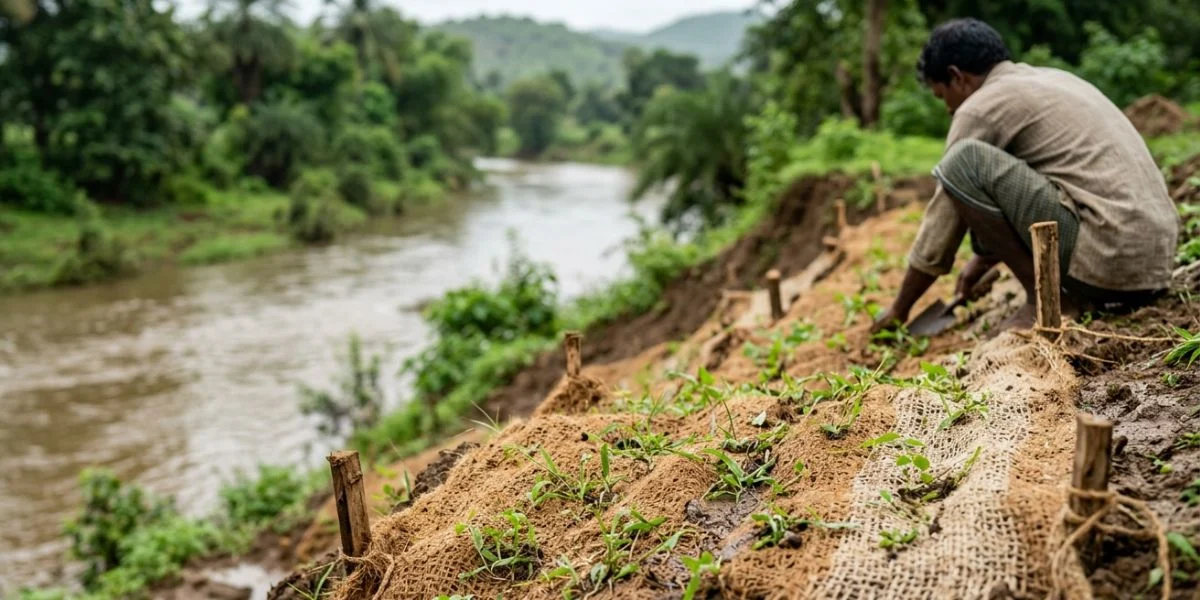
Biodegradable Erosion Control Geotextile — Coir & Jute Nonwoven India
Biodegradable erosion control geotextiles use natural coir (coconut fibre) or jute fibre needle-punched into mats that protect bare soil surfaces from rainfall impact, surface runoff, and wind erosion during revegetation. Unlike synthetic PP geotextile which persists indefinitely, biodegradable coir/jute mats decompose in soil within 2–5 years — adding organic matter while vegetation establishes root cover. Preferred for slopes, riverbanks, and road embankments in ecologically sensitive zones.
Browse our full range: View all nonwoven fabric products — spunlace, spunbond, SMS, bico — with GSM, width and certification options. B2B MOQ from 500 kg.
Specifications
| Property | Coir Geotextile | Jute Geotextile |
|---|---|---|
| GSM | 400–900 GSM | 200–500 GSM |
| Decomposition | 3–5 years in soil | 1–2 years in soil |
| Tensile MD | High (coconut fibre strength) | Moderate |
| Width | 1–4 m | 1–4 m |
| Standard | IS 15868 | IS 15868 |
Applications
Slope erosion control (highway embankments, railway cuts), riverbank and canal stabilisation, sand dune fixation, revegetation support on degraded lands, mining reclamation sites.
FAQ
When should I use biodegradable geotextile instead of PP?
Use biodegradable coir/jute when: vegetation will fully establish within 2–5 years (making permanent geotextile unnecessary), in ecologically sensitive areas where synthetic fibres are restricted, or where project specifications require biodegradable materials (many state PWD projects in India now specify biodegradable for slopes).
What is the difference between coir and jute geotextile?
Coir (coconut fibre) lasts 3–5 years — suitable for slopes needing longer establishment time. Jute decomposes faster (1–2 years) — used where vegetation establishes quickly in humid conditions. Coir is stronger and more weather-resistant; jute is more cost-effective for short-term applications.
Full range: spunbond nonwoven fabric manufacturer India. Related: PP needle punch geotextile nonwoven.
B2B Applications & End-Uses
Biodegradable geotextiles occupy a distinct technical niche in erosion control and slope stabilisation where the project timeline aligns with natural vegetation establishment — typically 18 months to 5 years. Coir (coconut fibre) geotextile woven into open-mesh or needle-punched mats at 400–900 GSM provides immediate surface protection against rainfall impact and sheet erosion on freshly cut highway embankments, mine spoil slopes, and river embankment restorations. As vegetation roots establish and the root mat develops sufficient tensile capacity to hold the slope independently, the coir matrix degrades naturally, returning organic matter and improving soil structure — a regenerative engineering outcome that synthetic geotextiles cannot replicate.
Jute geotextile serves a complementary function in shorter-duration applications. With a biodegradation timeline of 2–5 years depending on soil moisture and temperature, jute matting is ideal for temporary construction site perimeter erosion control required under environmental compliance conditions, post-wildfire hillslope stabilisation, and agricultural terrace construction in hillslope farming regions. The lignin-rich decomposing jute fibre improves soil cation exchange capacity and water retention — a secondary benefit that translates into faster and denser vegetation cover.
Coastal erosion control and riverbank bioengineering represent a growing procurement segment driven by state flood management and CAMPA (Compensatory Afforestation Fund) funded projects. Coir geotextile rolls installed along riverbanks protect the toe of the bank from hydraulic shear during monsoon peak flows while allowing riparian vegetation to colonise through the open matrix. Mine spoil revegetation under DGMS and state mining department closure obligations is another significant end-use, where biodegradable matting is specified in Environmental Impact Assessment (EIA) approved mine closure plans.
For ESG-focused infrastructure procurement teams — particularly those reporting under GRI 304 (Biodiversity) or aligned with SEBI BRSR disclosure requirements — biodegradable geotextile provides a quantifiable carbon sequestration angle: coir stores approximately 46% carbon by weight, and deployment avoids the embodied carbon of synthetic alternatives while contributing to soil organic carbon sequestration metrics reportable in sustainability annexures.
Certifications & Quality Assurance
Coir geotextile manufactured and sourced by Favourite Fab conforms to IS 16392 Part 2 (Geotextiles — Coir Geotextile Specification), which defines requirements for mass per unit area, roll dimensions, tensile strength (warp and weft), elongation, open area ratio, and biodegradability classification. Jute geotextile quality is verified against IS 14715 and relevant BIS standards for jute woven geotextile grades.
Tensile testing is conducted per ASTM D4595 (wide-width strip method) for woven natural fibre geotextile to simulate the biaxial loading conditions encountered on slope faces. Water absorption and saturation behaviour are characterised to ensure performance under monsoon conditions where sustained wetness is the operational norm. Fibre origin and certification supporting ESG procurement documentation — including GOTS traceability for certified natural fibre lots — is available on request for institutional buyers submitting sustainability disclosure annexures.
Each shipment is accompanied by a mill test report specifying lot-specific measured values against specified minimums for all critical parameters. Bulk orders for government tenders include documentation structured to support CPWD, NHAI, and state PWD submission formats. Our quality team assists with pre-bid sample submission and technical specification alignment for project-specific tender packages.
More Questions Answered
What is the functional difference between coir and jute geotextile for highway embankment slope protection?
Coir geotextile offers superior durability — typically 5–10 years degradation timeline — making it appropriate for permanent embankment slopes where vegetation establishment may be slow due to soil quality or climate. Jute geotextile degrades within 2–5 years and is better suited to temporary slopes, construction phase perimeter protection, and applications where rapid soil amendment is a design objective. For steeper slopes (>30°) or higher rainfall zones, coir’s superior tensile strength and longer service life makes it the technically preferred choice.
Can biodegradable geotextile be combined with synthetic geotextile in a composite slope stabilisation system?
Yes — hybrid systems combining a biodegradable surface mat (coir or jute) with an underlying synthetic woven or needle-punched geotextile are used for steep slopes requiring both immediate surface protection and long-term basal reinforcement. The biodegradable layer handles surface erosion control and vegetation establishment while the synthetic layer provides permanent tensile reinforcement and separation. Favourite Fab can supply both components and advise on appropriate grades for the specific slope geometry and soil conditions provided in your project brief.

Gaurav Garg
I'm Gaurav Garg, CEO of Favourite Fab, a company on a mission to revolutionize the nonwoven industry with sustainable practices. We work hand-in-hand with manufacturers and suppliers who share our commitment to eco-friendly production. With a deep interest in textile innovation, I'm passionate about educating consumers about sustainable material options and their potential to transform the nonwoven landscape.


